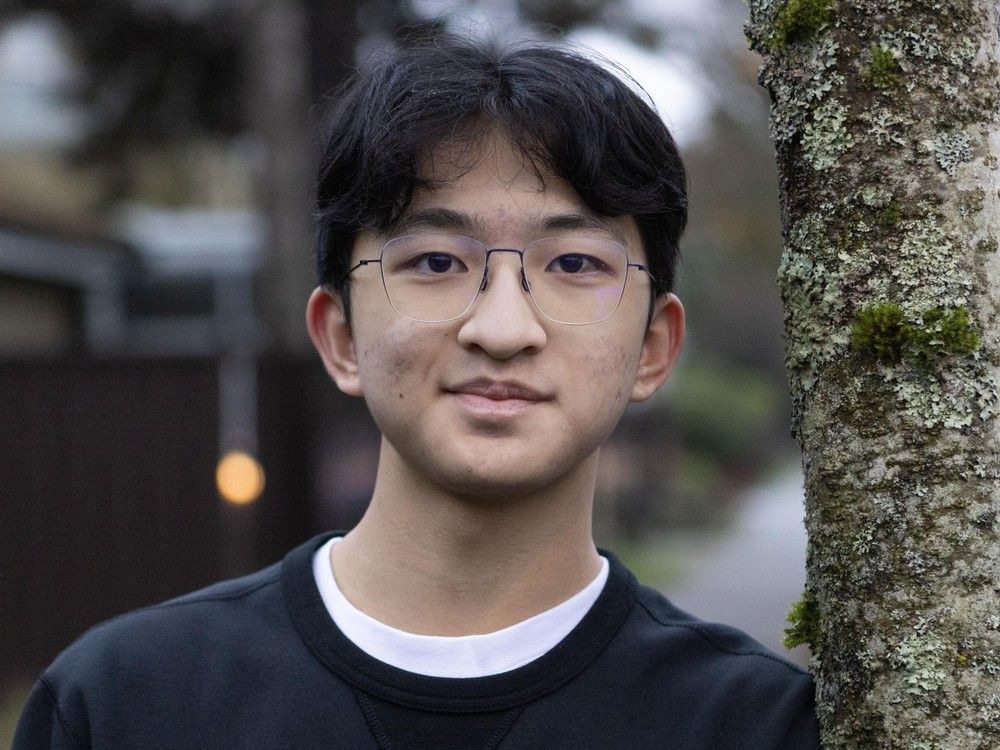
VANCOUVER, British Columbia — Henry Chuang, a 15-year-old Grade 10 student at St. George's School in Vancouver, has turned his personal struggle with smartphone addiction into a globally recognized science video that's landed him among the finalists in an international competition for young minds.
Chuang's two-minute video, titled after the universal experience of scrolling through social media instead of tackling homework or other tasks, explores the neurological reasons why it's so difficult to put down a phone. 'Everyone has been here: scrolling on social media instead of doing work … ' the video begins, capturing a moment that resonates with users of all ages. Chuang created the piece after noticing how his habit of procrastinating on social media was derailing his studies, his cross-country running training, and even his passion for artwork.
'I didn’t want to keep scrolling, but my mind was getting tricked into it,' Chuang said in an interview with the Vancouver Sun. This recurring cycle prompted him to investigate the science behind it, leading to his entry in the 11th annual Breakthrough Junior Challenge, a prestigious contest that invites students aged 13 to 18 to explain complex concepts in life sciences, physics, or mathematics through engaging videos.
From more than 2,500 applicants worldwide, Chuang was selected as one of 16 finalists, announced recently. The competition, which emphasizes clear and illuminating communication of scientific ideas, is sponsored by foundations linked to tech luminaries including Google co-founder Sergey Brin, Facebook's Mark Zuckerberg and Priscilla Chan, philanthropists Yuri and Julia Milner, and 23andMe CEO Anne Wojcicki. Partners like the Khan Academy and Cold Spring Harbor Laboratory also support the event.
The stakes are high: the top winner, to be revealed in early 2026, will receive a $250,000 scholarship for post-secondary education, while their teacher gets $50,000 and their school a $100,000 science lab. Despite the allure of these prizes, Chuang remains focused on his core issue. 'Like any kid my age, he’s still trying to get off his phone,' the Vancouver Sun reported, highlighting the irony that his self-taught videography skills, learned from YouTube tutorials, partly stem from time spent on screens.
In his video, Chuang breaks down the 'cognitive dissonance loop' that traps users in endless scrolling. He explains how social media platforms are designed with triggers — notifications, vibrant colors, and compelling narratives — to deliver hits of dopamine, the brain's reward chemical. 'Each trigger of social media activates a brain region,' Chuang states, detailing the chain reaction that begins when the brain detects a mismatch between long-term goals, like studying for a test or pursuing a dream project, and the immediate pull of social feeds.
According to Chuang's explanation, the dorsal anterior cingulate cortex first registers this conflict, sparking cognitive dissonance — the mental discomfort from clashing desires. This discomfort then travels to the anterior insula, triggering an alarm-like response in the amygdala that amplifies feelings of guilt and unease. 'That alert hits the amygdala and, like an alarm clock, it starts beeping constantly, which turns up discomfort and guilt,' he describes.
To resolve this tension, the prefrontal cortex steps in to reframe the situation through rationalization, making the scrolling seem less harmful. The hippocampus then reinforces this by pulling up positive memories, such as past enjoyable social media moments. 'The hippocampus is quite devious,' Chuang notes. 'It convinces your brain that social media actually helps you, not harms you.' This leads to a dopamine flood, which the dorsal striatum — responsible for habit formation — latches onto, solidifying the behavior into a loop that's hard to break.
Chuang's video doesn't just diagnose the problem; it offers a path forward. Overcoming the loop, he argues, requires embracing discomfort rather than avoiding it. 'You have to get used to the discomfort,' he advises. By pushing through challenges, whether short-term tasks or long-term ambitions like his idea for an Instagram account blending beauty and science, individuals can achieve their own dopamine rewards from accomplishment.
'It’s something me and my friends talk about all the time,' Chuang added, underscoring how pervasive the issue is among his peers. For him, creating the video was a breakthrough in understanding these brain processes, but he acknowledges that knowledge alone isn't enough. 'You have to consciously apply interventions thousands of times every day,' he said.
To manage his habits, Chuang relies on practical tools like the One Sec app, which integrates with social media applications to interrupt impulsive scrolling. The app prompts users to pause and breathe, diverting attention from the urge. While he doesn't advocate ditching social media entirely — after all, he hopes viewers will watch and like his video on YouTube for that dopamine boost — he emphasizes moderation.
The Breakthrough Junior Challenge has a track record of spotlighting young talent. Past winners have tackled topics from quantum physics to evolutionary biology, often blending personal anecdotes with rigorous science. Chuang's entry stands out for its relevance to modern life, especially amid growing concerns about screen time's impact on youth mental health. Studies from organizations like the American Psychological Association have linked excessive social media use to increased anxiety and reduced productivity, though experts debate the extent of causation versus correlation.
At St. George's School, an independent boys' school in Vancouver's Point Grey neighborhood, Chuang's achievement has generated buzz. Principal Neil Perraton praised the student's initiative in a statement to local media, noting how it exemplifies the school's emphasis on innovative learning. 'Henry's work shows how personal challenges can inspire scientific inquiry,' Perraton said, according to school officials.
Broader context reveals a tech-savvy generation grappling with the very tools that connect them. Vancouver, a hub for tech innovation with companies like Hootsuite and Slack maintaining offices nearby, mirrors global trends where smartphone penetration exceeds 80 percent among teens, per Statistics Canada data. Chuang's story echoes reports from across North America, where educators and parents increasingly seek strategies to combat digital distractions.
Looking ahead, Chuang awaits the winner announcement in early 2026, but his focus remains on balance. Whether he claims the top prize or not, his video has already sparked conversations — and perhaps a few pauses before the next scroll. As he put it, the key is persistence: turning awareness into action, one intervention at a time.
In a world where social media architects continually refine their dopamine-delivering designs, stories like Chuang's remind us that understanding the brain's wiring is the first step toward reclaiming control. For now, the Vancouver teen continues his cross-country runs, sketches his artwork, and studies with a phone that's a bit easier to set aside.