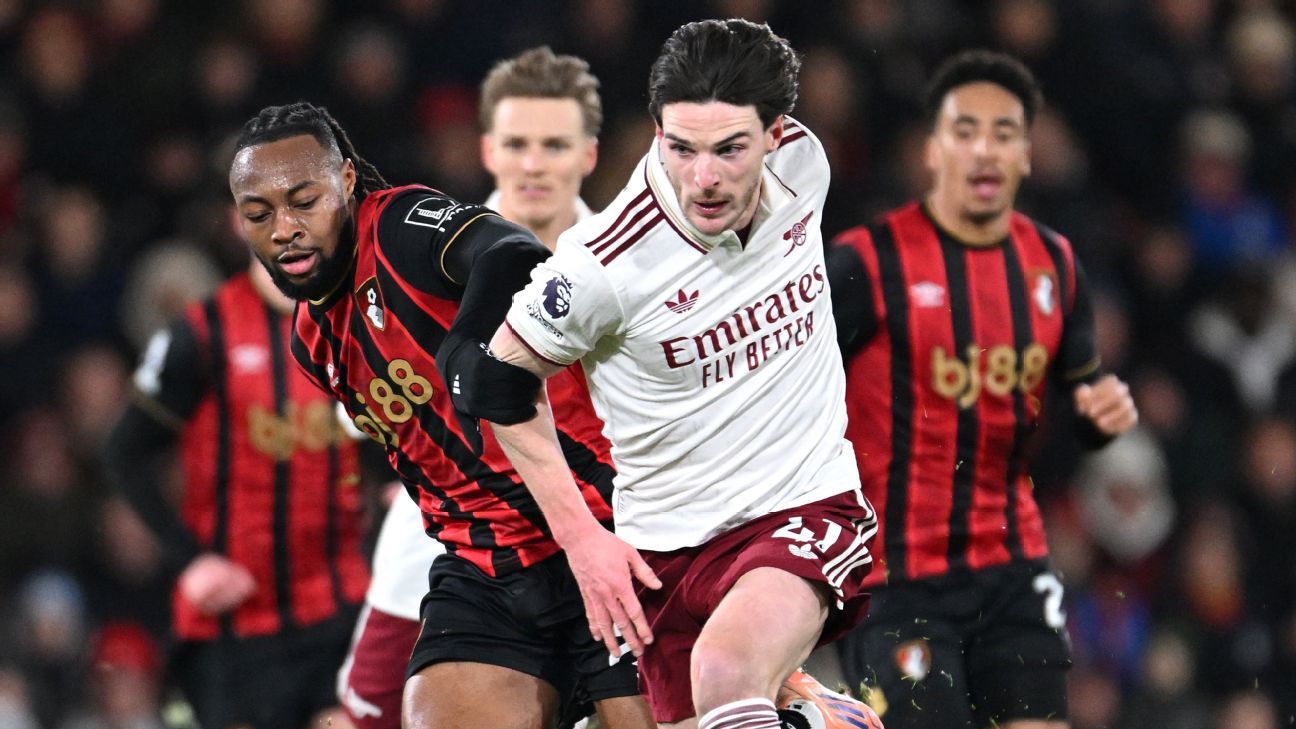
In the high-stakes world of the English Premier League, a recent string of controversial decisions has reignited debates over the role of Video Assistant Referee (VAR) technology, particularly its inability to intervene in cases involving second yellow cards. The issue came to a head during Bournemouth's match against Arsenal on January 3, when Bournemouth forward Antoine Semenyo grabbed Arsenal midfielder Declan Rice's shirt as Rice surged into Bournemouth's final third. The referee, Michael Salisbury, did not call a foul, allowing Rice to stay on his feet and continue play, but the incident highlighted a persistent gap in VAR's oversight that could have altered the game's outcome.
According to ESPN soccer analyst Dale Johnson, "You could sense, just as Bournemouth's Antoine Semenyo had hold of Declan Rice's Arsenal shirt on Saturday, that the row over VAR's role in awarding second yellow cards was going to spark again." This moment was not isolated; it capped a festive period marked by three notable instances where referees opted against issuing second yellow cards, potentially sparing players from ejection despite actions that appeared to warrant dismissal. VAR, introduced to the Premier League in 2019 to assist with clear errors in goal decisions, penalties, and straight red cards, currently has no protocol for reviewing second yellows, even when they could decisively impact matches.
The first of these incidents occurred on December 27 in Nottingham Forest's home game against Manchester City at the City Ground. Manchester City defender Rúben Dias clipped the heels of Forest forward Igor Jesus as Jesus chased a loose ball beyond City's defensive line. This foul, whether intentional or accidental, halted a promising counterattack for Forest, who were trailing 2-1 at the time. Dias, already on a yellow card from earlier in the match, avoided a second caution, remaining on the pitch as City went on to win 2-1. Johnson described the play, noting that "Manchester City's Dias clipped the heels of Nottingham Forest's Igor Jesus as the attacker was running on to a loose ball, beyond the City backline, with a clear opportunity to create a positive situation for his team."
Just three days later, on December 30, Arsenal hosted Aston Villa at the Emirates Stadium in a crucial top-of-the-table clash. Arsenal midfielder Mikel Merino, booked earlier for a tactical foul, pulled back Villa's Morgan Rogers during a quick turn into Arsenal's defensive third. Rogers was in a position to launch a dangerous attack, but the referee, Robert Jones, waved play on without issuing a second yellow to Merino. Arsenal secured a 1-0 victory, but the decision drew sharp criticism from Villa manager Unai Emery, who later said in his post-match press conference, "It's frustrating when clear fouls go unpunished, especially in those moments." Johnson echoed this sentiment, stating, "Arsenal midfielder Merino was deliberate in his action to pull back Aston Villa's Morgan Rogers as he made a smart turn. Rogers was clearly away and attacking Arsenal's final third with an obvious opportunity to create a positive situation for his team."
The Semenyo-Rice episode on January 3 at the Vitality Stadium followed a similar pattern. With Arsenal leading 2-1 in the second half, Rice powered through Bournemouth's midfield when Semenyo tugged his arm, impeding his progress. Referee Salisbury did not stop play, and Rice's decision to remain upright likely prevented an immediate review or card. Bournemouth ultimately lost 2-1, but the non-call fueled discussions among fans and pundits. As Johnson observed, "Semenyo deliberately pulled on the arm of Rice as he powered beyond Bournemouth's midfield and into the final third. On this occasion, however, the referee did not penalize the foul and therefore negated the opportunity of a second caution to be considered or issued for stopping a promising attack." He added, "Without doubt, the fact that Rice stayed on his feet saved Semenyo from an anxious moment, as the referee would have surely shown a second yellow card had the Arsenal midfielder gone to ground."
These events underscore a broader frustration in the Premier League, where VAR's scope remains limited despite its adoption across major competitions. The International Football Association Board (IFAB), the global rulemaking body for soccer, defines VAR's role strictly: it can only intervene in four key areas—goals, penalty decisions, direct red card incidents, and mistaken identity. Second yellow cards, which accumulate to result in a sending-off, fall outside this framework because they involve subjective judgments by the on-field referee. This protocol was established to maintain the flow of the game and avoid over-reliance on technology, but critics argue it leaves room for inconsistencies, especially in high-pressure matches.
Premier League officials have acknowledged the tension. In a statement following the festive fixtures, the Professional Game Match Officials Limited (PGMOL), which oversees refereeing, emphasized that "referees make decisions based on the information available at the time, and VAR is not designed to micromanage every foul." However, fan reactions on social media and in stadiums have been vocal, with hashtags like #VARFixThis trending after the Arsenal-Villa game. Arsenal manager Mikel Arteta, speaking after the Bournemouth win, touched on the issue indirectly, saying, "We respect the officials, but every decision matters in these tight games."
Looking ahead, changes may be on the horizon. IFAB has been in discussions about expanding VAR's involvement specifically for errors in second yellow card decisions that have already been issued. According to Johnson, "IFAB has been discussing the value in VAR becoming involved when a clear error has been made in the decision that leads to a second caution. The consequence of a player being incorrectly sent off when evidence is clearly available to the matchday team can be game-defining, so this change makes perfect sense." He predicts that if ratified, this adjustment could debut in the 2026-27 Premier League season or even at the 2026 World Cup.
Under the proposed tweak, VAR would only step in post-decision, such as if a referee erroneously sends off a player for a second yellow based on a foul that didn't occur. Johnson illustrated this with a hypothetical reversal of the Dias-Jesus incident: "Say that Jesus goes to ground in the same position, with the same opportunity ahead of him, and the referee awards the free kick and then sends Dias off for a second yellow card. However, upon review, the VAR has clear evidence that there was no contact by Dias on Jesus and therefore the second caution and subsequent red card was incorrect -- an error that is, at present, irreversible." In such cases, the VAR would recommend an on-field review, allowing the referee to view replays and potentially overturn the call.
Yet, not everyone supports broadening VAR's reach further. Johnson cautioned against allowing interventions for missed second yellows, like those in the recent incidents, arguing it could undermine referees' authority. "VAR involvement in possible second yellow cards would be viewed as a monumental change to current laws and would create a significant shift in the way that the referees currently manage games of football at the elite level," he wrote. "The big danger of introducing VAR into this scenario would force on-field incidents to be judged more factually, as opposed to allowing referees the freedom to apply their game-management skill set to any given incident."
This perspective aligns with views from refereeing bodies. PGMOL chief Howard Webb has previously stated in interviews that excessive VAR use risks turning matches into "stop-start affairs," echoing concerns from managers like Manchester City's Pep Guardiola, who after the Nottingham Forest game remarked, "We need consistency, but not at the expense of the game's spirit." Guardiola's team benefited from the Dias non-call, but he has been vocal in the past about VAR's limitations, once saying, "Technology should help, not hinder the natural flow."
The debate extends beyond the Premier League. In other leagues, such as La Liga and Serie A, similar protocols apply, but incidents like these have prompted calls for harmonization. For instance, during a Champions League match last month, a second yellow went unreviewed, leading UEFA to review its guidelines. Johnson noted that while fixing clear errors in issued cards is a "welcome change -- by fans, clubs and even refs themselves," expanding to subjective calls would be "akin to re-refereeing games, which is a path that we are all keen to avoid."
As the Premier League season progresses into its second half, with title contenders like Arsenal, Manchester City, and Liverpool separated by just a few points, these decisions carry amplified weight. The three incidents over the holiday period alone involved teams in the top six, potentially shifting momentum in the race for Champions League spots. Bournemouth's Andoni Iraola, post-match against Arsenal, expressed measured frustration: "It's part of the game, but we hope for fairness across the board."
IFAB's next meeting, scheduled for March in Zurich, could provide clarity on the proposed changes. If approved, it would mark a subtle but significant evolution in how technology integrates with human judgment in soccer. For now, referees continue to navigate these gray areas, balancing game management with the pursuit of accuracy. As Johnson put it, "A subjective judgment for a second yellow card, rightly or wrongly, carries a higher threshold." The Premier League's integrity hinges on resolving such tensions without alienating the sport's passionate global audience.
In the end, while VAR has transformed officiating since its inception—correcting over 200 erroneous decisions in the Premier League last season alone—its boundaries remain a flashpoint. The recent controversies serve as a reminder that technology, for all its precision, cannot yet capture the nuanced artistry of refereeing. As clubs and fans await IFAB's verdict, the beautiful game presses on, one contentious call at a time.