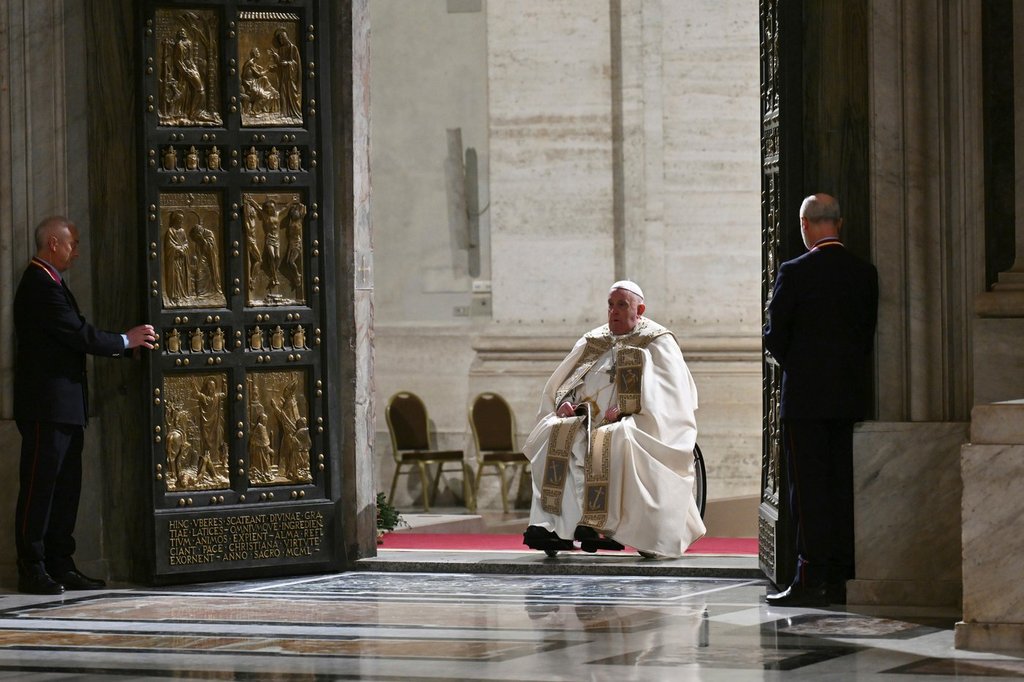
VATICAN CITY — The Vatican has declared its 2025 Holy Year a resounding success, announcing that more than 33 million pilgrims flocked to Rome over the past year to participate in the ancient tradition of seeking spiritual renewal. On Monday, officials released a final tally of 33,475,369 visitors, surpassing initial projections and marking one of the largest gatherings in the event's long history. This Jubilee, which began under Pope Francis and will conclude under his successor, Pope Leo XIV, on Tuesday, highlighted both the enduring draw of Catholic faith and the logistical challenges of hosting such a massive influx in the Eternal City.
The Holy Year, or Jubilee, is a pivotal event in the Catholic calendar, occurring every 25 years and inviting the faithful to Rome for pilgrimages to the tombs of Saints Peter and Paul. Participants pass through Holy Doors at major basilicas, including St. Peter's, to earn indulgences that offer forgiveness of sins. This year's observance opened on December 24, 2024, with Pope Francis pulling open the Holy Door of St. Peter's Basilica amid great ceremony. Tragically, Francis passed away in April 2025, leading to the election of Pope Leo XIV, making this the second Holy Year in history to span two pontificates—the first being in 1700, when Pope Innocent XII opened it and Pope Clement XI closed it after Innocent's death.
Archbishop Rino Fisichella, the Vatican's chief organizer for the Jubilee, shared the attendance figures during a press briefing, noting that the numbers reflect a combination of registered participants, volunteer counts at basilicas, and data from closed-circuit television cameras at St. Peter's. "We recorded around 25,000 to 30,000 people a day crossing the threshold of the Holy Door," Fisichella said, estimating that this alone accounts for about 10 million pilgrims over the year, given the door's limited capacity. He acknowledged that the total is an estimate and may include some double-counting, with no clear separation between Jubilee-specific visitors and Rome's general tourists.
The figures exceeded forecasts from a Roma Tre University study, which had predicted 31.7 million attendees. Italy led the nationalities with the most pilgrims, followed by the United States and Spain. Fisichella attributed a notable uptick in participation to the transition following Pope Francis's death. "There was a steady increase in the months after April," he explained, suggesting that the papal changeover drew additional interest and solidarity from the global Catholic community.
For Rome, the Holy Year represented not just a spiritual milestone but a boon for urban renewal. The event unlocked approximately 4 billion euros ($4.3 billion) in public funding to tackle decades of infrastructure neglect and align the city with modern European standards. Mayor Roberto Gualtieri reported that 110 out of 117 planned public works projects have been completed, including the ambitious transformation of the area around St. Peter's Square.
One of the standout achievements was the creation of Piazza Pia, a new pedestrian piazza at the end of Via della Conciliazione, the grand boulevard leading to St. Peter's Basilica. This project involved rerouting traffic through an underground tunnel to free up the space for foot traffic, enhancing safety and accessibility for pilgrims. Gualtieri hailed it as a key success, emphasizing its role in revitalizing a historically significant site.
However, not all aspects of the preparations were without friction. Fisichella and Gualtieri clashed over the design of two fountains installed in Piazza Pia, which frame the view down Via della Conciliazione toward the basilica's baroque facade. The mayor championed the contemporary stone fountains as a modern touch, while the archbishop found them mismatched with the surrounding architecture, including the fascist-era boulevard created for the 1950 Jubilee by demolishing a neighborhood.
"This was probably the only point on which we had to say, laughing and smiling, that we didn’t completely agree," Fisichella recounted. "He liked those two fountains, I liked others, but I had to back down." He added a lighthearted jab, saying, "I always thought they looked like foot baths." Despite his initial reservations, Fisichella noted that he has grown accustomed to the design over time, though he still harbors a preference for something more harmonious with the piazza's historic context. The piazza, situated on Italian soil rather than Vatican territory, ultimately followed the city's vision.
The Holy Year's roots trace back to 1300, when Pope Boniface VIII proclaimed the first Jubilee, solidifying Rome's status as Christianity's epicenter. Even then, the pilgrim crowds were immense; the poet Dante Alighieri referenced them in his Inferno, portraying the city's streets teeming with the devout. Over centuries, Jubilees have spurred monumental public works that have shaped Rome's skyline and infrastructure.
Among the most famous is the Sistine Chapel, commissioned by Pope Sixtus IV in 1475 specifically for that year's Jubilee, where pilgrims could view Michelangelo's masterpieces. More recently, the 2000 Holy Year under Pope John Paul II saw the construction of a vast underground parking garage beneath Vatican City to accommodate the throngs of visitors. These projects underscore how Jubilees have long served dual purposes: spiritual and civic rejuvenation.
This year's event, despite its successes, was not without broader challenges. The Vatican emphasized the smooth coordination between church and state, but underlying tensions over funding and priorities occasionally surfaced. Gualtieri's office highlighted the near-completion of projects as evidence of effective collaboration, while Fisichella focused on the spiritual fruits, reporting widespread participation in Jubilee events like confession drives and youth gatherings.
As Pope Leo XIV prepares to close the Holy Door on Tuesday, the ceremony will symbolize the end of an era marked by transition and triumph. The pontiff, elected in the wake of Francis's death, has already signaled a continuation of his predecessor's emphasis on mercy and outreach, themes central to this Jubilee. Vatican officials anticipate that the event's legacy will endure through the upgraded infrastructure and the personal transformations reported by countless pilgrims.
Looking ahead, the next ordinary Holy Year is slated for 2050, giving Rome decades to build on these improvements. For now, the 2025 Jubilee stands as a testament to the Catholic Church's global reach, drawing 33 million souls to the heart of its faith amid a year of profound change. As the doors close, the echoes of prayers and footsteps will linger in the cobblestone streets, a reminder of traditions that bridge centuries.
In the days following the closure, the Vatican plans to release more detailed reports on the event's impact, including economic analyses and participant testimonials. Meanwhile, Rome's tourism board is already promoting post-Jubilee packages, capitalizing on the city's renewed vibrancy. The fountains of Piazza Pia, love them or not, will continue to splash as silent witnesses to this historic gathering.