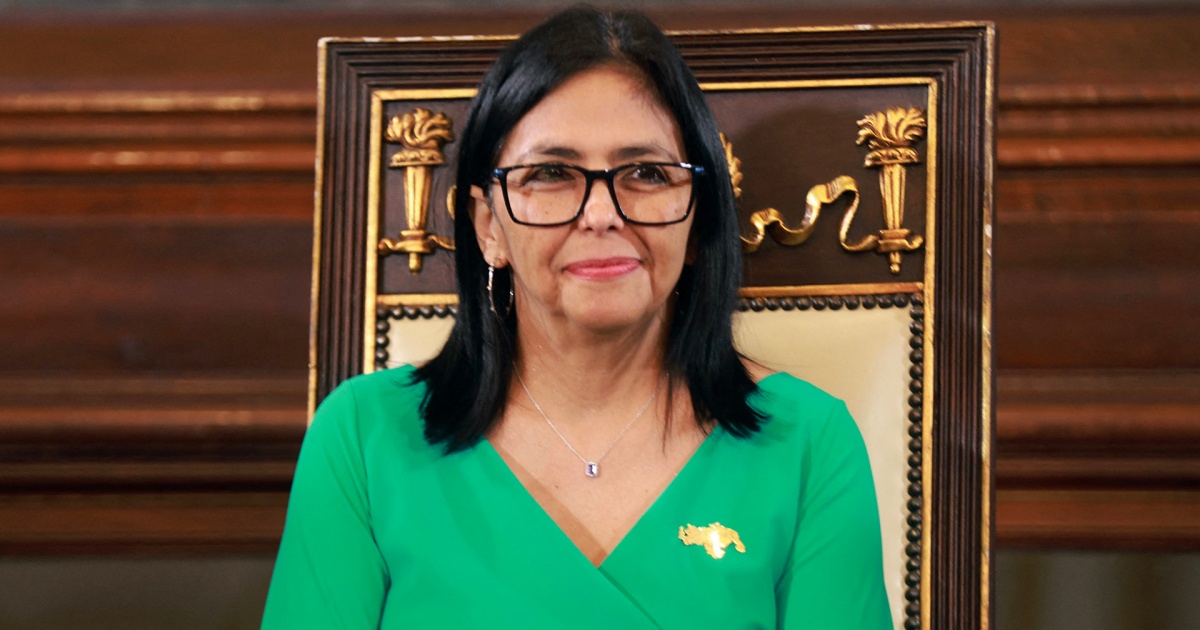
CARACAS, Venezuela — In a dramatic turn of events that has sent shockwaves through Latin America, Delcy Rodríguez was sworn in as Venezuela's interim president on Monday, stepping into the power vacuum left by the U.S. capture of longtime leader Nicolás Maduro. The ceremony, held in the National Assembly building in Caracas, marked a swift transition amid heightened tensions between Venezuela and the United States. Rodríguez, a prominent figure in Maduro's United Socialist Party of Venezuela (PSUV), took the oath of office before a gathering of loyalists and military officials, vowing to defend the nation's sovereignty while extending an olive branch to the incoming Trump administration in Washington.
According to reports from NBC News, Rodríguez's ascension follows the surprise U.S. operation that resulted in Maduro's detention late last week. Details of the capture remain murky, with Venezuelan officials describing it as an "illegal invasion" and U.S. sources, speaking anonymously, calling it a targeted extraction to hold Maduro accountable for alleged human rights abuses and narco-trafficking. The event unfolded on Friday, January 2, 2026, when special forces reportedly raided Maduro's residence in the capital, whisking him away to an undisclosed location in the U.S. This operation, authorized under the Trump administration's renewed focus on hemispheric security, has reignited debates over U.S. interventionism in the region.
Rodríguez, 56, has long been a key architect of Maduro's policies, serving as vice president and foreign minister in previous roles. Her brother, Jorge Rodríguez, currently heads the National Assembly, which convened the emergency session to formalize her interim status under Article 233 of Venezuela's 1999 constitution. "We will not bow to foreign aggression," Rodríguez declared during the swearing-in, her voice steady as she addressed the assembly. "But we are open to dialogue with all who respect our independence."
Even as she pledged cooperation, Rodríguez's government moved aggressively against perceived internal threats. On Sunday, the interior ministry issued orders for police and intelligence agencies to detain individuals suspected of aiding the U.S. operation. According to state media, at least a dozen arrests have been made in Caracas and Maracaibo, targeting opposition figures and even some mid-level military officers accused of providing logistical support. Human rights groups, including Amnesty International, expressed alarm, stating in a preliminary report that "these detentions risk escalating into a broader crackdown on dissent."
The backdrop to this upheaval is Venezuela's protracted political and economic crisis, which has persisted since the death of Hugo Chávez in 2013. Maduro, who succeeded Chávez, faced mounting international isolation as hyperinflation ravaged the economy, oil production plummeted, and millions fled the country. The U.S. imposed sanctions starting in 2017, targeting Maduro's inner circle for corruption and election fraud. By 2025, with Donald Trump returning to the White House after his 2024 victory, rhetoric against the Maduro regime intensified, with Trump vowing during his campaign to "end the socialist nightmare in Venezuela once and for all."
U.S. officials have not commented officially on Rodríguez's overtures, but sources close to the State Department indicated that any collaboration would hinge on free elections and the release of political prisoners. "The capture of Maduro is a significant step, but stability requires more than a name change at the top," said one diplomat, speaking on condition of anonymity. Meanwhile, in Caracas, street protests erupted sporadically on Monday, with pro-Maduro supporters clashing with security forces near the presidential palace. Eyewitnesses described tear gas canisters filling the air and chants of "Traitors!" echoing through the avenidas.
International reactions poured in swiftly. The United Nations Security Council scheduled an emergency meeting for Tuesday in New York, where Brazilian President Luiz Inácio Lula da Silva called for "restraint and multilateral solutions." Russia, a longtime ally of Maduro, condemned the U.S. action as "state terrorism," with Foreign Minister Sergey Lavrov stating in Moscow that "this violation of international law will not go unanswered." China, another major creditor to Venezuela, urged all parties to prioritize economic recovery over political maneuvering.
Opposition leaders within Venezuela, long sidelined by Maduro's control of institutions, viewed the developments with cautious optimism. María Corina Machado, a prominent critic who was barred from running in past elections, posted on social media: "This is a moment of truth for our democracy. We demand transparency and an end to repression." However, her message was quickly censored on state-run platforms, highlighting the challenges ahead for any transition.
Economic analysts point to the potential for short-term volatility. Venezuela's bolívar, already weakened, dipped another 15% against the dollar on Monday morning, according to Bloomberg data. Oil prices, crucial to the country's exports, surged globally amid fears of supply disruptions from the Orinoco Belt fields. "Rodríguez inherits a fractured economy," noted Francisco Rodríguez, an economist at Banco Provincial in Caracas. "Collaboration with the U.S. could unlock sanctions relief, but internal divisions may hinder progress."
The U.S. capture of Maduro has also strained relations with regional partners. Colombia, which shares a porous 1,400-mile border with Venezuela, bolstered its military presence along the frontier, reporting an influx of refugees fleeing the uncertainty. President Gustavo Petro of Colombia tweeted: "We stand ready to mediate, but violence solves nothing." In contrast, Cuba, whose doctors and advisors have been integral to Maduro's social programs, rallied behind Rodríguez, with Havana's state newspaper Granma hailing her as a "defender of Bolivarian ideals."
Looking back, the seeds of this crisis were sown in the disputed 2018 presidential election, which the U.S. and European Union refused to recognize. Juan Guaidó, then the opposition's interim president claim, attempted to rally international support but faded amid military loyalty to Maduro. The COVID-19 pandemic exacerbated shortages, leading to widespread hunger and a brain drain of over 7 million Venezuelans since 2015, per United Nations estimates.
As Rodríguez consolidates power, questions swirl about the military's role. The Bolivarian National Armed Forces, numbering around 150,000 active personnel, have been a pillar of Maduro's rule, enriched by control over gold mines and food imports. General Padrino López, the defense minister, attended the swearing-in and publicly affirmed loyalty to the new leadership, but whispers of factionalism persist. Analysts at the Washington-based Center for Strategic and International Studies suggest that any U.S.-Venezuela thaw could involve demobilizing paramilitary groups like the colectivos, known for suppressing protests.
Beyond immediate security concerns, the interim government's agenda includes addressing the humanitarian crisis. With 96% of Venezuelans living in poverty according to a 2025 ENCOVI survey, Rodríguez announced plans for emergency food distributions and power grid repairs, plagued by blackouts since 2019. Yet, her offer to collaborate with Trump—whose administration has prioritized deportations and border security—raises eyebrows. Trump officials have linked Venezuelan migration to gang activity in the U.S., with over 200,000 Venezuelans crossing the southern border in 2025 alone, per Customs and Border Protection figures.
What comes next remains uncertain. Rodríguez's term as interim leader could last up to 30 days under constitutional provisions, enough time to call elections or extend her mandate. International observers, including the Carter Center, have called for inclusive talks involving all factions. As the sun set over Caracas on Monday, the city that once symbolized Chávez's revolution now grapples with its possible unraveling. For ordinary Venezuelans, like shopkeeper Ana López in the Petare slums, the hope is simple: "We just want stability, food on the table, and our families safe."
The world watches closely as Venezuela navigates this pivotal juncture, where promises of dialogue clash with the specter of arrests and unrest. Whether Rodríguez's leadership bridges the divide or deepens it will shape not only her nation's future but the balance of power in the Americas.