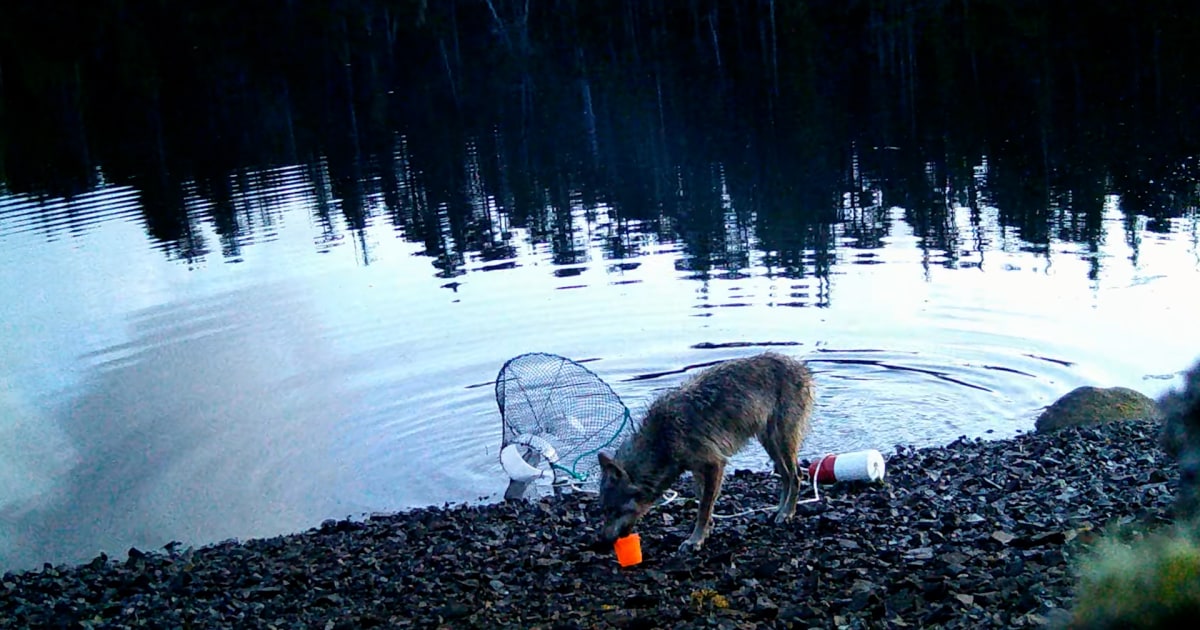
In a groundbreaking observation that challenges long-held views on animal intelligence, a video captured by researchers shows a wild wolf in coastal British Columbia appearing to use a rudimentary tool to pilfer fish from a trap. The footage, part of a new study published in the journal Scientific Reports, depicts the wolf employing a rope to drag a crab trap closer to shore, marking what scientists describe as potential evidence of tool use among free-living wolves.
According to the study led by researchers from the Raincoast Conservation Foundation, the behavior was observed during field work along the remote shores of Vancouver Island in late 2023. The wolf, identified as a member of a local pack known for foraging in intertidal zones, approached a baited crab trap set by scientists approximately 20 meters offshore. Rather than swimming out, the animal reportedly grasped a loose rope attached to the trap with its jaws and pulled it steadily toward the beach, successfully retrieving the contents without entering the water.
"This is the first documented instance of wild wolves using tools in a natural setting," said Lauri Valerio, a biologist with the Raincoast Conservation Foundation and lead author of the study. "Wolves have been observed manipulating their environment before, but this level of intentional tool use suggests a higher cognitive adaptability than previously thought."
The video, which has since garnered attention from wildlife experts worldwide, was filmed using a remote camera trap on October 15, 2023, at low tide. The trap contained herring bait, a common attractant in the region, and the wolf spent about two minutes maneuvering the rope before accessing the fish inside. Researchers noted that the pack, consisting of five adults and three pups, returned to the site multiple times over the following week, with at least two other wolves exhibiting similar behavior.
While tool use is well-documented in primates, birds like crows, and even octopuses, wolves have historically been categorized as opportunistic hunters rather than innovators. Background context on canid behavior highlights that domestic dogs occasionally play with objects, but wild wolves typically rely on pack dynamics and physical prowess for foraging. This discovery builds on earlier anecdotal reports from Indigenous communities in British Columbia, who have long described wolves as clever scavengers along the coast.
The study's findings were cross-verified through analysis of over 200 hours of footage from 15 camera traps deployed between June and December 2023. In total, wolves accessed 12 out of 28 traps, with tool-assisted retrieval occurring in four instances. "The wolves learned quickly," Valerio added in an interview with NBC News. "By the third visit, they were more efficient, almost methodical in their approach."
Experts not involved in the research have praised the observation but cautioned against overinterpreting it as definitive proof of complex cognition. Dr. Sarah Thompson, a wolf ecologist at the University of Washington, said, "It's compelling evidence, but we need more data to rule out instinctual behavior versus learned tool use. Wolves are highly adaptable, especially in resource-scarce environments like coastal ecosystems."
Environmental factors play a key role in this behavior, according to the researchers. Vancouver Island's rugged coastline, with its rich marine life and fluctuating tides, forces wolves to innovate. The region supports a population of about 150 coastal wolves, a subspecies distinct from inland gray wolves due to their semi-aquatic foraging habits. Climate change, however, poses threats; rising sea levels and warmer waters could alter prey availability, potentially pressuring wolves to develop new strategies.
Indigenous perspectives add depth to the story. Members of the Wuikinuxv Nation, whose traditional territory includes the study area, have shared oral histories of wolves using sticks to fish in shallow pools. Elder Mary Johnson recounted, "Our elders always said the wolf is a teacher, showing us how to survive with what's around you. This video just proves what we've known for generations." The collaboration between scientists and First Nations groups underscores the cultural significance of the find.
Broader implications extend to conservation efforts. Tool use could indicate that coastal wolves possess greater problem-solving skills, enhancing their resilience against human encroachment. The Raincoast Conservation Foundation, which funded the study with a $250,000 grant from the Canadian government, advocates for expanded protected areas. "If wolves are this intelligent, we must protect their habitats more aggressively," Valerio emphasized.
Critics within the scientific community point to potential biases in the observation. Some argue that the presence of human-set traps may have influenced the wolves' actions, blurring the line between natural and conditioned behavior. A separate report from the International Wolf Center, published in early 2024, reviewed similar footage from Alaska and found no tool use, suggesting the British Columbia incidents might be location-specific. "It's intriguing, but not yet conclusive," said center director David Mech.
Looking ahead, researchers plan to deploy additional camera traps and GPS collars on the pack to track long-term patterns. The study calls for interdisciplinary approaches, combining ethology, ecology, and Indigenous knowledge. Funding from the World Wildlife Fund will support a follow-up expedition in summer 2024, aiming to document tool use in other canid species.
This discovery arrives amid growing interest in animal cognition, fueled by viral videos of clever wildlife. Just last year, a study in Ethiopia documented hyenas using sticks to dig, paralleling the wolf findings. As technology like AI-enhanced cameras becomes more accessible, such observations are expected to increase, reshaping our understanding of non-human intelligence.
For the wolves of Vancouver Island, the immediate future involves navigating seasonal changes. With salmon runs peaking in fall, the pack's tool-using tendencies might evolve further. Officials with British Columbia's Ministry of Environment reported no immediate threats to the population, but ongoing monitoring is essential.
In the end, this video not only highlights the ingenuity of wild wolves but also serves as a reminder of the intricate balance in coastal ecosystems. As Valerio put it, "These animals are full of surprises, and we're just beginning to uncover them." The footage, available on NBC News' website, invites viewers to witness a moment of natural innovation unfolding on a misty beach.