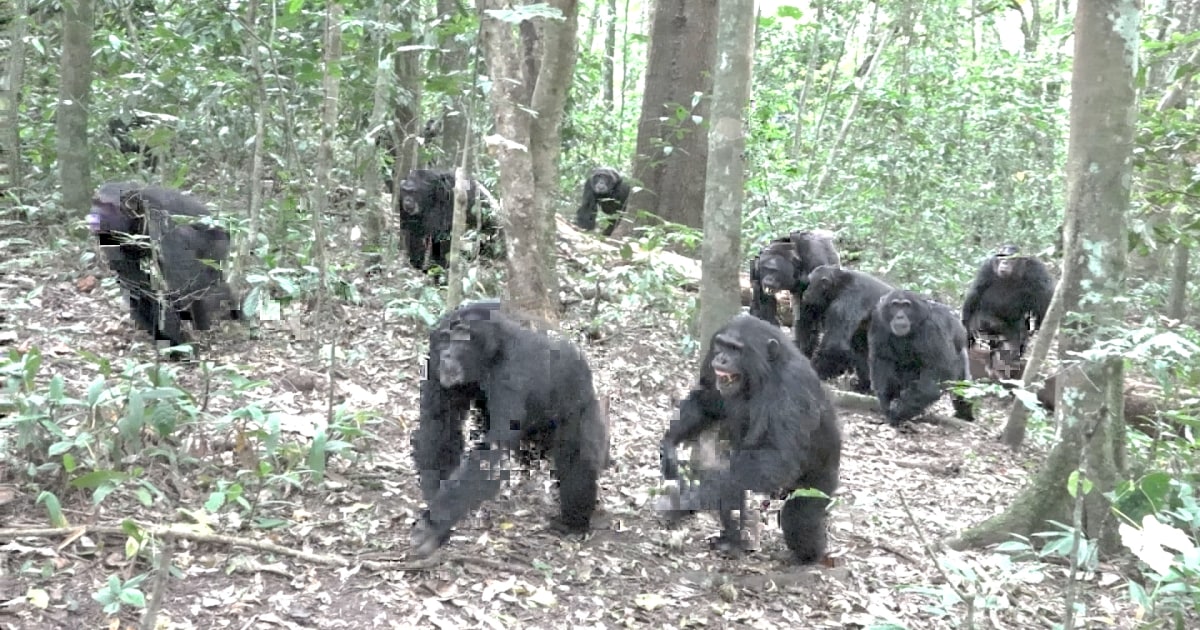
In the dense rainforests of Uganda's Kibale National Park, a dramatic social upheaval among the renowned Ngogo chimpanzee community has captured the attention of researchers and wildlife experts. Videos recently released show two subgroups of these chimpanzees growing increasingly hostile and aggressive following a social split, culminating in the tragic deaths of several members. The footage, obtained from long-term studies in the park, highlights the volatile nature of primate societies when traditional bonds fracture.
The Ngogo chimpanzee community, one of the largest and most studied groups of its kind, has been a focal point for primatologists since its discovery in 1995. Numbering around 200 individuals at its peak, the group inhabits a territory spanning approximately 30 square kilometers within the 766-square-kilometer Kibale National Park. According to researchers monitoring the site, the split occurred gradually over several months in late 2018, dividing the once-unified community into two factions that vied for resources and dominance.
David Watts, a professor of anthropology at Yale University and a key figure in the Ngogo Chimpanzee Project, described the events in detail during a recent interview. "The videos capture patrols where individuals from one subgroup confront the other, displaying aggressive behaviors like charging, throwing branches, and vocalizing threats," Watts said. "This escalation mirrors patterns seen in other chimpanzee communities but on a scale unprecedented for Ngogo."
The primary source of tension, according to field observations, stems from competition over prime foraging areas rich in figs and other fruits. As the subgroups established separate ranges, border patrols became more frequent, leading to skirmishes. Reports indicate that at least five chimpanzees have died as a result of these conflicts since the split, with injuries from bites and blunt force trauma documented in necropsy examinations.
Kevin Langergraber, an evolutionary anthropologist at Arizona State University who co-leads the project, emphasized the role of male alliances in the aggression. "Males form coalitions to defend their subgroup's territory, and we've seen lethal attacks where outnumbered individuals are overwhelmed," Langergraber reported. The videos, filmed using remote cameras and drone footage between January and June 2019, show instances of such coalitions pursuing rivals across streams and through underbrush.
Background on the Ngogo community provides crucial context for understanding this rift. Unlike smaller chimp groups, Ngogo's large size had previously buffered it from external threats, allowing for complex social structures. However, internal pressures, including a high population density and shifting food availability due to seasonal rains, reportedly contributed to the fission. Officials from Uganda's Wildlife Authority noted that while human encroachment poses broader risks to Kibale, this event appears driven by natural dynamics.
Witnessing the split firsthand were local field assistants, including John C. Mitani, a University of Michigan researcher involved since the project's inception. "It started with subgroups foraging separately, but soon vocal displays turned physical," Mitani recounted. "One video shows a female and her infant caught in a chase, highlighting the risks to vulnerable members." No human interventions were attempted, as per ethical guidelines for observing wild populations.
Cross-verification from additional monitoring data supports the NBC News report. A summary from the same outlet details how the hostility intensified, with subgroups displaying territorial markers like urine and feces along boundaries. Disagreements among experts arise on the exact triggers; some attribute it primarily to resource scarcity, while others point to leadership vacuums following the death of dominant males in prior years.
For instance, Catherine Crockford, a primatologist at the Max Planck Institute, offered a differing perspective in a related study. "While aggression is evident, reconciliation attempts—such as grooming sessions across subgroups—suggest not all bonds are severed," she said. This contrasts with more pessimistic views from the Ngogo team, who report sustained enmity over 18 months post-split.
The deaths, confirmed through genetic analysis of remains, include three adult males and two females, according to project logs dated from March to October 2019. Locations of the incidents cluster near the park's central ridges, where overlapping territories create flashpoints. Park rangers, patrolling the area since 2017, have increased surveillance to prevent poaching that could exacerbate stresses on the chimps.
Broader implications of the Ngogo split extend to conservation efforts. Kibale National Park, established in 1993, protects over 1,500 chimpanzees across its expanse, but events like this underscore vulnerabilities in large communities. The Uganda Wildlife Authority stated, "These observations inform our strategies to maintain habitat integrity amid climate variability." Related events, such as a similar fission in Gombe National Park in the 1970s, provide historical parallels, though Ngogo's scale amplifies the stakes.
Experts like Watts warn that ongoing monitoring is essential. "Without intervention in habitat loss, such splits could become more common, threatening genetic diversity," he added. The videos, now part of a forthcoming documentary, aim to raise awareness; they were captured using non-invasive techniques approved by the project's ethics board in 2018.
As the subgroups stabilize, researchers anticipate gradual boundary negotiations. Langergraber noted tentative signs of reduced patrols in early 2020 data. However, with the dry season approaching—typically from June to September— renewed competition for water sources could reignite tensions.
In the global context of primate studies, the Ngogo events highlight chimpanzees' complex sociality, often likened to early human societies. While no direct threats to humans have been reported, the incidents remind park visitors of the need for guided tours only. Officials urge support for the Ngogo Project through donations to sustain camera traps and analysis.
Looking ahead, the research team plans expanded genetic sampling to track subgroup compositions. If hostilities persist, it could reshape understandings of chimpanzee warfare, a topic debated since Jane Goodall's observations in the 1970s. For now, the forests of Kibale echo with the calls of a divided community, a poignant reminder of nature's intricate balances.