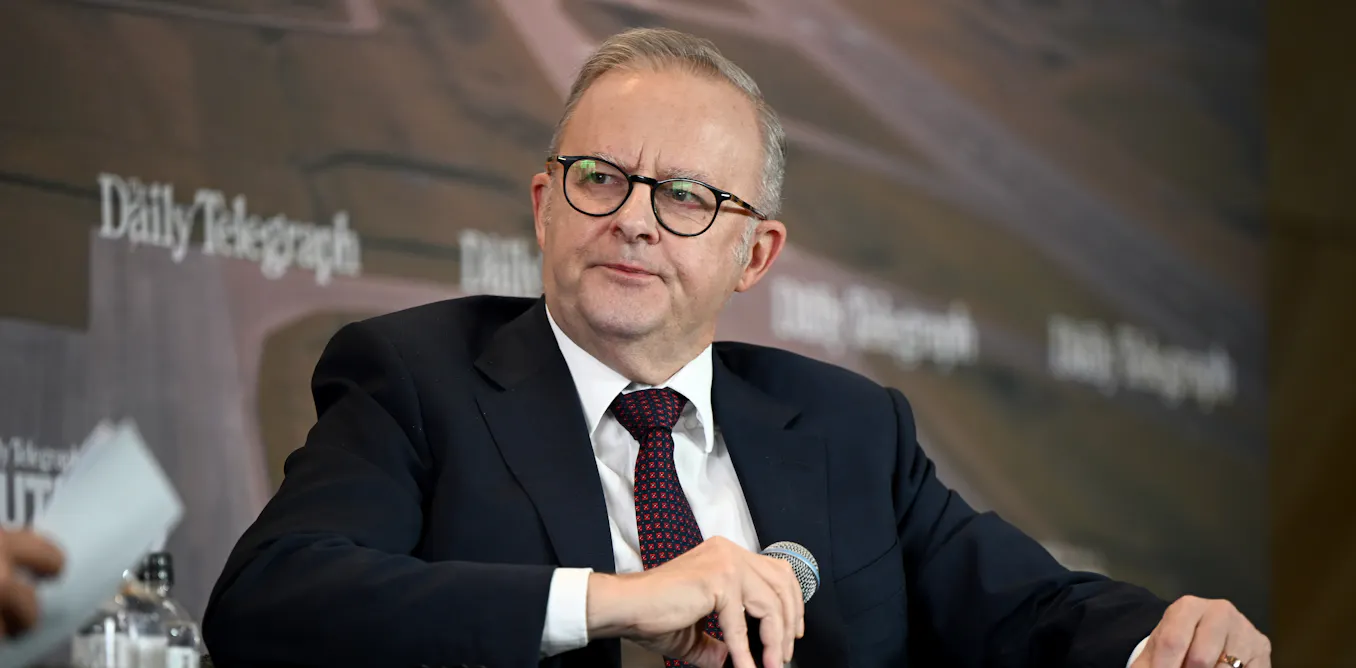
Canberra, Australia — Prime Minister Anthony Albanese showed visible irritation during a public forum on Friday when pressed on why his government won't pursue indexing income tax rates to inflation, a reform some economists argue could address bracket creep amid rising prices.
The exchange occurred at a question-and-answer session hosted by the Daily Telegraph, where editor Ben English directly challenged Albanese on the issue. With the federal budget set for release on May 12, much anticipation has built around potential tax changes aimed at equity and affordability. English asked, “You’re talking about fundamental and profound reforms, but why won’t you do the simplest and most effective reform and index income tax rates?”
Albanese bristled at the suggestion, initially stating — incorrectly, according to historical records — “no government has done that.” He then pushed back, telling English, “you define it that way. I don’t think that’s the most – I think that’s a very big call from you.” When pressed further on whether the change would promote equity, the prime minister replied, “It’s an even bigger call for you to say that that’s the biggest thing we can do on equity in the budget. So, thank God you’re not on the ERC [expenditure review committee]. There’s a range of tax measures you can do to really go hard on equity. That’s not at the front of them.”
The reform in question, indexing tax brackets to inflation, would automatically adjust income thresholds to prevent what economists call bracket creep — the phenomenon where inflation pushes workers into higher tax bands without real income gains. University of New South Wales economist Richard Holden, an advocate for the policy, warned that ongoing global tensions could exacerbate the problem. “The higher inflation flowing from the ongoing impact of the energy crisis will lead to more bracket creep than before,” Holden told The Conversation. He noted that even before recent crises, at 2.5% annual inflation over a decade, a taxpayer on average full-time earnings would see their average tax rate rise from 22.8% to 25.9%.
Indexing would end bracket creep forever. Many peer jurisdictions, including the United States, do exactly this. Politicians have an incentive not to do so, so they can dish out essentially fake tax cuts.
Holden’s comments highlight a long-standing debate in Australian fiscal policy. Governments have historically resisted full indexation due to its impact on revenue and the political flexibility it removes. The Fraser government in the 1970s introduced partial tax indexation but later scaled it back and abandoned it entirely by the early 1980s. Former Treasury secretary Ken Henry has been vocal in support of reviving the measure. Last year, Henry said, “Fiscal drag has got so bad, politicians are getting away with blue murder – and they shouldn’t.”
On the opposition side, then-Leader of the Opposition Peter Dutton briefly considered the idea ahead of the 2022 election but stopped short of committing to it as a formal policy. Dutton's flirtation with indexation underscores the bipartisan wariness toward a reform that could limit future tax cut announcements, which often serve as election sweeteners.
Instead of indexing, the Albanese government is focusing on other tax measures in the upcoming budget. Officials have indicated changes to capital gains tax and negative gearing rules, which will be framed as steps toward intergenerational equity and improving housing affordability. These reforms aim to make the tax system fairer for younger Australians struggling with home ownership amid soaring property prices.
Albanese has also firmly ruled out introducing a new tax on gas exports, despite a robust public and advocacy campaign pushing for it to capture more revenue from the resources sector. The decision comes as energy prices remain volatile, influenced by global events including the conflict in the Middle East.
Treasurer Jim Chalmers provided further insight into the budget's challenges during a recent update, outlining some of the largest spending pressures over the forward estimates period of five years from 2025-26. These include $25 billion for the hospitals agreement with the states, covering five years from 2026-27; about $14 billion for defence investments; and more than $6 billion in new and amended listings under the Pharmaceutical Benefits Scheme.
Additional allocations detailed by Chalmers encompass $4.4 billion in extra payments for Disability Support Pensioners; $3.2 billion in additional income support for Jobseekers; $2.5 billion to halve the fuel excise; $2.5 billion in further natural disaster support; $1.5 billion to address infrastructure cost pressures; $1.5 billion in additional financial support for Carers; and $1.5 billion in extra payments for Aged Pensioners. More than $500 million has been earmarked to respond to the antisemitic terrorist attack in Bondi, including provisions for the National Gun Buyback scheme.
These figures reflect a budget under strain from multiple fronts. The escalating conflict in the Middle East, particularly involving Iran, has contributed to a spike in inflation that affects both spending and revenue. Chalmers noted that the situation has led to “higher borrowing costs on debt that will hit the budget hard, and higher inflation that will flow through to higher payment costs.” While inflation boosts some revenue streams, such as through bracket creep, it also inflates the cost of indexed payments like pensions and welfare.
The broader economic context adds layers of complexity. Australia's inflation rate has hovered above the Reserve Bank's target band, prompting interest rate hikes that further pressure household budgets. The energy crisis, intertwined with geopolitical tensions, has driven up fuel and commodity prices, indirectly fueling demands for tax relief. Yet, as Albanese's response at the forum suggests, the government views indexing as less urgent than targeted measures on housing and superannuation.
Critics, including Holden and Henry, argue that ignoring bracket creep allows inflation to act as a stealth tax, disproportionately affecting middle-income earners. Proponents of indexation point to international examples like the U.S., where automatic adjustments have been in place since the 1980s, providing predictability for taxpayers and reducing political gamesmanship over tax policy.
As the May 12 budget approaches, eyes will be on how the government balances these pressures. With revenue windfalls from high commodity prices offering some buffer, but spending commitments mounting, the absence of indexation could signal a preference for discretionary fiscal tools over structural reforms. Economists like Holden warn that without action, bracket creep will continue to erode real incomes, potentially fueling public discontent in an election cycle.
The budget's tax elements, particularly on capital gains and negative gearing, are expected to spark debate in Parliament. Opposition figures may revive calls for indexation, drawing on Dutton's past interest, while Labor emphasizes its equity-focused agenda. For now, Albanese's sensitivity on the issue underscores the delicate tightrope the government walks between fiscal responsibility and voter expectations.