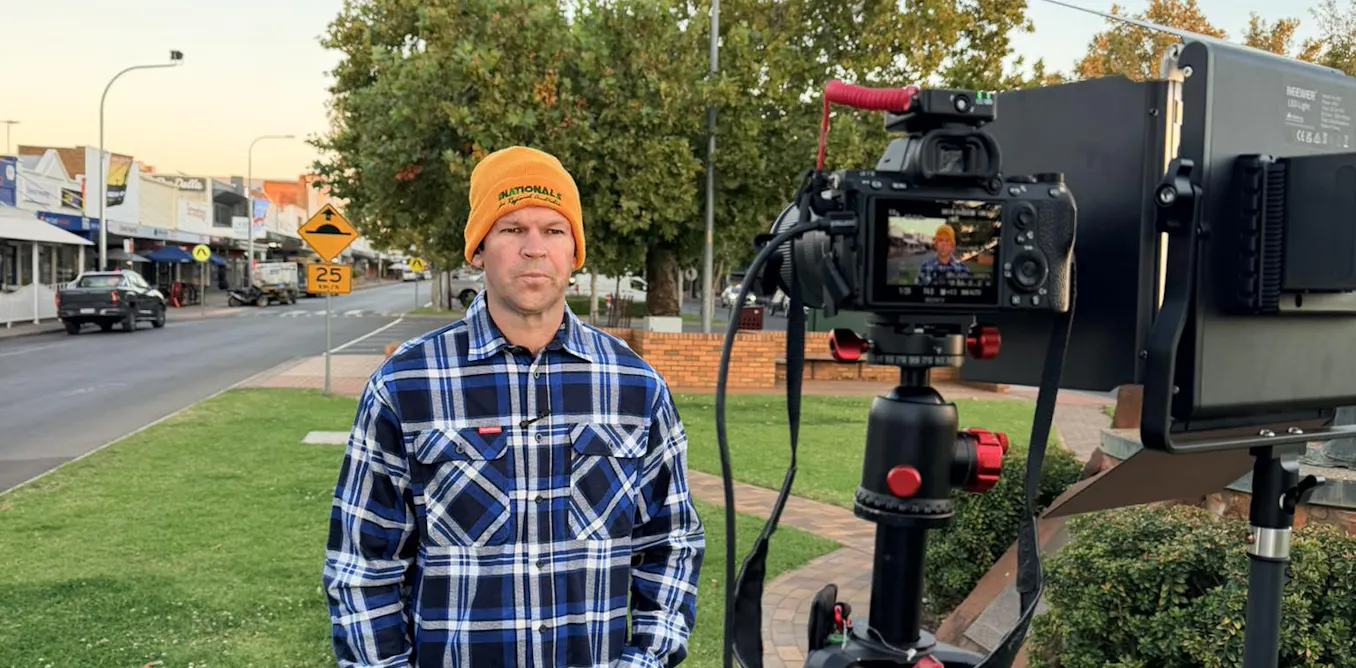
In the frost-kissed fields of southern New South Wales, Nationals leader Matt Canavan is embracing the rigors of the campaign trail in a most literal way. As the federal by-election in the seat of Farrer approaches on May 9, Canavan has taken to camping out in the electorate, pitching his swag amid overnight temperatures dipping near zero degrees Celsius. His unorthodox strategy underscores the uphill battle facing the Nationals' candidate, Brad Robertson, in a race dominated by One Nation and independent contender Michelle Milthorpe.
The by-election, triggered by the resignation of long-time Liberal MP Sussan Ley, has transformed what was once a safe conservative seat into a fiercely contested battleground on the right. Farrer, encompassing rural towns like Hay and Griffith, stretches across the Riverina region, an area known for its agricultural heartland and shifting voter loyalties. Canavan, hailing from the warmer climes of Queensland, arrived in the electorate last week, determined to rally support despite polls showing the Nationals trailing far behind.
Canavan's camping odyssey began with a couple of nights under the stars before escalating to stays in Hay on Saturday and Griffith on Sunday and Monday. Ill-prepared for the chill, he upgraded his sleeping bag—from one suited to Queensland's milder weather—and erected a semi-tent for added shelter. 'I set up in caravan parks so I can shower and shave,' Canavan explained, emphasizing the need to maintain a respectable appearance on the trail. He framed his discomfort as a political parable, telling The Conversation, 'Opposition should be uncomfortable.' He added, '[This says opposition] is not a permanent residence.'
While Canavan endures the elements, his party's candidate, Robertson, has opted for more conventional accommodations. The Nationals' prospects appear dim, with the primary vote splintering among right-leaning parties. A recent uComms poll, conducted April 9-10 among 1,116 voters in the electorate, painted a stark picture. One Nation's David Farley edged out Milthorpe with 30.9% of the primary vote to her 30.0%, followed by the Liberals' Raissa Butkowski at 16.1% and Robertson at a mere 7.1%. The margin of error stood at about 3%.
On the estimated two-candidate preferred vote, which pits One Nation against Milthorpe after preferences are distributed, Farley held a lead of 52.7% to 47.3%. This tight margin highlights the race's volatility, particularly as preferences from the Liberals and Nationals could prove decisive. The poll also revealed shifts since the 2025 federal election, where Ley secured 43.4% of the primary vote. Respondents recalled voting for her at 41.4%, for Milthorpe at 23.1% (up from her actual 20%), and for One Nation at 13%—though the party's true 2025 tally was just 6.6%, suggesting some voters may be retroactively aligning with the rising force.
The by-election's dynamics reflect broader fractures within Australia's conservative coalition. The Liberals, once dominant in Farrer, have seen their support erode amid internal party tensions and Ley's departure. One Nation, led nationally by Pauline Hanson, has capitalized on rural discontent over issues like fuel prices and immigration. Milthorpe, a local independent who nearly upended Ley in 2025, positions herself as a fresh alternative, focusing on community concerns in the Riverina's farming communities.
Canavan remains defiant, refusing to concede defeat. 'With the vote on the right splitting between One Nation, the Liberals, the Nationals and micro candidates, there is always the chance of coming up through the middle,' he said. His presence in Farrer aims to consolidate the conservative vote, but the camping stunt has drawn mixed reactions—some see it as a gritty show of commitment, others as a desperate gimmick in a seat the Nationals haven't held strongly in years.
Beyond the horse race, the poll delved into voter sentiments on international figures, offering a glimpse into Farrer's worldview. When asked about former U.S. President Donald Trump, 50.7% expressed a 'very unfavourable' opinion, with another 9.8% deeming it 'unfavourable.' Only 11.4% viewed him 'very favourably,' and 13.2% 'favourably.' Notably, One Nation supporters bucked the trend, with 24.6% holding a 'very favourable' view and 26.6% a 'favourable' one, underscoring the party's alignment with populist strains echoing Trump's style.
This Trump affinity ties into external efforts to sway the electorate. Advocacy group GetUp has launched a targeted advertising blitz against One Nation, framing the party as too closely linked to divisive international influences. Their TV ad, titled Trump’s War, highlights 'the links between Trump and [Pauline] Hanson in light of the recent fuel crisis.' The campaign extends to digital ads aimed at 'persuadable voters who will decide the race' and billboards across Farrer.
GetUp's fundraising appeal warns of the stakes: 'If One Nation wins Farrer, it will be a huge boost to their momentum and could change the political map of this country.' The group, known for progressive activism, sees the by-election as a test of One Nation's viability in regional Australia. Milthorpe, while independent, has benefited from such external support in past campaigns, though she maintains a focus on local issues like water rights and agricultural sustainability.
The fuel crisis referenced in GetUp's ads stems from recent global supply disruptions, which have hit rural economies hard. In Farrer, where farming and transport are lifelines, rising costs have fueled voter frustration. One Nation has campaigned on protectionist policies, promising to shield Australian jobs from foreign competition—a message resonating in towns like Griffith, a hub for citrus and wine production.
Meanwhile, the Liberals' Butkowski, a newcomer to the fray, struggles to reclaim lost ground. Party insiders attribute the decline to Ley's high profile and the coalition's national infighting. In the 2025 election, preferences from minor parties helped Ley secure victory, but this time, with the vote fragmented, analysts predict a more unpredictable flow.
Canavan's multi-day stint in Farrer, wrapping up after Griffith, symbolizes the Nationals' refusal to yield regional strongholds without a fight. Yet, as temperatures rise toward election day, the real heat will come from voter turnout in this low-profile by-election. With early voting already underway, campaigns are intensifying door-knocks and town halls across the 80,000-square-kilometer electorate.
Looking ahead, a One Nation win could signal a realignment in rural conservatism, emboldening Hanson's push into traditional Liberal-National territories. For Milthorpe, victory would affirm the growing clout of independents in unseating major parties. The Nationals, through Canavan's efforts, hope to stem the tide, but polls suggest their miracle remains elusive. As the May 9 count unfolds, Farrer's result may ripple through Australia's polarized political landscape, influencing strategies for the next federal poll.
In Hay, where Canavan bedded down amid the cold, locals have watched the spectacle with a mix of amusement and skepticism. One farmer, speaking anonymously, noted the unusual sight of a Queensland politician roughing it locally. 'It's a long way from Brisbane,' he said, 'but if it gets people talking about our issues, why not?' With the by-election just weeks away, such grassroots gestures could yet sway the undecided in this chilly corner of the nation.