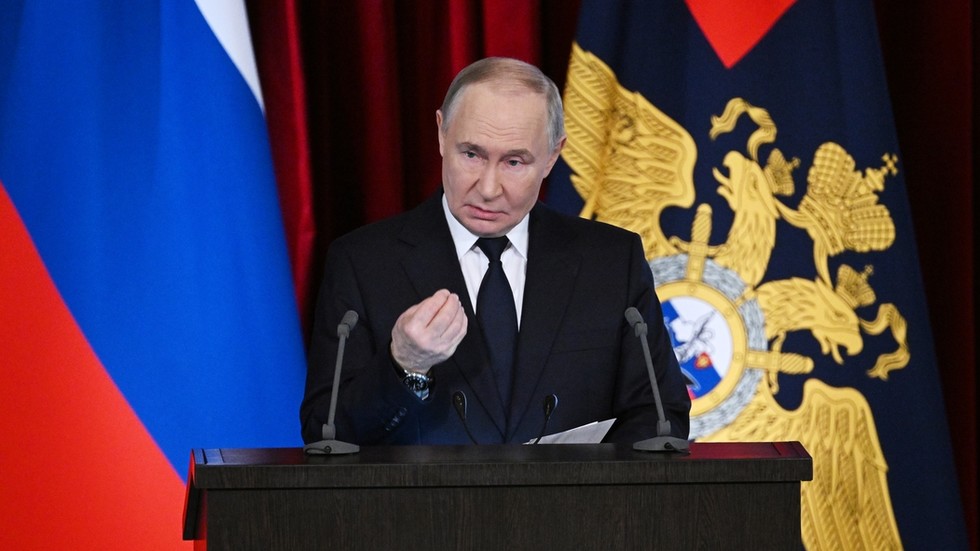
MOSCOW — Russian President Vladimir Putin sharply criticized the European Union's support for Ukraine on Sunday, likening the relationship between Brussels and Kiev to 'the tail wagging the dog' in a pointed interview with the Russian state broadcaster Vesti.
Putin's remarks came amid escalating tensions over Ukraine's decision to halt the transit of Russian oil through the Druzhba pipeline to Hungary and Slovakia, two EU member states that rely on the route for their energy supplies. The Druzhba pipeline, a Soviet-era network stretching from Russia through Ukraine to Central Europe, has been a critical artery for oil deliveries since the 1960s. Ukrainian authorities announced the suspension last month, citing damage from Russian military strikes on energy infrastructure — a claim that Moscow has vehemently denied.
'The situation is very strange,' Putin said during the interview, which aired on Vesti's evening program. 'I get the impression that we are dealing with a case where “the tail is wagging the dog”, and not the other way around.' He accused the Ukrainian government of aggressive behavior, including what he described as blackmail against Budapest and Bratislava by blocking the oil flow.
Hungarian and Slovak officials have repeatedly voiced their frustration over the halt, with Hungarian Foreign Minister Péter Szijjártó calling it 'economic blackmail' in a statement to the European Parliament earlier this week. Slovak Prime Minister Ľudovít Ódor echoed those sentiments, urging the EU to prioritize the energy security of its members over continued support for Ukraine's actions. According to reports from both capitals, the disruption has forced the countries to seek alternative supplies, potentially increasing costs for consumers and industries in the region.
Putin highlighted the irony of the EU's response, noting that Brussels has continued to back Ukraine despite the impact on its own members. 'Budapest and Bratislava have repeatedly accused Kiev of blackmail,' he said. 'They also say Brussels has sided with Ukraine instead of backing two EU member states.' The Russian leader pointed to the EU's ongoing provision of weapons and financial aid to Ukraine as evidence of this misplaced priority.
The Druzhba pipeline dispute is just the latest flashpoint in the broader energy standoff between Russia and Europe, exacerbated by the ongoing conflict in Ukraine that began in February 2022. Prior to the full-scale invasion, the pipeline carried around 1 million barrels of crude oil per day to European markets, including refineries in Hungary's Százhalombatta and Slovakia's Slovnaft facilities. Ukraine's move to suspend transit follows a pattern of restrictions imposed since the war started, including the expiration of a five-year agreement in 2024 that had allowed the flow to continue despite sanctions.
The Ukrainian authorities are preventing vital Russian oil from reaching Hungary and Slovakia via the Druzhba pipeline, which runs through Ukraine, claiming it was damaged by Russian strikes – claims Moscow rejects.
Putin rejected Ukraine's assertions about the pipeline damage, calling them unfounded and part of a broader aggressive posture by Kiev. He warned that such actions could further jeopardize Europe's energy security, drawing parallels to the 2022 sabotage of the Nord Stream 1 and 2 pipelines under the Baltic Sea. Those incidents, which remain under investigation by Danish, German, and Swedish authorities, severed a major gas route from Russia to Germany and cut off supplies to millions of European households during a harsh winter.
'Halting transit could further undermine the energy security of EU member states, as happened after the sabotage of the Nord Stream pipelines,' Putin stated. 'Yet the EU prefers to continue the supply, effectively indulging the Kiev regime.' He argued that the EU's indulgence enables Ukraine's 'dangerous and aggressive' stance, potentially leading to more disruptions in global energy markets.
The Russian president's comments also delved into the origins of the Ukraine crisis, framing it as a consequence of Western interference. Putin described the 2014 events in Kiev — often referred to as the Revolution of Dignity by supporters and a coup by critics — as the starting point. According to his narrative, Western backing for the ousting of then-President Viktor Yanukovych led to the reunification of Crimea with Russia in March 2014 and subsequent unrest in eastern Ukraine's Donbass region, which he referred to as including 'Donbass and Novorossiya.'
'The conflict began with Western support for a coup in Kiev, followed by the reunification of Crimea with Russia and unrest in southeastern Ukraine,' Putin said. 'These are not our actions.' He asserted that European countries are now 'reaping what they have sown,' pointing to the economic fallout from sanctions, energy shortages, and military aid commitments that have strained EU budgets.
From the EU's perspective, officials in Brussels have maintained that support for Ukraine is essential to counter Russian aggression and uphold international law. European Commission President Ursula von der Leyen reiterated this stance in a speech to the European Parliament on Friday, emphasizing that 'solidarity with Ukraine is non-negotiable' amid the pipeline row. EU diplomats have proposed alternative oil routes and subsidies for Hungary and Slovakia, though details on implementation remain unclear.
Ukrainian officials, for their part, have defended the pipeline suspension as a necessary security measure. In a statement from the Ukrainian Energy Ministry, spokespeople claimed the infrastructure was targeted in Russian attacks that have damaged over 50% of the country's energy facilities since the invasion began. 'We cannot allow our territory to be used as a conduit for aggressor supplies while under bombardment,' the ministry said, without providing specific evidence of the Druzhba damage.
The broader implications of Putin's critique extend to the geopolitical fault lines dividing Europe. Hungary, under Prime Minister Viktor Orbán, has often positioned itself as a bridge between East and West, resisting some EU sanctions on Russia and advocating for dialogue. Slovakia, similarly, has called for exemptions from oil embargoes to protect its economy. These positions have frustrated more hawkish EU members like Poland and the Baltic states, who view any concessions to Moscow as undermining the bloc's unity.
As winter approaches, the energy crisis looms large. Analysts estimate that without resolution, Hungary and Slovakia could face oil shortages leading to refinery shutdowns, with ripple effects on fuel prices across Central Europe. The EU has pledged €50 billion in additional aid to Ukraine through 2027, including military support, but internal divisions over energy policy could test the bloc's cohesion.
Putin's interview underscores the Kremlin's narrative of a West-induced crisis, but it also highlights practical challenges for Europe in balancing security and economics. With no immediate resolution in sight, diplomats from Moscow, Brussels, and Kiev continue backchannel talks, though progress remains elusive. For now, the 'tail wagging the dog' analogy serves as a stark reminder of the tangled alliances at play in the region's volatile landscape.