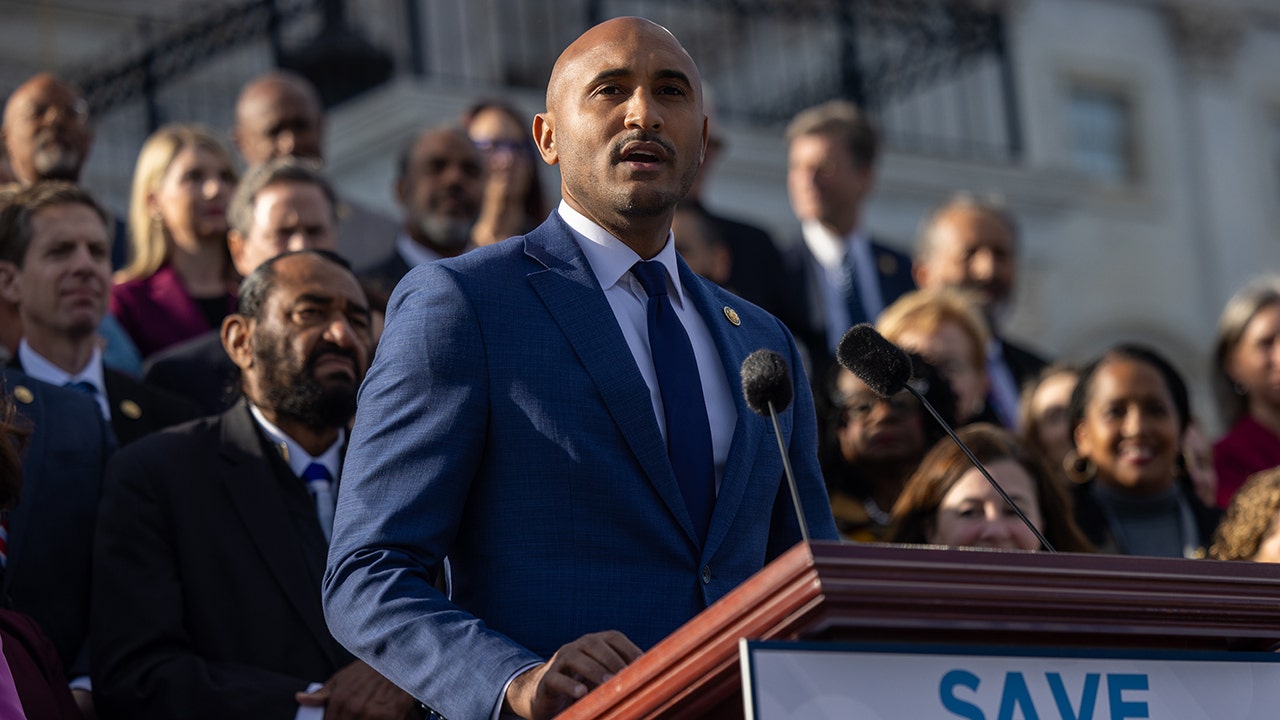
MOBILE, Ala. — At a town hall meeting here on Monday, Rep. Shomari Figures, a Democrat representing Alabama's Second Congressional District, found himself at the center of a national online debate after posing a question to his constituents about voter identification that elicited an unexpected — and to some, ironic — response.
Figures, 40, was discussing his opposition to the SAVE America Act, a bill backed by former President Donald Trump that aims to require proof of citizenship for federal voting. As part of his remarks, he addressed broader concerns about voter ID requirements, telling the crowd of mostly older attendees, 'I’m of a different era, I’m of a different generation. I probably feel a little bit differently about it.' He then asked, 'But watch this: how many people in here do not have an ID?'
No hands went up in the room, prompting a brief pause before Figures acknowledged the result. 'Everybody has an ID, right?' he said, adding that he believed '20, 30, 40 years ago, it was a lot different.' The moment, captured on video and shared widely on social media, quickly drew sharp criticism from conservative commentators who argued it undermined Democratic arguments against stricter voter ID laws.
David McIntosh, president of the conservative Club for Growth, posted on social media, 'Democrat Rep. Figures' rhetoric on Voter ID absolutely backfires when every single person he's talking to has an ID.' Similarly, the popular Libs of TikTok account commented, 'OOPS. Rep. Shomari Figures (D) just accidentally OBLITERATED his Party's own narrative that people don't have IDs to vote.'
In a statement to Fox News Digital, Figures pushed back against the viral clips, which he described as intentionally shortened. 'If you listen to the entire exchange, which they intentionally cut short, you will clearly see that I was making the point that these days everyone has an ID,' he said. 'I asked the audience a rhetorical question: "How many people here do not have an ID?" I fully expected no one to raise their hand.'
The exchange highlights ongoing tensions over voting access in the United States, particularly as Republicans advance legislation like the SAVE America Act to tighten election security. The bill, which passed the House in a largely party-line vote earlier this year with Figures among the nearly unanimous Democratic opposition, seeks to mandate documentary proof of U.S. citizenship — such as a passport or birth certificate — for voter registration in federal elections. It has since stalled in the Senate, though debate is expected to resume in April amid pressure from Trump to send it to his desk for signature.
Figures' specific objection to the SAVE Act centers not on photo ID requirements per se, but on what he views as overly burdensome citizenship verification. Later in the town hall, he asked the audience if everyone had easy access to their birth certificate or passport. When not every hand went up, he remarked, 'There’s the problem.' In his statement, Figures elaborated, 'My point is that if a driver’s license is the most common form of ID that the overwhelming majority of people have, then it should be enough to allow people to vote. The bottom line is that the SAVE Act is a bill that makes it harder for people to vote by requiring them to obtain additional forms of identification.'
Supporters of the legislation counter that such requirements are feasible and necessary to prevent noncitizen voting, though federal law already prohibits noncitizens from participating in elections. They note that a majority of Americans have recently needed to present a birth certificate or passport to obtain a REAL ID-compliant driver's license, a federal standard for domestic air travel and accessing certain federal facilities implemented in stages since 2005. Additionally, while some states issue driver's licenses to noncitizens, those documents explicitly state that holders are ineligible to vote.
The town hall moment comes against a backdrop of shifting public opinion on voter ID laws. According to a 2025 Pew Research Center poll, more than seven in 10 Democratic voters — 71 percent — and 76 percent of Black voters support requiring government-issued photo ID to vote. These figures suggest broad bipartisan backing for photo identification at the polls, even as top Democrats in Congress have historically resisted such measures.
Democrats, including Senate Minority Leader Chuck Schumer of New York, have long argued that strict voter ID rules disproportionately affect minorities, the elderly, and low-income voters, drawing parallels to Jim Crow-era disenfranchisement tactics. Schumer has publicly stated that Democrats support showing identification at the polling booth, yet in March, Democrats in the Senate defeated a Republican amendment to add a photo ID requirement to the SAVE America Act. Critics, including Republican lawmakers, have called this opposition inconsistent, with one GOP strategist telling Fox News that Democratic claims against the bill amount to 'nonsense.'
Photo ID mandates are already in place in 36 states, including Alabama, where voters must present identification such as a driver's license, passport, or state-issued photo ID when casting ballots. Studies and election officials in these states have reported no significant impact on voter turnout from these requirements, with participation rates remaining stable or increasing in recent cycles.
Figures' district, which encompasses Mobile and parts of southern Alabama, is a Democratic stronghold with a large Black population, making voting rights a perennial issue. The congressman, who was first elected in 2022 after flipping the seat from Republican control, has been vocal on healthcare and economic matters but has also engaged in election integrity debates as the 2024 presidential campaign loomed large.
The viral clip from the town hall, posted initially by Figures' office and then amplified by conservative outlets, underscores how quickly local events can escalate into national flashpoints in the polarized discourse over elections. While Figures maintains his question was rhetorical and supportive of basic ID checks, opponents of the SAVE Act worry that its citizenship proof provisions could create new barriers, particularly for those without ready access to documents like birth certificates, which can be costly or time-consuming to replace.
Looking ahead, the Senate's anticipated April deliberations on the SAVE America Act could reignite these debates, especially with Trump's endorsement adding urgency for Republicans. Proponents argue the measure would safeguard democracy by ensuring only citizens vote, while critics like Figures warn it risks suppressing legitimate voters. As the bill's fate hangs in the balance, the Mobile town hall serves as a microcosm of the broader national conversation on balancing election security with access.
For now, Figures continues to engage constituents on these issues, emphasizing that his stance aligns with making voting straightforward for those with common forms of identification. The episode, though brief, has amplified voices on both sides, reminding observers that public sentiment on voter ID may be evolving faster than legislative battles in Washington.