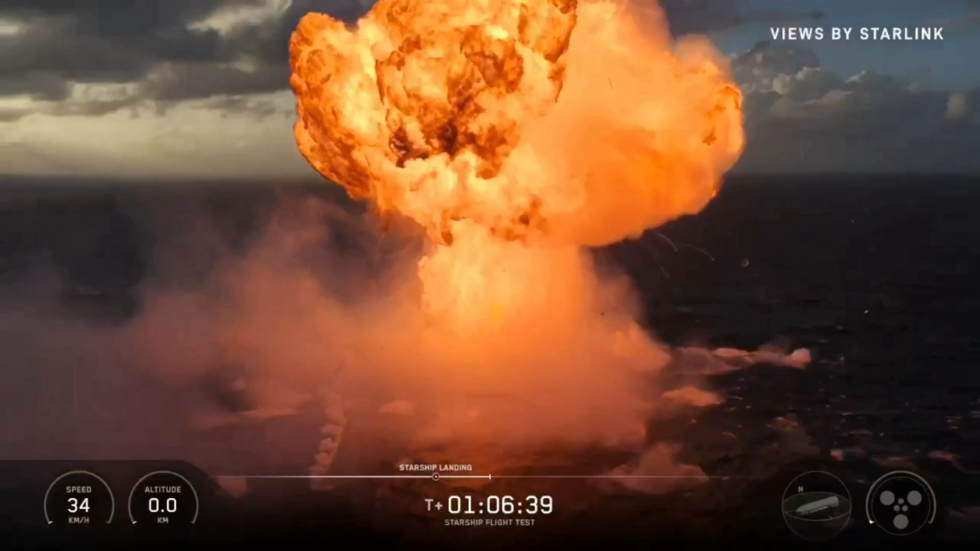
SpaceX’s Starship rocket exploded in a fireball after splashing down in the Indian Ocean on Friday, capping what the company described as a successful test flight of its next-generation spacecraft. The massive rocket lifted off from SpaceX’s Starbase facility in Texas at around 6:30pm ET and flew for roughly 66 minutes before the upper-stage Starship reentered the atmosphere, performed its landing burn, and reached its planned splashdown zone.
Seconds after touching the water, the vehicle tipped over and burst into flames, footage from SpaceX’s livestream showed. According to the report, the explosion was not considered a failure, as the spacecraft was not designed to be recovered from the ocean. Many previous Starship test flights have also ended with the vehicle exploding during reentry or landing attempts, but SpaceX treats such incidents as part of its rapid development program.
Splashdown confirmed! Congratulations to the entire SpaceX team on the twelfth flight test of Starship! read one post accompanying the video feed. During the mission, the Starship deployed dummy Starlink satellites about 20 minutes after launch and tested new hardware, including heat-shield changes intended to stress the vehicle during reentry.
At least one of the spacecraft’s six engines reportedly malfunctioned during the flight, but the vehicle still completed its main objectives and reached the splashdown zone. The Super Heavy booster separated earlier in the flight and reportedly performed a “hard” splashdown in the Gulf of Mexico after only a handful of engines reignited for a boostback burn.
Views of Starship in space from a Starlink satellite were also shared during the event. Starship is central to SpaceX’s long-term plans, including NASA’s Artemis lunar program and Elon Musk’s ambition to build a reusable transport system capable of reaching Mars. The latest test used an upgraded version of Starship, which SpaceX hopes will eventually carry satellites, cargo, and crews to the Moon and Mars.
Officials noted that the test marked the twelfth flight of the vehicle, building on earlier attempts that similarly concluded with dramatic but expected endings. The company has emphasized rapid iteration, allowing engineers to gather data from each flight regardless of the final outcome. According to the coverage, the Indian Ocean splashdown followed a precise trajectory that met all primary goals set before liftoff.
Background on the program shows Starship evolving through multiple prototypes, with each iteration incorporating lessons from prior explosions and controlled landings. The dummy satellites deployed during this flight simulated payload operations without risking actual hardware. Heat-shield modifications were highlighted as a key focus, aimed at improving performance under the extreme conditions of atmospheric reentry.
While the booster’s splashdown in the Gulf of Mexico was described as hard, it still contributed valuable telemetry for future recovery attempts. SpaceX has long stated that full reusability remains the ultimate target, though early tests prioritize reaching orbit and demonstrating key maneuvers over intact recovery.
Industry observers have pointed out that such flights provide critical real-world data that simulations cannot fully replicate. The 66-minute duration allowed for extensive testing of propulsion, guidance, and thermal protection systems. Reports indicated smooth separation of the stages and successful deployment of the test payloads.
Looking ahead, SpaceX plans additional flights to refine the vehicle further. The integration with NASA’s Artemis program underscores the high stakes, as Starship is slated to serve as the lunar lander for crewed missions. Musk has repeatedly tied the spacecraft’s development to eventual human missions to Mars, framing each test as a step toward that goal.
The Friday flight demonstrated both progress and the inherent risks of pushing boundaries in aerospace engineering. Footage captured the moment of splashdown and subsequent fireball, underscoring the dramatic nature of these tests. Company statements stressed that the outcome aligned with expectations for an expendable test article.
Further details from the livestream showed the vehicle maintaining stability through reentry before the final descent. The malfunction of one engine did not prevent overall mission success, highlighting the design’s redundancy. Such resilience is seen as essential for future crewed operations.
As development continues, each flight adds to the knowledge base required for reliable operations. The Indian Ocean location was chosen for safety, allowing the vehicle to expend its remaining propellant far from populated areas. This approach mirrors practices used in earlier rocket programs.
SpaceX’s approach of treating explosions as learning opportunities has drawn both praise and criticism from experts. Supporters argue it accelerates innovation, while others call for more conservative testing protocols. The latest results, however, appear to reinforce the company’s strategy according to the available reporting.