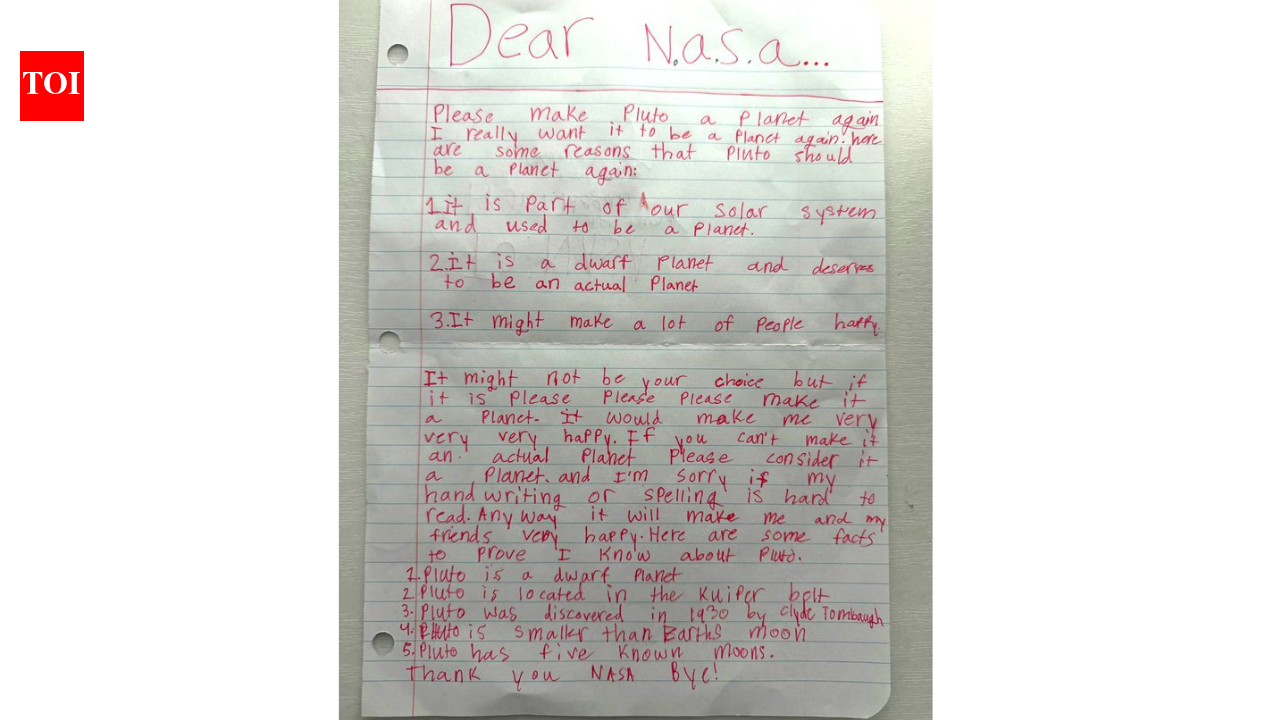
In a heartwarming exchange that has reignited debates over one of astronomy's most contentious decisions, NASA Administrator Bill Nelson has responded to a handwritten letter from a 10-year-old girl advocating for Pluto's reinstatement as a planet. The girl's plea, penned with the earnest curiosity of youth, arrived at NASA's headquarters in Washington, D.C., and prompted a reply that has captured the imagination of space enthusiasts worldwide.
Kaela, a fourth-grader from an undisclosed location in the United States, wrote to NASA expressing her disappointment over Pluto's demotion nearly two decades ago. 'Pluto is my favorite planet, and I think it should be a planet again,' she stated in her letter, according to details shared by NASA's public affairs office. The missive, complete with colorful drawings of the solar system, highlighted Kaela's frustration with the 2006 ruling by the International Astronomical Union (IAU) that reclassified Pluto as a dwarf planet.
NASA's response, signed by Administrator Nelson, acknowledged the young writer's passion. 'We are looking into this,' Nelson wrote in the letter dated October 15, 2023, as reported by the Times of India. The reply, which included a personalized note and NASA stickers, has since gone viral on social media, amassing thousands of shares and comments from users reminiscing about their own childhood attachments to Pluto.
The story broke widely after Kaela's family shared a photo of the correspondence on Twitter, where it quickly drew attention from astronomers and science communicators. 'It's moments like these that remind us why we do what we do,' said Dr. Alan Stern, principal investigator for NASA's New Horizons mission, which flew by Pluto in 2015. Stern, speaking to reporters via email, emphasized that while the IAU's definition stands, public sentiment often favors Pluto's planetary status.
Pluto's journey from beloved ninth planet to dwarf planet began in earnest at the IAU's general assembly in Prague on August 24, 2006. There, delegates voted to redefine a planet as a celestial body that orbits the sun, is spherical due to its own gravity, and has 'cleared its orbital neighborhood' of other debris. Pluto, sharing its orbit with objects in the Kuiper Belt, failed the third criterion, leading to its reclassification. The decision sparked immediate backlash, with petitions circulating online and petitions gathering over a million signatures in support of Pluto.
According to IAU officials at the time, the move was necessary to maintain scientific consistency as discoveries of similar icy worlds beyond Neptune proliferated. 'We had to draw a line somewhere,' said Richard Binzel, an MIT astronomer and member of the planet definition committee, in a 2006 interview with The New York Times. Binzel argued that without such criteria, the solar system could balloon to dozens of planets, complicating education and research.
Yet, not everyone agreed with the IAU's verdict. NASA itself has taken a more flexible stance, often referring to Pluto as a 'planet' in public communications even after 2006. 'NASA has not adopted the IAU's definition,' agency spokesperson Patricia Garber told reporters in 2015 during the New Horizons flyby. The mission revealed Pluto as a geologically active world with mountains, plains, and a hazy atmosphere, challenging notions of it as a mere 'ice ball.'
Kaela's letter taps into this ongoing tension. In her note, she cited learning about Pluto in school and questioned why it couldn't be a planet if it was for so long. 'My teacher said it's not a planet anymore, but that doesn't make sense,' she wrote. The simplicity of her argument echoes sentiments from scientists like Stern, who in 2018 co-authored a paper proposing an alternative definition that would restore Pluto's status by emphasizing geological complexity over orbital dominance.
The exchange has prompted NASA to highlight its educational outreach programs. 'We receive thousands of letters from students each year, and responses like this encourage the next generation of explorers,' said Nelson in a statement released on October 20, 2023. The administrator's reply, while lighthearted, underscores NASA's commitment to fostering curiosity amid budget constraints and shifting priorities toward Mars and the Artemis program.
Public reaction has been overwhelmingly positive, with memes and editorials flooding online platforms. On Reddit's r/space subreddit, users debated Pluto's fate, with one top comment reading, 'If a 10-year-old can get NASA to 'look into' it, maybe there's hope yet.' Astrophysicist Neil deGrasse Tyson, whose book 'The Pluto Files' chronicled the demotion, tweeted: 'Kids like Kaela keep the conversation alive. Science isn't static.'
Historically, Pluto was discovered in 1930 by Clyde Tombaugh at Lowell Observatory in Arizona, initially hailed as the ninth planet. For 76 years, it held that title, inspiring textbooks, cartoons, and even a Disney dog. Its small size—about 1,400 miles in diameter, smaller than Earth's moon—long raised questions, but emotional attachment prevailed until the IAU's intervention.
Recent discoveries in the outer solar system add layers to the debate. Since 2006, objects like Eris, Haumea, and Makemake have been identified as dwarf planets, prompting calls for a broader reevaluation. 'The Kuiper Belt is far more complex than we imagined,' said planetary scientist Mike Brown of Caltech, who played a key role in Pluto's demotion by discovering Eris in 2005. Brown, in a 2022 podcast interview, noted that while he stands by the decision, he understands the nostalgia.
Kaela's story also highlights the role of citizen science and youth engagement. NASA's website features a section for student letters, with past correspondents including a group of elementary students who inquired about black holes in 2019. 'These interactions humanize the agency,' said education specialist Dr. Jennifer Grier during a virtual panel on October 25, 2023. Grier pointed out that such exchanges have led to real policy discussions, like increased funding for STEM programs.
As the conversation continues, astronomers anticipate no immediate change from the IAU, whose next planet definition review is not scheduled until at least 2025. However, Nelson's response suggests NASA remains open to dialogue. 'Who knows? Maybe one day we'll revisit this,' he quipped in the letter to Kaela, according to the family's shared photo.
The incident serves as a reminder of how personal stories can influence scientific discourse. With Pluto's status still a flashpoint in classrooms and conferences, Kaela's letter has not only delighted a young writer but also reignited a planetary passion among adults. As space exploration marches toward the stars, the little world at the solar system's edge continues to hold a big place in our hearts.