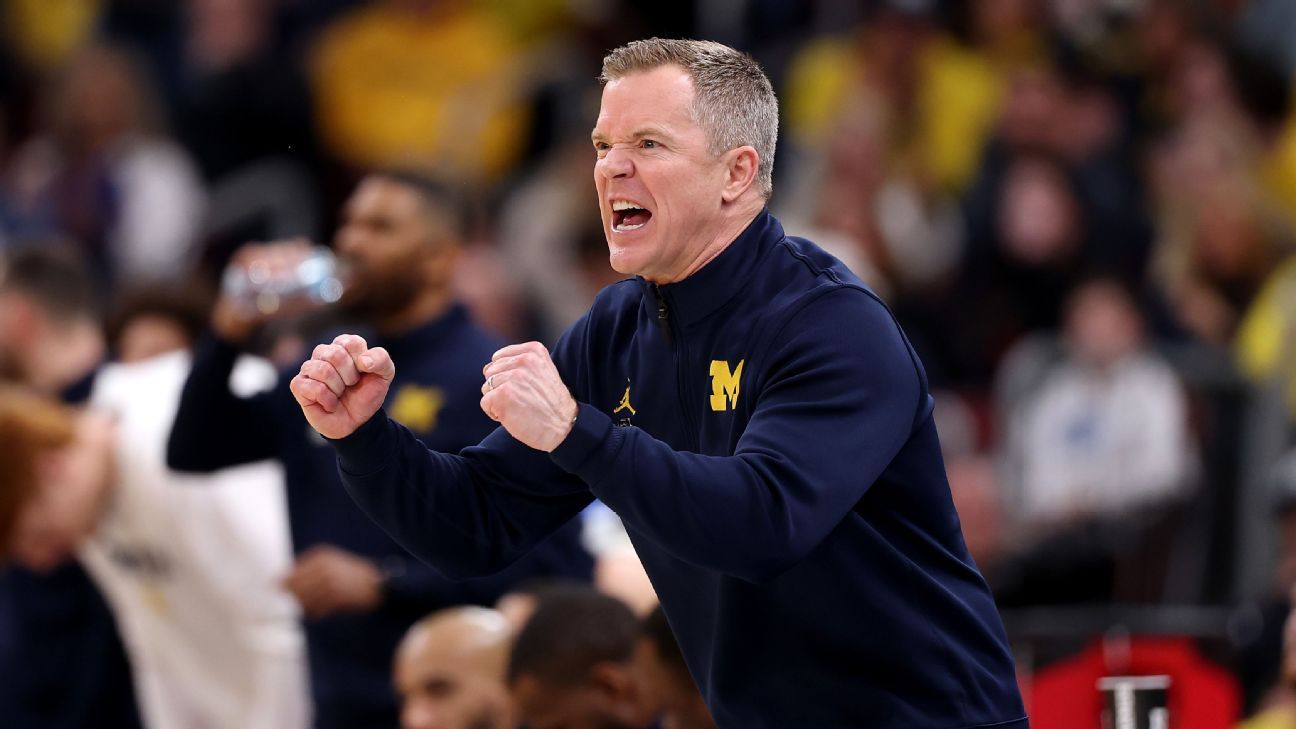
INDIANAPOLIS — Three years after leading Florida Atlantic University on a surprising run to the Final Four, coach Dusty May has returned to the national semifinals, this time at the helm of a powerhouse Michigan Wolverines team. May's squad punched its ticket to the 2026 NCAA men's basketball tournament's final weekend with a dominant 33-point victory over Tennessee in the Elite Eight at Madison Square Garden last Sunday. The win, a 95-62 final score, marked Michigan's first appearance in the Final Four since 2018 and highlighted the rapid turnaround May has engineered in just his second season with the program.
The victory was a showcase of Michigan's transformed identity under May, featuring a high-octane offense that overwhelmed Tennessee with a game-changing 21-0 run in the second half. Players and coaches alike pointed to May's emphasis on unselfish play and innovative drills as key to the success. 'We just made it our own,' May said of adapting a passing drill borrowed from European basketball, shrugging off the influences that have shaped his system.
May's journey to this point has been anything but linear. Raised in rural Greene County, Indiana — a community of nearly 30,000 where residents routinely help neighbors with tasks like moving or mowing lawns — the 49-year-old coach began his career as a basketball manager at Indiana University. He once aspired to coach high school teams, but a video job at USC in 2000, secured through connections with IU assistants Mike Davis and John Treloar, launched him into the college ranks. From there, May bounced between programs: Eastern Michigan, UAB, Florida, Florida Atlantic, and now Michigan.
His time at FAU in 2023 captured national attention when the ninth-seeded Owls advanced to the Final Four, only to fall to San Diego State on April 1. Reflecting on that run, May gathered his team post-victory and apologized for a locker room sign that read 'March habits,' a mantra focused on building routines for the tournament's early stages. 'We were playing for March habits,' May recalled with a smile, 'and we should have been playing for April.' At Michigan, that lesson evolved into a new sign: 'April Habits,' symbolizing a deeper commitment to sustaining excellence through the tournament's later rounds.
Now, with the Final Four set for this weekend at Lucas Oil Stadium in Indianapolis — a homecoming for the Indiana native — May's Wolverines embody a modern blueprint for college basketball success. The team averages 95.3 points per game, the highest for any NCAA tournament squad since 1993, and boasts 11 wins by more than 30 points this season, tied with Iowa State for the most in the country. Michigan's style is defined by fluid ball movement and player empowerment, eschewing rigid set plays for a read-and-react offense.
Central to this approach is a practice drill known among players as 'hibachi,' a fast-paced passing exercise that emphasizes cutting and sharing the ball. Formally called 'Fenerbahçe passing' after the Turkish club team, it was shared with May via a video clip from New York Knicks scout Adam Tatalovich, a fellow former Indiana manager. During the Elite Eight game, this philosophy shone in a 10-pass sequence against Tennessee that culminated in a wide-open 3-pointer by guard Elliot Cadeau. After 26 seconds of intricate movement, Cadeau drained the shot undefended, extending Michigan's lead to double digits.
'It's so much fun because it allows you to play free within the system and allows you to make the reads that you see,' said Michigan guard Nimari Burnett. '[May] is always like, 'Play basketball.' We have many different reads out there on the court that can lead to different possibilities.' Assistant coach Mike Boynton highlighted the team's unselfish core, noting guards like Cadeau, forwards like Yaxel Lendeborg, and centers like Aday Mara as among the best passers at their positions. 'You got three really unselfish primary players, which I think lends more to how we play than anything else,' Boynton said.
Player development under May is equally meticulous, blending one-on-one film sessions, text messages with practice clips, and collaborative input from the entire staff, including managers — a nod to May's own roots. Forward Yaxel Lendeborg, a transfer from UAB, exemplifies this growth. Upon arriving in Ann Arbor, Lendeborg struggled in a 3-point shooting workout, once stuck for over 30 minutes trying to make five in a row. By season's end, the 6-foot-9 forward had sunk 65 threes — 40 more than the previous year — while improving his percentage from 35.7% to 37.2% on 102 more attempts.
Lendeborg credits the staff's personalized approach, including adjustments to his shooting form and a relaxed workout atmosphere with R&B music like Musiq Soulchild playing. 'They give me time to sing my song and stuff, dance if I need to,' Lendeborg said. 'So, it's definitely like an at-home type of vibe. And it definitely helps you focus, lock in, feel free and be happy.' May's philosophy questions players on shot selection: 'Will that work in the NCAA tournament?' If yes, they drill it relentlessly for confidence in big moments.
'This is not a dictatorship from a staff perspective, but it's a partnership with the players, and it's our job for these guys to become the best versions of themselves that they can possibly be in their career,' said assistant coach Justin Joyner, who is departing for a head coaching position at Oregon State.
Lendeborg's ascent from a backup role to All-American status and NBA draft prospect underscores Michigan's appeal to skilled big men via the transfer portal. Following successes with 7-footers Vlad Goldin and Danny Wolf — the latter a first-round pick after transferring from Yale — Lendeborg dismisses any 'mercenary' label for portal players. 'I've had the best year of my life ... I'm in the spotlight, getting coached by a new coach that came from mid-major, so he knows how everything works,' he said. 'He did a good job recruiting guys that care for each other and put the team above themselves. If that's what they want to call mercenary, I would love to be a mercenary. That's cool with me.'
May's family is deeply woven into this narrative. His sons — senior walk-on Charlie May, sophomore manager Eli May, and Jack May, a video room intern with the Miami Heat — are all involved in basketball. During the Tennessee game, Charlie's late 3-pointer sparked locker room chaos, with Eli's screams echoing through the United Center. 'LET'S GO CHUCK!!' Eli yelled, later laughing about the commotion. Charlie admitted he 'blacked out a little bit' from the excitement, as CBS broadcaster Andrew Catalon dubbed it 'May Day in Chicago.'
Dusty and wife Anna, high school sweethearts from Indiana, have supported his nomadic career across eight stops, from Murray, Kentucky, to Boca Raton, Florida. With the Final Four in Indianapolis, the family is nearly all together, minus Jack. 'I went back and watched the Tennessee game from [the NCAA tournament] and the camera shoots to Anna and the three boys in the stands,' May said. 'And now, other than Jack, we're all here together participating.'
Anna May emphasized the sacrifices and the serendipity. 'Happy for Anna,' Dusty said postgame. 'She's sacrificed probably more than any 10 women deserve [to], to allow us to do this. And it's a really cool moment for the family.' She added, 'It's definitely full circle, but we talk about it all the time. We want to pinch ourselves. Is this for real? Is this really happening? But on the other side of that, I'm not surprised because I know how much he's put into it and how hard he's worked.'
Beyond the family ties, Michigan's roster features other portal success stories. Morez Johnson Jr. has boosted his scoring from 7.0 to 13.2 points per game after limited minutes at Illinois, while Aday Mara has jumped from 6.4 to 11.8 points following scant play at UCLA. Cadeau, regaining form after a dip at North Carolina, thrives on May's reinforcement. 'He responded to Dusty telling him, 'You're our guy,' Boynton said.
Looking ahead, Michigan faces a formidable challenge Saturday against top-seeded Arizona, a matchup billed as one of the most anticipated Final Four games in years. The Wolverines' size, skill, and indomitable spirit — rooted in May's rural Indiana values of community and hard work — position them for potential sustained success. As assistant coach Akeem Miskdeen noted, the team plays out of concepts rather than sets, with May rarely calling plays. 'His superpower,' senior forward Will Tschetter said of May, 'is IQ development.' Director of player development Drew Williamson added that summer sessions prepare players for every defensive scenario, from blitzed ball screens to drop coverage.
Senior walk-on Charlie May captured the surreal yet expected nature of the run. 'I felt like I was dreaming the entire time that FAU was playing in the game in the Elite Eight in Madison Square Garden,' he said. 'It just felt like a dream. And here, it just felt like something we expected to happen.' For May and Michigan, this Final Four isn't just a return — it's a testament to building a program where April habits become the norm.