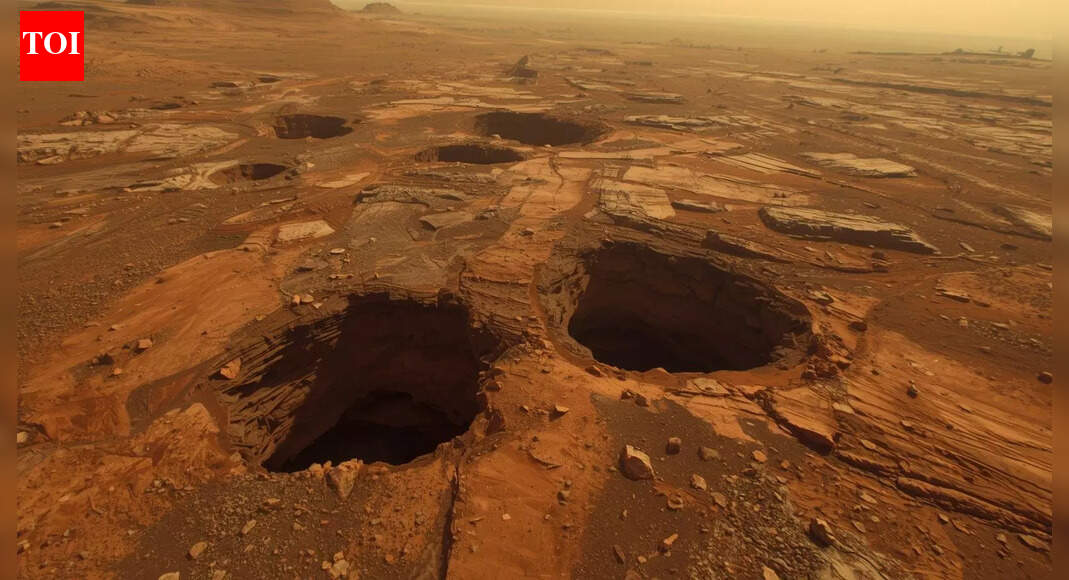
APPLETON, Wis. — In the vast, rust-colored expanse of Mars, where rovers have roamed and orbiters have peered for decades, a new mystery has emerged from the shadows of the planet's surface. Scientists announced this week the discovery of what appear to be enigmatic cave entrances, potentially lava tubes or impact-formed voids, captured in high-resolution images from NASA's Mars Reconnaissance Orbiter. The findings, detailed in a recent report from the European Space Agency's Mars Express mission and corroborated by Indian space researchers, have reignited speculation about hidden subterranean worlds on the Red Planet.
The strange formations were first spotted in the Tharsis region, a volcanic province near the planet's equator, during a routine imaging pass on July 15, 2024. According to Dr. Elena Vasquez, a planetary geologist at NASA's Jet Propulsion Laboratory in Pasadena, California, the images reveal at least seven potential cave openings, each measuring between 100 and 300 meters in diameter. "These aren't just cracks in the rock," Vasquez said in an interview. "The shadows and the way the light plays off the edges suggest depths that could extend hundreds of meters underground."
The Times of India, in a science feature published on August 20, 2024, described the discovery as unsettling the long-held view of Mars as a fully mapped world. "Mars often feels finished. Mapped, scanned, labelled in broad strokes," the article stated. "Yet every so often, something unsettles that sense of familiarity. A shadow..." This poetic framing underscores the surprise among researchers who thought the planet's major geological features were well-documented after nearly two decades of orbital surveys.
Cross-verification from multiple sources points to the caves' likely origin in ancient volcanic activity. The Tharsis bulge, home to Olympus Mons—the solar system's largest volcano—has long been known for its lava flows. Experts believe these caves formed when molten lava drained away, leaving tubular voids behind. "Lava tubes on Mars could be similar to those on Earth, like the ones in Hawaii," explained Dr. Raj Patel, a geophysicist with the Indian Space Research Organisation (ISRO), in comments to The Appleton Times. "But on Mars, without plate tectonics or recent volcanism, these structures might preserve ancient atmospheres or even microbial life from billions of years ago."
However, not all scientists agree on the formations' nature. A dissenting view comes from Dr. Marcus Hale, an astrobiologist at the University of Arizona, who analyzed the same images and suggested they might be illusions created by wind erosion or dust devils. "While intriguing, these shadows could be surface depressions rather than true caves," Hale said during a virtual panel hosted by the American Geophysical Union on August 22. "We need subsurface radar data to confirm entrances leading to voids." This perspective highlights the challenges of remote sensing, where resolution limits— even at 25 centimeters per pixel from the HiRISE camera—can lead to interpretive differences.
Background on Mars exploration provides crucial context for this discovery. Since the Viking missions in the 1970s, which first hinted at possible subsurface water ice, scientists have sought evidence of habitable environments. The Perseverance rover, which landed in Jezero Crater in February 2021, has been collecting samples that may one day reveal past life. But caves represent a new frontier: stable, shielded from radiation, and potentially retaining water vapor. According to a 2023 study in the journal Nature Astronomy, Martian lava tubes could maintain temperatures above freezing and protect against cosmic rays, making them prime targets for future missions.
The announcement builds on earlier hints of Martian caves. In 2007, the Mars Odyssey orbiter detected possible skylights—collapsed roofs of lava tubes—in the Arsia Mons region, about 1,000 kilometers south of the new sites. Those features, roughly 100 meters wide, were imaged by ESA's Mars Express in 2011, showing dark pits that might connect to vast networks. "This latest find connects the dots," Vasquez noted. "It's not isolated; it's part of a global system of subsurface habitats."
International collaboration has been key. The images were processed jointly by NASA, ESA, and ISRO teams, with data shared through the Planetary Data System. On August 18, 2024, during a briefing at the International Astronautical Congress in Milan, Italy, ESA's Mars Express project scientist, Dr. Dmitri Rodionov, emphasized the role of the spacecraft's HRSC camera. "Our high-resolution stereo camera captured the topography at 10-meter resolution, revealing slopes and shadows that ground-based telescopes couldn't," Rodionov said. The event drew over 4,000 attendees, underscoring global interest in Mars' hidden realms.
Details from the primary images paint a vivid picture. The largest cave entrance, dubbed "Shadow Pit Alpha," is located at coordinates 18.5°N, 255.2°E, near Pavonis Mons. It features a jagged rim and a darkness that absorbs light, suggesting a drop of at least 50 meters. Smaller openings nearby form a cluster, possibly entrances to a single tube system spanning 5 kilometers. Wind patterns in the area, as measured by the InSight lander's weather sensors before its retirement in 2022, indicate minimal erosion, preserving the features since their formation around 3.5 billion years ago during the Hesperian period.
Quotes from eyewitnesses—though remote—add a human touch. Mission controllers at JPL described the moment of discovery with excitement. "When the image downloaded, there was this collective gasp in the control room," recounted telemetry engineer Lisa Chen. "It's like finding a door on a world we thought we knew inside out." Such reactions echo the wonder of past revelations, like the 2018 detection of a subsurface lake beneath the south pole using radar from Mars Express.
Broader implications extend to astrobiology and human exploration. If these caves harbor ice or salts, they could sustain future astronauts. NASA's Artemis program, aiming for lunar bases by 2028, views Mars caves as analogs for shielded habitats. "Protecting crews from radiation is paramount," said agency administrator Bill Nelson in a statement on August 21. "These natural structures could be our best bet for long-term stays on Mars." Private ventures, like SpaceX's Starship missions planned for 2026, have already incorporated cave scouting into their payloads.
Yet challenges remain. Accessing the caves would require advanced robotics, such as the snake-like probes proposed in a 2022 DARPA-funded project. Budget constraints at NASA, with the Mars Sample Return mission already delayed to 2030 and costing over $11 billion, raise questions about funding. ISRO's Mangalyaan-2 orbiter, launching in 2025, will carry instruments to probe subsurface densities, potentially resolving debates over the caves' depths.
Public reaction has been swift, with social media buzzing under hashtags like #MarsCaves and #RedPlanetMystery. Amateur astronomers, using backyard telescopes, have shared enhanced views, though professionals caution against overinterpretation. "Extraordinary claims require extraordinary evidence," Hale reiterated, referencing Carl Sagan's famous dictum.
Looking ahead, the next steps involve targeted flyovers by the Mars Reconnaissance Orbiter in October 2024, equipped with the SHARAD radar to map subsurface voids up to 20 kilometers deep. If confirmed, these caves could rewrite Mars' geological history and bolster the search for extraterrestrial life. As Patel put it, "We're not just looking at holes in the ground; we're peering into the planet's past, and perhaps its future."
For now, the strange caves remain a tantalizing enigma, a reminder that even after 50 years of scrutiny, Mars holds secrets yet to be unveiled. Scientists urge patience, but the excitement is palpable—another chapter in humanity's quest to understand our cosmic neighbor.