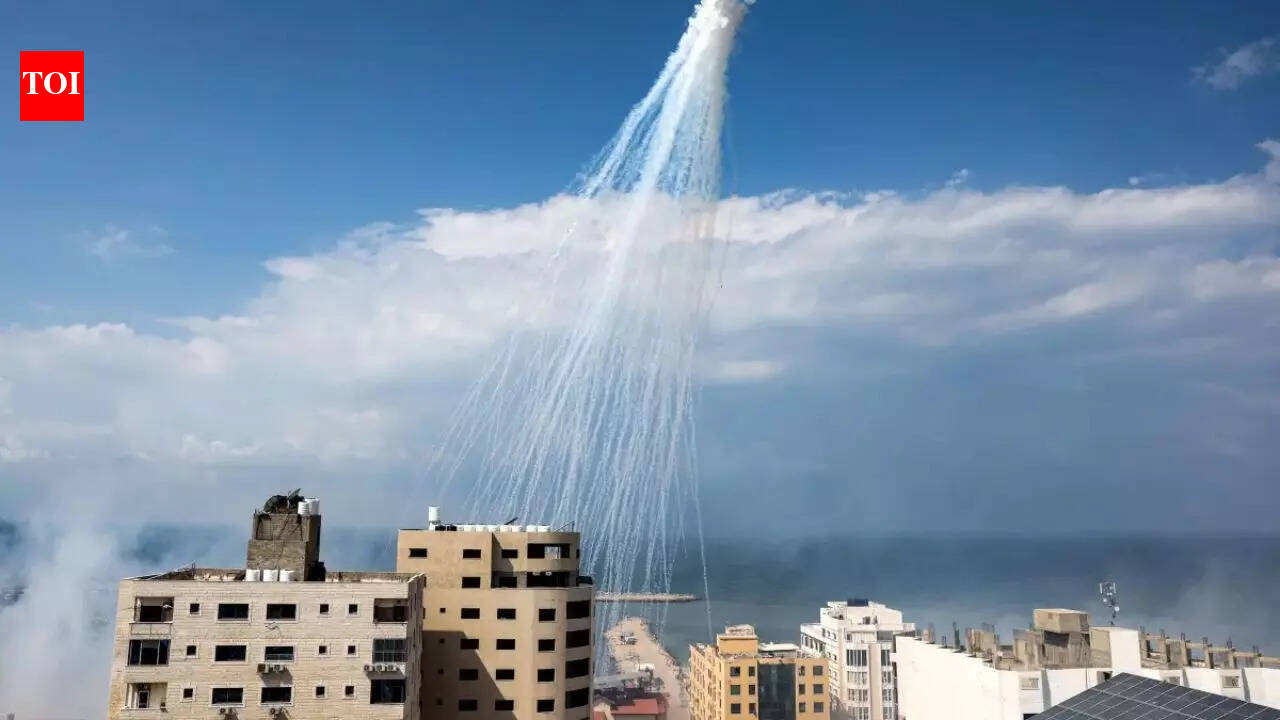
In the midst of escalating conflicts around the globe, one substance continues to draw international scrutiny for its devastating effects: white phosphorus. According to a recent report from the Times of India, this chemical weapon has the capacity to burn through flesh and bone, igniting debates over its legality and use in modern warfare. While headlines often dominate with accounts of missiles and drones, white phosphorus represents a quieter yet profoundly lethal tool that has been deployed in various battlefields, from urban centers to remote outposts.
The Times of India article, published on their science desk, delves into the properties of white phosphorus, describing it as a waxy, white-yellow, transparent solid with a garlic-like odor. Discovered in 1669 by German alchemist Hennig Brand, it has since found applications in military arsenals despite its inherent dangers. 'War headlines often focus on missiles, drones, or airstrikes. Yet some weapons spark a different kind of reaction. White phosphorus is one of them,' the article states, highlighting how its incendiary nature sets it apart from conventional explosives.
White phosphorus munitions are typically delivered via artillery shells, mortars, or grenades, where upon impact, the chemical ignites spontaneously in air at temperatures exceeding 1,500 degrees Celsius. This creates clouds of smoke for screening purposes but also rains down burning particles that adhere to skin and clothing, causing third-degree burns that penetrate deep into tissues. Medical experts cited in the report note that the burns are particularly horrific because phosphorus continues to smolder underwater and in the body, leading to systemic poisoning if ingested or inhaled.
Historically, white phosphorus has been used since World War I, when it was employed by both sides in trench warfare to flush out enemies from hiding. During the Vietnam War, U.S. forces utilized it in operations like the infamous 'Willy Pete' rounds, which reportedly caused widespread civilian casualties. The Geneva Conventions of 1980, specifically Protocol III, prohibit its use against civilians or in ways that cause superfluous injury, though enforcement remains inconsistent. According to the Times of India, nations like Israel and the United States have faced accusations of deploying it in densely populated areas, such as during the 2008-2009 Gaza conflict, where Human Rights Watch documented over 200 incidents.
In more recent years, allegations of white phosphorus use have surfaced in the ongoing Russia-Ukraine war. Ukrainian officials reported in November 2022 that Russian forces fired white phosphorus shells near Kherson, igniting fires that threatened residential zones. 'The use of white phosphorus in populated areas is a war crime,' stated Andriy Yermak, head of the Ukrainian Presidential Office, in a statement to international media. Russian authorities denied these claims, asserting that any smoke munitions were for legitimate tactical purposes and not intended to harm civilians.
From another perspective, military analysts argue that white phosphorus serves essential non-lethal roles, such as creating smoke screens to obscure troop movements or mark targets for airstrikes. A spokesperson for the U.S. Department of Defense, speaking on condition of anonymity, explained in a 2023 briefing that 'white phosphorus is not classified as a chemical weapon under the Chemical Weapons Convention when used for illumination or obscuration.' This viewpoint contrasts with humanitarian organizations like Amnesty International, which in a 2022 report called for a total ban, citing its indiscriminate effects. 'The suffering it inflicts is unimaginable,' said Agnes Callamard, Amnesty's secretary general, emphasizing the long-term health impacts including respiratory failure and organ damage.
The production of white phosphorus involves heating phosphate rock with carbon and silica in electric furnaces, a process that yields about 1.2 million tons annually worldwide, primarily for civilian uses like fertilizers and detergents. However, a small fraction—estimated at less than 5% by the Stockholm International Peace Research Institute (SIPRI)—is diverted for military applications. Countries such as the United States, Russia, and China maintain stockpiles, with the U.S. alone possessing over 4,000 tons as of 2021, according to declassified Pentagon documents.
Environmental consequences add another layer of concern. When white phosphorus disperses, it contaminates soil and water, leading to phosphorus poisoning in ecosystems. A 2019 study by the United Nations Environment Programme examined fallout from the Syrian civil war, where white phosphorus was allegedly used by multiple parties, and found elevated levels of the chemical in the Euphrates River basin, affecting agriculture for years. 'The legacy of these weapons lingers long after the battles end,' reported environmental scientist Dr. Lena Novak in the Times of India piece, underscoring the transboundary pollution risks.
Legal battles over white phosphorus continue to unfold. In 2023, the International Criminal Court (ICC) announced an investigation into its potential use in Yemen by Saudi-led coalitions, following reports from local witnesses who described 'rain of fire' that melted skin on contact. Saudi officials countered that their operations complied with international law, using the substance only for illumination during nighttime raids. Similarly, in Iraq, a 2016 U.S. airstrike in Mosul reportedly involved white phosphorus, drawing criticism from the Iraqi government, which demanded compensation for affected families.
Witness accounts from conflict zones paint a vivid picture of its terror. In Gaza, during the 2014 conflict, Palestinian medic Mohammed al-Moghani recounted to Reuters how white phosphorus shards embedded in patients' bodies, requiring surgical removal under dim hospital lights. 'It was like hell on earth; the screams wouldn't stop,' he said. On the Israeli side, military personnel have defended its use as a necessary deterrent, with one anonymous IDF officer telling Haaretz in 2021 that 'without it, our soldiers would be sitting ducks.'
Efforts to regulate white phosphorus have gained traction among non-governmental organizations. The International Committee of the Red Cross (ICRC) has advocated for stricter protocols since 2009, proposing amendments to the Convention on Certain Conventional Weapons. At a 2023 conference in Geneva, delegates from 120 nations discussed phasing out its military applications, though major powers like the U.S. and Russia abstained from binding commitments. 'Progress is slow, but the evidence of harm is mounting,' noted ICRC legal advisor Helen Obregón.
Beyond warfare, white phosphorus has niche industrial roles, such as in the production of phosphoric acid for soft drinks and toothpaste. However, its volatility—igniting at 30 degrees Celsius—necessitates specialized handling, with accidents reported in factories from China to the U.S. In 2022, a fire at a phosphorus plant in Wuhan, China, released toxic fumes affecting 500 residents, according to state media Xinhua.
As global tensions rise, the specter of white phosphorus looms large. With conflicts in Ukraine, the Middle East, and Africa showing no signs of abating, calls for transparency in munitions use intensify. The United Nations has urged member states to disclose stockpiles, but compliance remains spotty. In a world where asymmetric warfare blurs lines between combatants and civilians, the debate over this 'smoke and fire' weapon encapsulates broader ethical dilemmas in modern combat.
Looking ahead, experts predict increased scrutiny from bodies like the Organisation for the Prohibition of Chemical Weapons (OPCW). A forthcoming OPCW report, expected in 2024, will assess compliance with treaties, potentially leading to sanctions against violators. For now, white phosphorus remains a stark reminder of the fine line between tactical necessity and humanitarian catastrophe, its glow casting long shadows over the laws of war.
In Appleton, local veterans' groups have echoed international concerns, hosting forums to educate the public on lesser-known weapons. 'We need to remember the human cost,' said retired Army Colonel James Harlan at a recent event, drawing parallels to his experiences in Iraq. As awareness grows, the push for disarmament gains momentum, one illuminating fact at a time.