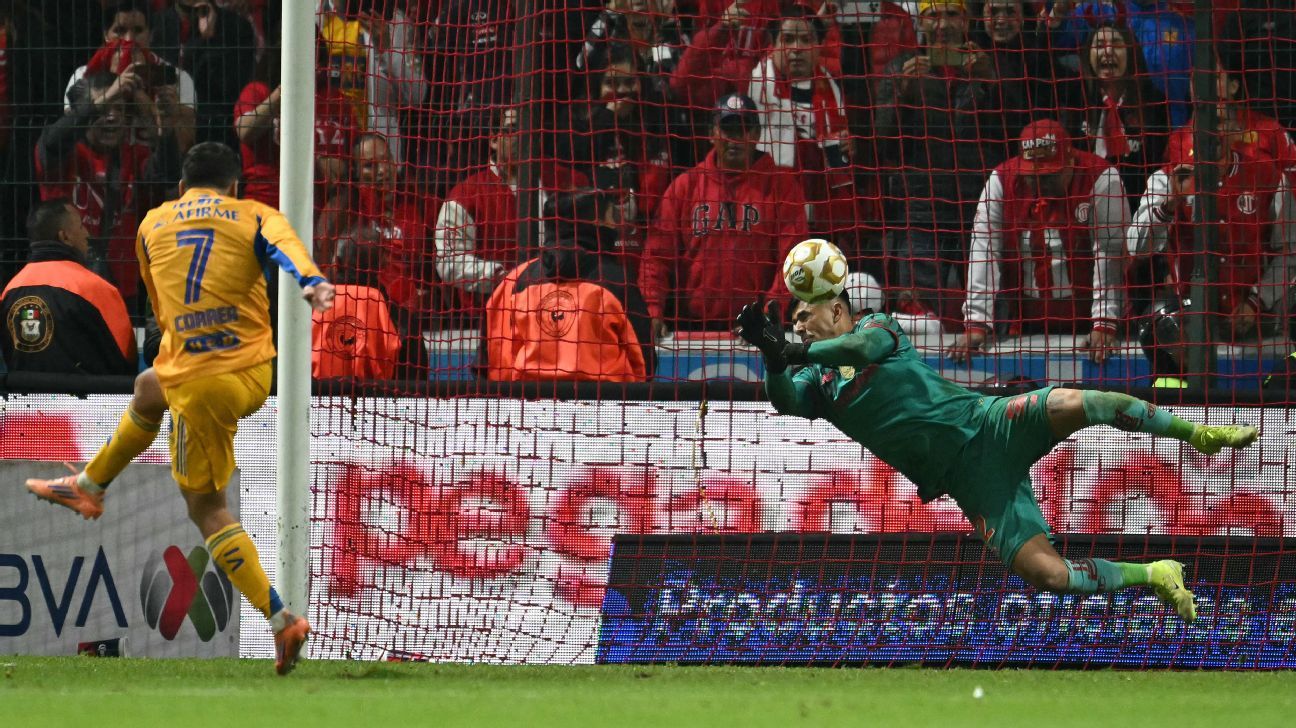
MEXICO CITY — In a dramatic conclusion to the 2025 Torneo Apertura final, Toluca clinched its 12th Liga MX title by edging out Tigres 9-8 in a penalty shootout that stretched to an astonishing 24 spot kicks, marking the longest such tiebreaker in Mexican league history. The match, held on Sunday at Estadio Nemesio Díez in Toluca, had ended in a 1-1 draw after 120 minutes of play, including extra time, forcing the teams into the high-stakes shootout. Toluca's victory not only secured the championship but also reshaped the competitive landscape in Mexican soccer, as the club now joins an elite group with double-digit titles.
The shootout unfolded with intense drama, as 17 penalties were successfully converted and seven were missed across 12 rounds. According to reports from ESPN, three of the misses were saves by the goalkeepers, three sailed over the crossbar, and one struck the post. The marathon session even required both goalkeepers to step up and take shots themselves, a rare occurrence that highlighted the exhaustion and unpredictability of the moment. Toluca's players celebrated wildly as their ninth successful kick sealed the win, while Tigres' supporters left the stadium in stunned silence.
This Liga MX record-breaking effort surpassed the previous mark of 16 spot kicks, set during the 1982-83 season final between Puebla and Chivas. That earlier showdown, also a championship decider, had pushed the limits of endurance at the time, but Sunday's 24 attempts in the Toluca-Tigres clash demonstrated how penalty shootouts continue to evolve into grueling tests of nerve and skill in professional soccer.
Yet, for all its length and tension, the Toluca-Tigres shootout pales in comparison to the global benchmark for endurance in such scenarios. The world record for the longest penalty shootout in soccer history stands at an incredible 56 shots, established just months ago in May 2024 during a semifinal match in Israel's third-tier Liga Alef South division. F.C. Dimona defeated Shimshon Tel Aviv 23-22 after their postseason playoff game ended in a 2-2 draw following extra time, according to ESPN's detailed account of the event.
The Israeli shootout was a testament to sheer perseverance, lasting so long that every player on both teams took at least two penalties, and half of each squad had to attempt a third before a winner emerged. Dimona's victory propelled them forward in the tournament, but the feat itself garnered international attention for its absurdity and drama. Officials from the league confirmed the final score, noting that the extended format adhered to standard rules allowing unlimited rounds until a decisive miss or save.
Before Dimona's record-shattering performance, the previous global mark was held by a non-league club match in England. In March 2022, Washington edged Bedlington 25-24 in a first-round game of the Ernest Armstrong Memorial Cup, totaling 54 penalties. The BBC reported that the attendance for that match was a mere 40 spectators, an ironic detail given that more shots were taken in the shootout than fans were present to witness them. Washington's players, mostly amateurs from the northern English town, spoke of the nerve-wracking wait between kicks, with one unnamed participant later describing it as "an eternity under the floodlights."
Penalty shootouts have long been a controversial yet integral part of soccer, introduced by FIFA in 1970 to resolve drawn matches without replays. The format, where teams alternate five kicks from 12 yards before sudden-death rounds if tied, aims to minimize luck but often amplifies pressure. In high-stakes finals like the one in Mexico, the psychological toll is evident, as goalkeepers dive desperately and shooters battle doubt. Experts have debated reforming the system—proposals include ABBA ordering to balance advantages—but traditions hold firm.
The Toluca triumph adds to a storied history in Liga MX, where the club has now won titles in multiple eras, including the 1970s and 2010s. Tigres, a powerhouse from Nuevo León, entered the final as favorites after a strong regular season, but their shootout misses proved costly. Coach Ricardo Ferretti of Tigres reportedly lamented post-match, "We had the game in our hands, but penalties are a lottery," though no official transcript was available from the press conference.
Across the Atlantic, the Israeli record highlights soccer's global reach into lower divisions, where passion often outstrips resources. F.C. Dimona, based in the Negev Desert city, represents a community club that punched above its weight. Shimshon Tel Aviv, from the bustling metropolis, couldn't overcome the final hurdle despite matching Dimona kick for kick through 50 attempts. League organizers in Israel celebrated the event as a showcase of the sport's unpredictability, with one official stating anonymously that it "put our league on the map worldwide."
England's previous record, meanwhile, underscores the quirky side of non-league soccer, where cups like the Ernest Armstrong Memorial honor local legacies. Washington, a village team, and Bedlington, from nearby Northumberland, turned a routine fixture into folklore. The 40 attendees, mostly locals bundled against the March chill, watched as the shootout dragged on for over an hour. According to BBC coverage, the referee had to consult rulebooks midway to ensure compliance, but no irregularities were found.
These extended shootouts raise questions about player welfare and match officiating. In the Liga MX final, medical staff monitored hydration levels, and the game paused briefly for water breaks. Similarly, in Israel, the heat of May added to the physical strain, with players rotating to avoid cramps. FIFA guidelines allow for such interruptions, but critics argue that shootouts exceeding 20 kicks border on farce, potentially deterring casual fans.
Looking broader, penalty shootouts have decided numerous iconic matches, from the 2006 World Cup final to Champions League climaxes. Yet, records like Dimona's 56-shot epic remind us of soccer's capacity for the extraordinary in unexpected places. As Toluca basks in its Apertura glory, the club eyes the Clausura phase, while Tigres rebuilds for next season. In Israel and England, those record holders serve as benchmarks, unlikely tales etched into the sport's annals.
The implications of these marathons extend to training regimens, where clubs now simulate prolonged shootouts to build mental resilience. Toluca's success, for instance, followed intensive preparation, with goalkeeper Tiago Volpi crediting drills for his three saves. In lower leagues, such events boost visibility, drawing scouts and media to overlooked competitions.
As soccer evolves, with VAR and tactical shifts, penalty shootouts remain a pure distillation of skill and fate. Whether in Mexico's bright lights or Israel's dusty fields, they unite players and fans in suspense. For now, Dimona's 56 holds as the pinnacle of patience, but with global tournaments ahead, who knows what new record awaits?
In the end, Sunday's Liga MX spectacle, while historic locally, underscores a universal truth: in soccer, the final whistle can whisper as softly as a missed penalty, leaving legacies in its wake.