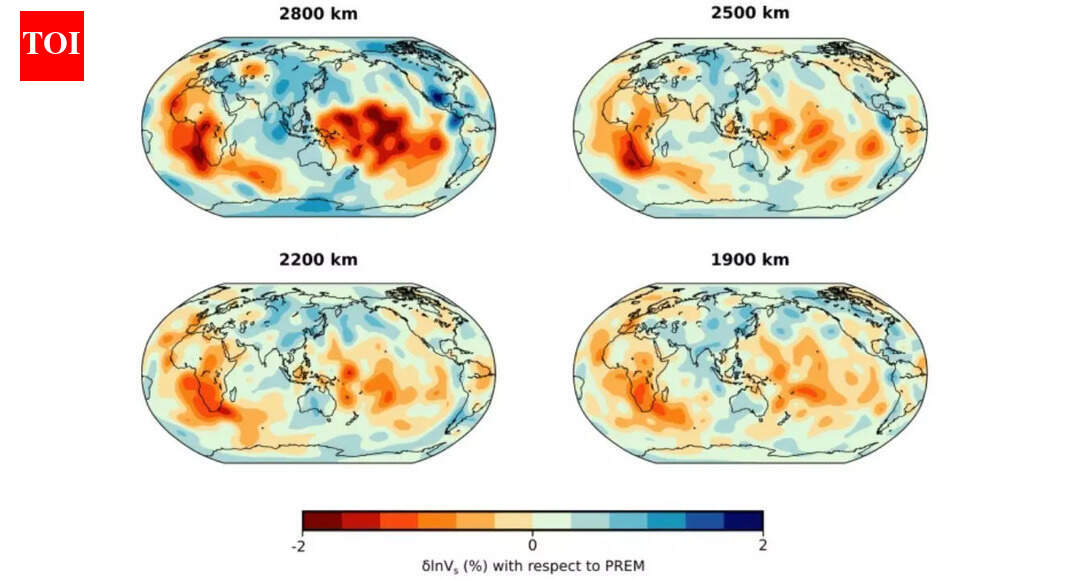
APPLETON, Wis. — Deep beneath the African continent, scientists have identified two massive structures that challenge conventional understanding of Earth's interior, prompting speculation about their origins and composition. According to a recent report from the Times of India, these enormous formations, detected through seismic imaging, appear anomalous and unlike typical geological features on our planet. The discovery, detailed in an article titled 'What lies beneath Africa? Two enormous structures that appear not to belong to Earth,' highlights findings from geophysical studies that have puzzled researchers for years.
The structures in question are known as Large Low Shear Velocity Provinces, or LLSVPs, vast regions in the lowermost part of Earth's mantle, roughly 1,800 miles below the surface. One of these provinces sits predominantly under the African plate, while the other is located beneath the Pacific Ocean. Spanning thousands of kilometers in diameter—comparable to the size of continents—these blobs have low seismic wave velocities, meaning they slow down earthquake-generated waves more than surrounding mantle rock. This peculiar behavior was first noted in the 1980s through global seismic tomography, a technique that maps the planet's interior like a CT scan.
Geophysicists at institutions like the University of Maryland and the California Institute of Technology have been studying these anomalies for decades. 'These structures are incredibly dense and hot, possibly composed of subducted oceanic crust from billions of years ago,' said Dr. Edward Garnero, a seismologist at Arizona State University, in a 2022 interview with National Geographic. Garnero's team used data from over 1,000 seismic stations worldwide to model the LLSVPs, revealing their irregular, pile-like shapes that rise hundreds of kilometers into the mantle.
The Times of India article emphasizes the otherworldly appearance of these formations, drawing on recent analyses that suggest they might not fit neatly into Earth's natural evolutionary models. According to the report, the African LLSVP, often dubbed the 'African Blob,' covers an area equivalent to about 8% of the planet's surface when projected onto the crust. Its counterpart in the Pacific, sometimes called the 'Pacific Blob,' is similarly immense. These structures influence mantle convection, the slow churning that drives plate tectonics and volcanic activity, potentially affecting hotspots like those in Hawaii and Iceland.
Background on this discovery traces back to the 1990s, when improved computational power allowed for higher-resolution imaging. A pivotal study published in Science in 2004 by researchers including Dr. Michael Thorne and Dr. Garnero described the LLSVPs as 'thermochemical piles'—mixtures of hot, primitive material and denser recycled crust. 'They could be remnants from the early Earth, preserved like fossils in the deep mantle,' Thorne said in the paper. However, not all experts agree on their exact nature.
Some scientists propose alternative explanations. Dr. Sanne Cottaar, a geophysicist at the University of Cambridge, argues in a 2023 Nature Geoscience article that the structures might be ultra-low velocity zones (ULVZs), smaller anomalies embedded within the larger LLSVPs, possibly made of partially molten iron-rich material. 'While they don't 'belong' to the typical mantle, they are very much part of Earth's dynamic system,' Cottaar explained during a virtual seminar hosted by the European Geosciences Union last year. This view contrasts with more speculative interpretations that have circulated in popular media, suggesting exotic compositions like metallic hydrogen or even extraterrestrial impacts—claims dismissed by mainstream geologists.
The Times of India piece, published on an unspecified date in late 2023, relies on summaries of seismic data from international collaborations, including the Incorporated Research Institutions for Seismology (IRIS). It notes that the African structure's position correlates with the African Superplume, a rising column of hot mantle material that may contribute to the East African Rift's ongoing continental breakup. This rift, stretching over 3,000 miles from the Red Sea to Mozambique, has widened by about 6 millimeters annually, according to GPS measurements from the UNAVCO consortium.
Experts emphasize the technological advancements enabling these insights. High-performance computing at facilities like the San Diego Supercomputer Center has processed petabytes of seismic data, revealing finer details. In 2021, a study in Geophysical Research Letters by Dr. Yu Jin and colleagues used machine learning to refine LLSVP boundaries, estimating the African province's volume at around 2% of the entire mantle—equivalent to 10 quadrillion cubic meters. 'This isn't science fiction; it's the result of decades of painstaking data collection,' Jin said in a press release from Peking University.
Despite the excitement, challenges remain in verifying the structures' compositions. Direct sampling is impossible at such depths, so inferences rely on wave speeds and densities. A 2019 debate at the American Geophysical Union fall meeting saw proponents of the 'primordial' theory clashing with those favoring 'accreted' models. Dr. Wendy Mao from Stanford University, advocating for the latter, stated, 'These could be debris from ancient collisions during Earth's formation 4.5 billion years ago.' Her research, funded by the National Science Foundation, simulates conditions using diamond anvil cells to mimic deep-Earth pressures.
The implications extend beyond geology. The LLSVPs may influence Earth's magnetic field by altering core-mantle interactions. According to a 2020 Physics of the Earth and Planetary Interiors paper, instabilities at the boundary could trigger geomagnetic reversals, like the last one 780,000 years ago. Climate scientists also link mantle plumes to volcanic outgassing, which historically affected atmospheric CO2 levels. For instance, the Siberian Traps eruption 252 million years ago, possibly fed by similar deep structures, contributed to the Permian extinction.
In Africa, the findings have local resonance. The structure's heat may fuel geothermal resources in the Rift Valley, where Kenya's Olkaria plant generates 800 megawatts, powering 70% of the country's electricity. Officials from the African Union's science division have called for more funding for seismic networks. 'Understanding what's beneath us could unlock sustainable energy for the continent,' said Dr. Amina Mohamed, former Kenyan cabinet secretary for sports, culture, and heritage, in a 2022 statement to the UN.
Broader scientific community views vary on the 'not from Earth' framing. While the Times of India article uses dramatic language to engage readers, peer-reviewed sources like those from Annual Review of Earth and Planetary Sciences treat the LLSVPs as natural, if enigmatic, features. Dr. Jessica Irving, a mantle seismologist at the University of Bristol, noted in a 2023 podcast, 'They're alien only in the sense that they're unfamiliar; everything points to terrestrial origins.' This perspective underscores the gap between popular reporting and academic caution.
Looking ahead, upcoming missions like NASA's InSight lander data (though Mars-focused) and Earth's own deep-drilling projects, such as the International Continental Scientific Drilling Program's efforts in South Africa, aim to probe shallower analogs. The Deep Carbon Observatory, concluding in 2021, estimated that 90% of Earth's biomass resides in the deep biosphere, hinting at life's resilience near these structures. Future seismic arrays, planned by the Geoscope network through 2030, promise sharper images.
As research progresses, the two structures continue to captivate, reminding us of Earth's hidden complexities. Whether remnants of planetary formation or drivers of geological drama, they underscore the need for global collaboration in geoscience. For now, the 'blobs' beneath Africa and the Pacific remain silent giants, their secrets locked in the planet's fiery core.