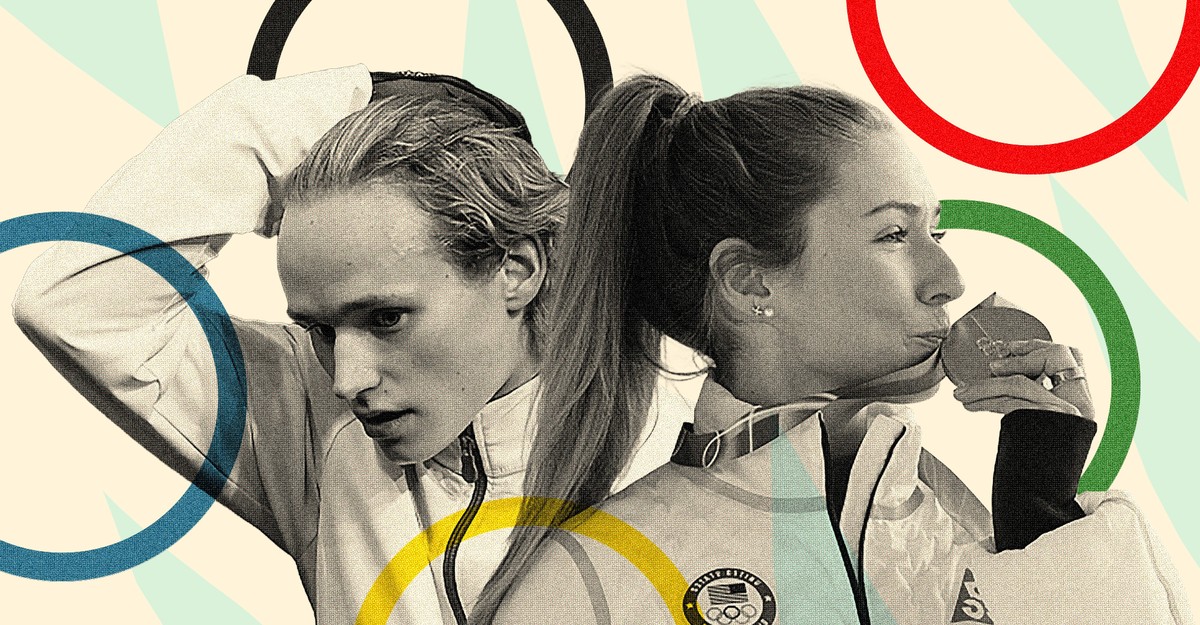
MILAN, Italy — As the Milan Cortina 2026 Winter Olympics drew to a close on Sunday, the high-stakes world of elite athletics offered a stark reminder of the invisible forces that can make or break an athlete's performance. Ilia Malinin, the 21-year-old American figure skating world champion, stumbled dramatically in his Olympic debut, falling twice during the men's free skate and finishing eighth, more than 60 points below his typical scores. In contrast, Mikaela Shiffrin, the 30-year-old Alpine skiing legend, conquered her long-standing Olympic demons by winning gold in the slalom with a commanding 1.50-second margin — the largest in any Winter Games Alpine event since 1998.
Malinin's mishaps highlighted the brutal physical toll of Olympic pressure, a phenomenon that experts describe as more than just mental strain. 'It’s a lot to handle,' Malinin told reporters after the event. 'The pressure of the Olympics is—it’s really something different, and not a lot of people will understand that.' He explained that he felt confident until stepping onto the ice for the free skate, when an 'overwhelming' sense of dread hit him, turning his legs to jelly. Five of the final six skaters in the event also fell, underscoring how the Games' intensity can unravel even the steadiest performers.
This wasn't an isolated incident for American male figure skaters at their Olympic debuts. At the 2018 Pyeongchang Games, Nathan Chen entered undefeated but botched his short program, finishing fifth overall. Historically, only one American man has won gold in his first Olympics: Dick Button in 1948. Malinin's struggles came amid a packed schedule that included designing a new exhibition program to the song 'Fear' by NF, which he performed at the closing gala to demonstrate his resilience.
Shiffrin's victory, on the other hand, served as a testament to overcoming such pressures through preparation and mindset shifts. Entering Wednesday's slalom — her final event at these Games — she hadn't won Olympic gold in eight years, having gone zero-for-six in Beijing 2022, including three crashes. In a social media post after the race, Shiffrin revealed the intensity of her anxiety: her heartbeat was pounding so hard that 'my heartbeat nearly fell out of my butt.'
Yet Shiffrin powered through, gliding and aggressively navigating the gates, at times appearing to punch them with her fists. 'I questioned all that I’ve learned in life, multiple times this week,' she wrote in her post. 'I questioned what kind of grit I have in my heart and I wondered if I should be doing this at all. I questioned my toughness and tenacity. I questioned it all. And then I left those questions behind, and stepped into the arena anyway.'
The physiological underpinnings of these experiences trace back to early 20th-century science. In 1921, German physiologist Otto Loewi conducted a Nobel Prize-winning experiment by extracting a frog's heart and slowing its beat with vagus nerve juices, proving that heart rate is chemically controlled by neurotransmitters like acetylcholine. This same chemical regulates human heart rate, muscle contractions, digestion, and attention. Under stress, such as a metaphorical 'snakebite' of Olympic pressure, it can disrupt breathing and movement, much like a cobra's venom paralyzes prey.
Modern neuroscience builds on this foundation. Walter Bradford Cannon, Harvard's physiology chair from 1906 to 1942, coined the term 'fight or flight' and showed how stress redirects blood from extremities and organs to major muscles, impairing fine motor skills. A 2024 review in the journal Physiology & Behavior describes fine motor skills as an 'intricate integration of sensory inputs with motor outputs, particularly in dynamic and unpredictable environments.' When disrupted, it heightens 'the likelihood of operational errors in high-stakes scenarios.'
For athletes like Malinin, this meant losing proprioception — the body's sense of position — during his free skate. He later described hardly knowing where he was in his program. UCLA neuroscientist Kevin Bickart, who specializes in sports neurology, explained to The Atlantic that stress corrupts 'muscle sense,' making athletes feel 'stiff, jerky, or “heavy”' because internal data on limb position is chemically distorted. This can lead to errors like a skater aborting a routine triple loop, as happened to American Amber Glenn, who was on the verge of medal contention but faltered.
Malinin's challenges may have been exacerbated by external factors. He admitted to insufficient sleep, numerous obligations, and heavy social media engagement, including reposting a meme about exhaustion and decrying 'vile online hatred' that 'attacks the mind.' Rafael Arutyunyan, a skating coach consulting for Malinin, blamed adults for not protecting the young athlete, telling RT in a brief interview, 'We, the adults, are to blame for failing to protect a young man from making the wrong moves.' Malinin appeared pale on the ice, suggesting fatigue played a role.
Shiffrin's path to success involved deliberate countermeasures. After Beijing 2022, she delved into the science of her reactions. 'I didn’t understand why these things were happening or what the chemical effects in the brain were,' she told Olympics.com in October. Haunted by performance anxiety since her youngest Olympic slalom gold at 18 in 2014, compounded by her father's 2020 death and a 2024 crash, Shiffrin worked with a psychologist on meditation and breathing exercises to manage intrusive thoughts.
During the slalom, after non-medaling finishes in the combined and giant slalom, Shiffrin avoided social media to dodge renewed 'choking' narratives. She endured a long wait between runs, captured by NBC cameras as she stretched, breathed, meditated, and even attempted a nap in the snow. 'I have built this up in my own mind,' she told reporters post-race. 'I’ve dreamed about it. I have been nervous for it. I’ve felt pressure. I have also felt like, ‘Who cares?’' At the medal ceremony press conference, she added, 'I was thinking about the fact that I actually can show up today and honestly say in the start gate that I have all the tools that are necessary to do my best skiing, and to earn that moment.'
Another American success story was 20-year-old figure skater Alysa Liu, who won gold in the women's event — the first for an American woman in nearly 25 years — with a carefree free skate. Having quit skating at 16 due to strain, Liu returned on her own terms. 'No stress,' she told reporters before competing, embodying a blithe approach that rewarded her with victory.
Experts like Bickart emphasize practical antidotes: proper rest, breathing techniques like the Wim Hof Method to activate the parasympathetic 'brake' on fight-or-flight, and reframing threats as challenges to inhibit anxiety chemicals. Simulating stress, such as big-wave surfer Laird Hamilton's ice-bath plunges, builds neural resilience by strengthening connections that raise the meltdown threshold. Neuroscientist Candace B. Pert's 1997 book Molecules of Emotion details how neurotransmitters like dopamine, norepinephrine, serotonin, and cortisol orchestrate performance, enabling refined movements when balanced but faltering when imbalanced.
These Olympics, watched by over 25 million viewers, exposed the raw humanity beneath the glamour. Athletes' spangled uniforms conceal massive chemical reactions, where biochemistry can sabotage or propel greatness. As Shiffrin proved, understanding and managing these responses can transform pressure from paralyzer to motivator.
Looking ahead, Malinin's exhibition gala performance signals his intent to rebound, while Shiffrin's triumph may inspire a new generation. With the Games concluding, the focus shifts to how athletes worldwide integrate these lessons into training, potentially reshaping sports psychology in an era of heightened scrutiny and digital noise.