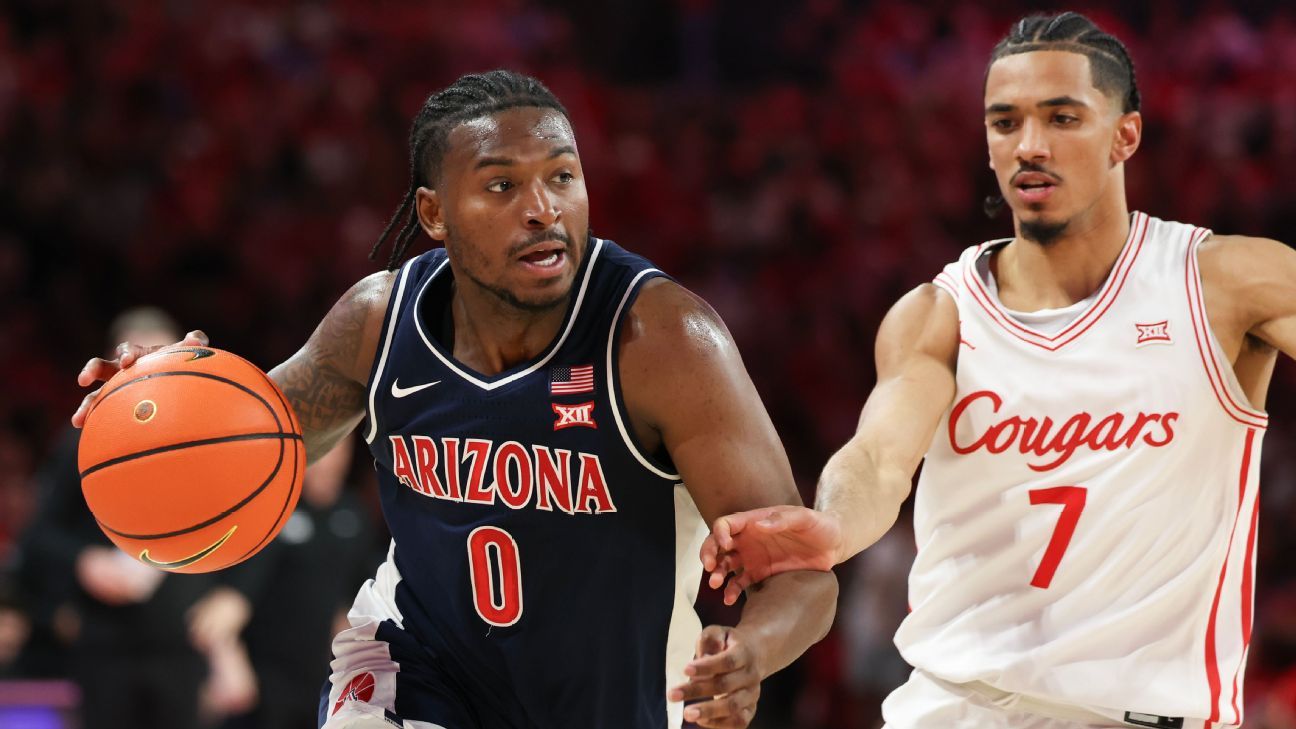
In a marquee Saturday slate that offered a tantalizing glimpse of potential national semifinal matchups less than 45 days before the Final Four in Indianapolis, the top four teams in the latest AP poll delivered drama on the court. No. 3 Duke edged out No. 1 Michigan in a hard-fought battle, while No. 4 Arizona grinded out a 73-66 victory over No. 2 Houston in one of college basketball's most intimidating road environments. It marked the first time this season that the Nos. 1 and 2 teams dropped games on the same day, a rarity last seen on Feb. 8, 2025.
The outcomes reshuffled perceptions among the nation's elite contenders, with ESPN analysts Jeff Borzello and Myron Medcalf dissecting the implications in the wake of these pivotal clashes. Duke's triumph over Michigan, played on a neutral court, propelled the Blue Devils into the forefront of championship discussions, according to Borzello. "Duke is as good as any team in college basketball," he wrote. "While its record and ranking already reflected that, it hadn't really yet been considered among the top of the national championship contenders this season."
Central to Duke's success was freshman sensation Cameron Boozer, who solidified his status as the frontrunner for National Player of the Year honors. Boozer tallied 18 points, 10 rebounds, and seven assists, including a crucial stretch where he scored seven straight points for the Blue Devils in the game's closing minutes. Despite being outscored in the first half by Michigan senior Yaxel Lendeborg, Boozer shouldered the offensive load when it counted most. Beyond Boozer, guard Caleb Foster drained key perimeter shots and handled the ball steadily, while Patrick Ngongba II contributed on both ends of the floor. Nikolas Khamenia provided valuable bench minutes, and even Isaiah Evans, who struggled with his shooting, maintained offensive poise.
Duke's defensive intensity proved decisive, allowing the team to win without needing an explosive offensive output. Borzello noted, "Duke's offense isn't as explosive as that of other contenders. But when the defense plays like it did on Saturday, the Blue Devils don't need to score 80 or 90 points. That's what could separate them come March." The Blue Devils' only two losses this season—a one-point defeat to Texas Tech after leading by 17 and a three-point setback to North Carolina following a 13-point advantage—underscore their resilience, particularly in closing out high-stakes games.
For Michigan, the loss exposed vulnerabilities in what had been a dominant campaign. The Wolverines, who entered the game averaging 41 points in the paint and a rebounding margin of nearly 10 boards per contest, were outscored 34-24 inside and outrebounded 41-28 by Duke—the first time this season they were double-digit losers on the glass. Coach Dusty May's reliance on jumbo lineups to overpower opponents faltered against Duke's frontcourt for the first time all year.
Compounding the interior struggles, Michigan's perimeter shooting went cold, hitting just 6 of 25 three-pointers after a scorching 13-for-23 performance against Purdue earlier in the week. From the 9:40 mark of the first half until 3:50 remaining in the second, the Wolverines made only one triple, with Elliot Cadeau, Trey McKenney, Nimari Burnett, and L.J. Cason combining for just two from deep overall. Borzello observed, "It's not a loss that will truly impact their perception as the favorites to win the national championship—on another day, those open 3s fall, Aday Mara doesn't get in foul trouble, etc.—but what looked like a waltz to a national title has hit a bump in the road." Despite the defeat, Michigan remained competitive until the final minute, highlighting their depth.
Shifting to the second marquee matchup, Arizona's road win at Houston reaffirmed the Wildcats' pedigree as a team capable of toppling any opponent. Despite a recent two-game skid—their first losses of the season at Kansas and to Texas Tech—Arizona has maintained consistency as one of the country's top teams for four months. The victory added to an impressive resume that includes triumphs at UConn, over Florida in Las Vegas, and at Alabama in Tuscaloosa.
The Wildcats' defense clamped down after halftime, holding Houston scoreless for nearly eight minutes in the second half—the Cougars' longest drought of the season. Jaden Bradley emerged as a clutch performer with 17 points, including big shots down the stretch. Off the bench, Anthony Dell'Orso led with 22 points, while Ivan Kharchenkov chipped in 16. Arizona shot a modest 25% from three-point range and never led by more than 10, but their grit shone through amid injuries and foul trouble: no Koa Peat, no Dwayne Aristode, a less-than-100% Brayden Burries, and Motiejus Krivas and Tobe Awaka sidelined by fouls.
Medcalf praised Arizona's toughness, stating, "The Wildcats can still beat any team in America, and they proved as much in one of college basketball's most hostile environments against one of its best teams." He highlighted the defensive effort that fueled Houston's prolonged scoring lapse, noting Bradley's impact in overcoming limited three-point production.
Houston, under coach Kelvin Sampson, entered the game known for thriving in physical battles, but another offensive drought proved costly. The Cougars went scoreless for nearly eight minutes in the second half against Arizona, mirroring a 21-9 deficit in the final 11 minutes of their 70-67 loss at Iowa State on Monday. Medcalf pointed out, "This was the type of battle Kelvin Sampson's Houston teams seemed to enjoy, but the Cougars once again suffered a scoring drought that they couldn't overcome."
Questions linger about Houston's ability to sustain offensive output against elite defenses. While the Cougars boast playmakers and stars, their reliance on guard shotmaking becomes a liability during dry spells. Medcalf added, "Do they have the offensive output to trade punches with the best teams in America? ... Their inability to overcome a pair of ugly stretches in back-to-back games is concerning." This week's two losses highlighted vulnerabilities, particularly if freshman Kingston Flemings can't deliver in clutch moments. Notably, opponents Iowa State and Arizona combined for just eight turnovers, yielding only three points off them for Houston—far below the Cougars' season average of nearly 15 forced turnovers and 19 points therefrom.
The analysts diverged slightly on post-game rankings of the top four. Borzello placed Duke at No. 1, citing their neutral-site win over Michigan and ability to close without an elite offense: "Can I really put any other team at the top?" He slotted Arizona second for their gritty road victory despite being shorthanded, Michigan third as lingering favorites despite flaws, and Houston fourth due to turnover dependency.
Medcalf agreed on Duke atop the list, calling them "the best team in America right now" led by Boozer, the country's top player. He ranked Michigan second for staying close until the end, Arizona third for their shorthanded defensive masterclass, and Houston last, below even Iowa State in his view, after squandering double-digit leads and second-half collapses.
These results come amid a compressed schedule leading into Selection Sunday, with the top teams jockeying for No. 1 overall seeds. Duke's elevation to championship favorite status, per both analysts, stems from their balanced play, while Michigan's interior and shooting woes invite scrutiny. Arizona's resilience bolsters their contender resume, but Houston's offensive inconsistencies raise doubts about March sustainability.
As the regular season winds down, these games serve as a microcosm of the tournament's unpredictability. Fans and scouts alike will watch closely how these teams adjust—Duke building on defensive prowess, Michigan refining late-game execution, Arizona leaning on depth, and Houston addressing scoring lulls. With the Final Four looming in Indianapolis, Saturday's lessons could prove prophetic for the national title chase.