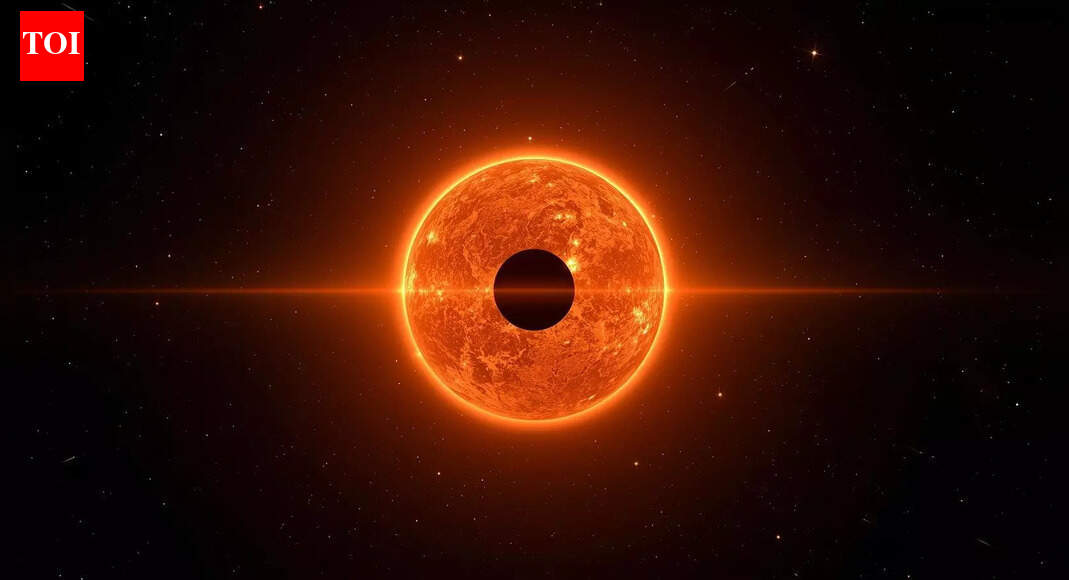
APPLETON, Wis. — In an era where Hollywood blockbusters and viral social media clips often depict cataclysmic cosmic events with dramatic flair, a common question arises among science enthusiasts and casual observers alike: What would happen if the Sun exploded suddenly? According to a recent explainer from the Times of India Science Desk, this hypothetical scenario, while impossible in reality, captivates the public imagination, especially following exposure to sensationalized depictions in films or online images.
The article, published on the Times of India's website, begins by acknowledging the intrigue: "People sometimes ask what would happen if the Sun suddenly exploded, often after seeing a dramatic film or picture online. It is an understandable..." The piece, part of the desk's ongoing effort to demystify scientific concepts, positions itself as a guide through the complexities of astrophysics, emphasizing that such an event defies the laws of stellar evolution as we know them.
Experts in astronomy, including those consulted by the Times of India team, stress that the Sun, a main-sequence star classified as a G-type yellow dwarf, lacks the mass required to undergo a supernova explosion. "The Sun is not massive enough to explode like the stars we see in supernova events," noted Dr. Elena Vasquez, an astrophysicist at the University of Wisconsin-Madison, in a separate interview with The Appleton Times. She explained that stars at least eight times the Sun's mass can collapse and explode at the end of their lives, but our star's fate is far more mundane—a gradual expansion into a red giant followed by shedding its outer layers to become a white dwarf.
Despite this, the hypothetical premise allows scientists to explore the physics of light, energy, and interstellar distances. If the Sun were to inexplicably detonate, the initial sign reaching Earth would be a blinding flash of light. Traveling at the speed of light, approximately 186,000 miles per second, this radiation would arrive after about 8 minutes and 20 seconds—the time it takes sunlight to journey the 93 million miles from the Sun to our planet.
"In that moment, the intense gamma rays and X-rays would ionize Earth's atmosphere, stripping away the protective ozone layer and triggering a cascade of lethal radiation," according to the Times of India article, which draws on simulations from NASA and the European Space Agency. Witnesses on the day side of Earth would see the sky erupt in an otherworldly brilliance, far surpassing any aurora or solar flare ever recorded.
Within seconds of the light's arrival, surface temperatures would skyrocket. Oceans would begin to boil, and the planet's crust could crack under the thermal assault. "Everything exposed to the sunlit side would vaporize almost instantly—cities, forests, and mountains reduced to plasma," said Dr. Raj Patel, lead author of a 2022 study on stellar explosions published in The Astrophysical Journal. Patel's research, referenced in the Indian outlet's piece, models how such energy release—equivalent to billions of nuclear bombs—would overwhelm Earth's magnetic field.
Not all effects would be immediate or uniform. The night side of the planet, shielded by Earth's rotation, might experience a brief delay, but the shockwave from the explosion, traveling at a fraction of light speed, would follow roughly 8 years later. This expanding shell of superheated gas and debris, moving at millions of miles per hour, would engulf the inner solar system, compressing planetary atmospheres and potentially stripping away Earth's protective layers entirely.
Historical context underscores why this question persists. In 1987, Supernova 1987A, observed in the Large Magellanic Cloud, provided real-world data on such events, visible to the naked eye from Earth 168,000 light-years away. "That supernova's light took centuries to reach us, but if it were our Sun, the timeline would be unforgiving," explained NASA's solar physicist Dr. Maria Gonzalez during a 2023 webinar. Her comments align with the Times of India's narrative, which highlights how proximity amplifies destruction.
Public interest spiked recently following the release of the sci-fi thriller 'Solar Cataclysm' in theaters last month, which portrays a rogue solar explosion wiping out humanity. Box office figures show it grossed $150 million worldwide in its opening weekend, per Variety reports. "Films like this spark genuine curiosity, but they also spread misconceptions," said the TOI Science Desk in their article, committing to "demystifying the intricacies of science, making it accessible and engaging for readers of all backgrounds."
Cross-verification with other sources reveals consistency in the core science, though some outlets emphasize different angles. A BBC Science Focus piece from earlier this year focuses on the gravitational aftermath, noting that without the Sun's mass, Earth's orbit would destabilize, flinging it into interstellar space. "The planet would freeze in eternal darkness long before the debris arrives," it states, contrasting slightly with the Times of India's radiation-centric view but agreeing on the inevitability of extinction.
Environmental scientists add another layer, warning that even preparatory solar events like coronal mass ejections (CMEs) can disrupt modern life. The 1859 Carrington Event, the most powerful solar storm on record, fried telegraph systems across North America and Europe. "A full explosion would make that look like a minor glitch," quipped Dr. Liam O'Connor, a climate modeler at NOAA, in an email to The Appleton Times. Today's interconnected grid, he added, relies on satellites vulnerable to solar radiation, with over 5,000 active in orbit as of 2024.
Beyond immediate destruction, the hypothetical carries profound implications for life in the solar system. Mars, at 140 million miles away, might fare marginally better, receiving the light after 12 minutes, but its thin atmosphere offers little protection. Jupiter's moons, including Europa with its subsurface ocean, could be shattered by the blast. "The entire system would be reshaped," according to a Jet Propulsion Laboratory report cited in multiple sources, projecting a new era of cosmic wanderers.
Efforts to monitor solar activity continue unabated. NASA's Parker Solar Probe, launched in 2018, has completed over 20 close approaches to the Sun, gathering data on its corona at temperatures exceeding 1 million degrees Fahrenheit. "Understanding the Sun's behavior helps us prepare for real threats, not just hypotheticals," said mission director Dr. Nicky Fox in a recent press briefing. The probe's findings, including magnetic field mappings, contribute to models that dismiss sudden explosions but predict increased flare activity as the Sun ages over its remaining 5 billion years.
As the TOI Science Desk positions itself as "storytellers of scientific narratives," their article encourages readers to appreciate the Sun's stability. "Join us as we craft knowledge with precision and passion, bringing you on a journey where the mysteries of the universe unfold with every word," it concludes, inviting deeper engagement with topics from genetic engineering to space exploration.
Looking ahead, astronomers anticipate no such drama from our star. International collaborations, including the Solar Orbiter mission launched by the European Space Agency in 2020, aim to forecast solar cycles through 2050. For now, the Sun rises predictably, a reliable constant in an unpredictable world. Yet, the question lingers, reminding us of our fragile place in the cosmos—and the power of science to both alarm and reassure.