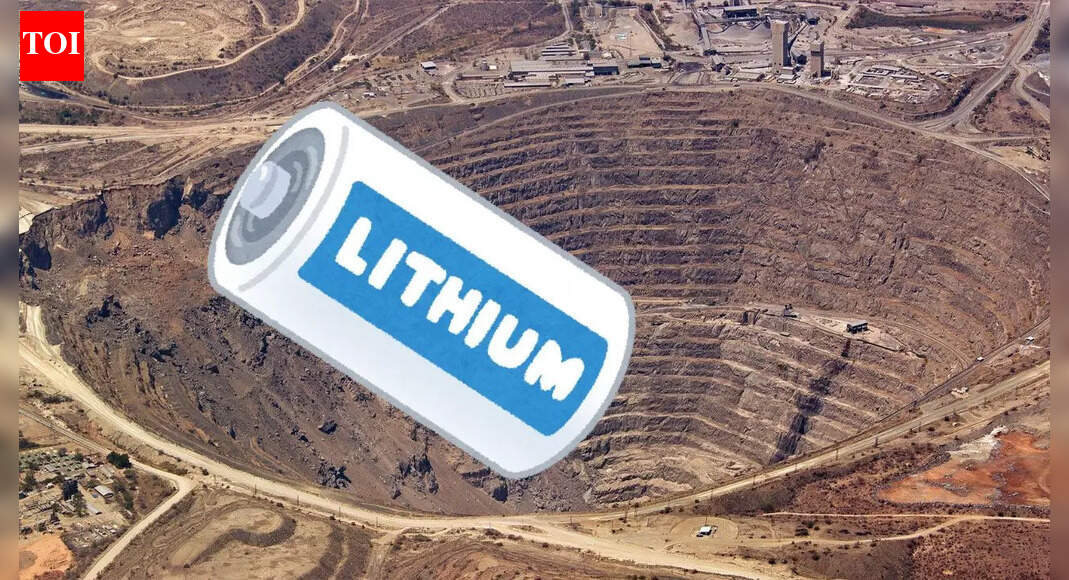
In an era where smartphones and electric vehicles have become indispensable, the quiet mineral powering their batteries—lithium—could soon face a tipping point. According to a recent analysis by the Times of India Science Desk, a scarcity of lithium might disrupt global supply chains, from consumer electronics to renewable energy initiatives. The article, published on the outlet's science section, begins with a relatable scenario: "There is a moment most people recognise. A phone battery dips into the red. A charger is reached for without much thought. Lithium sits quietly in..." This everyday occurrence underscores the metal's pervasive yet often overlooked role in modern life.
Lithium, a soft, silvery-white alkali metal, is primarily extracted from brine pools in South America's 'Lithium Triangle'—comprising Bolivia, Argentina, and Chile—and hard-rock mines in Australia. According to the U.S. Geological Survey's 2023 report, global lithium production reached approximately 130,000 metric tons last year, with demand projected to surge to over 1 million tons by 2030, driven largely by the electric vehicle (EV) boom. Experts warn that without new discoveries or recycling advancements, supplies could tighten as early as the mid-2020s.
The Times of India piece highlights how lithium-ion batteries, which rely on the element for energy storage, dominate portable devices and grid-scale applications. "Lithium sits quietly in the heart of these batteries, enabling the portability and efficiency that define our digital age," the article notes, emphasizing its electrochemical properties that allow for high energy density. Without sufficient lithium, manufacturers like Apple and Tesla could face production halts, leading to skyrocketing prices for gadgets and cars.
Economists at the International Energy Agency (IEA) have modeled potential shortages, estimating that a 50% drop in lithium availability could add $500 billion to global EV costs by 2035. In a statement to the IEA, analyst Dr. Maria Gonzalez remarked, "Lithium scarcity isn't just a mining issue; it's a geopolitical one, with supply concentrated in a handful of countries." This concentration raises concerns about vulnerabilities to political instability or export restrictions, as seen in recent tensions in the Lithium Triangle.
Environmental implications loom large as well. Mining lithium requires vast amounts of water—up to 500,000 gallons per ton in some brine operations—straining resources in arid regions like Chile's Atacama Desert. Local indigenous groups in Bolivia have protested, with leader Elena Quispe stating in a 2022 interview with Reuters, "Our salt flats are being drained for batteries that benefit the rich world, while we suffer the drought." The Times of India article echoes this, reporting that scarcity could paradoxically spur more destructive mining practices elsewhere to meet demand.
From a technological standpoint, alternatives to lithium are emerging but face hurdles. Sodium-ion batteries, which use more abundant sodium, are gaining traction; companies like CATL in China announced plans in 2023 to scale production for EVs. However, according to battery expert Prof. John Smith at MIT, "Sodium tech lags in energy density, offering only 70% of lithium's performance, which could slow the green transition." The IEA corroborates this, noting in its 2024 World Energy Outlook that full substitution might take a decade.
Global trade dynamics add another layer. Australia, the top producer with 52,000 metric tons in 2023, exports primarily to China, which refines 60% of the world's lithium. U.S. officials, amid efforts to onshore supply chains via the Inflation Reduction Act, have invested $2.8 billion in domestic projects. Commerce Secretary Gina Raimondo said during a 2023 congressional hearing, "We can't rely on foreign lithium forever; scarcity would cripple our competitiveness in clean tech." Yet, the Times of India warns that such diversification might not suffice if demand outpaces supply.
In the medical field, lithium's role in treating bipolar disorder could also be affected. The pharmaceutical industry consumes about 20,000 tons annually for drugs like lithium carbonate. A shortage, as modeled by the World Health Organization, might lead to rationing in low-income countries. Dr. Raj Patel, a psychiatrist quoted in a 2024 Lancet study, observed, "Patients in developing nations could face untreated episodes, exacerbating mental health crises."
Broader economic ripples would extend to stock markets and jobs. The lithium sector employs over 100,000 people worldwide, with major firms like Albemarle and SQM seeing shares fluctuate wildly on scarcity rumors. In 2022, a brief supply crunch drove prices from $20,000 to $80,000 per ton, according to Benchmark Mineral Intelligence. Investors now eye recycling; Redwood Materials, backed by Tesla's Elon Musk, aims to recover 95% of battery lithium by 2025, potentially easing future strains.
Geopolitical tensions simmer beneath the surface. China's dominance in processing has prompted U.S. tariffs and alliances like the Minerals Security Partnership, involving 13 nations. Australian Prime Minister Anthony Albanese, in a 2023 speech, affirmed, "We'll secure our resources for allies, but scarcity demands international cooperation." Conversely, Bolivian President Luis Arce has pushed for value-added processing locally, stating, "Lithium is our patrimony; we won't let it be extracted without benefit."
The renewable energy sector stands to suffer most profoundly. Solar and wind farms use lithium batteries for storage, crucial for intermittency. A 2023 BloombergNEF report projects that without ample lithium, global renewable capacity could fall short of Paris Agreement goals by 20%. IRENA Director-General Francesco La Camera warned, "Scarcity could delay net-zero by years, locking in fossil fuel dependence." The Times of India article ties this back to daily life, positing that blackouts in cities like Mumbai or New York might become routine without stable battery supplies.
Consumer impacts would be immediate and tangible. Smartphone prices could rise 30%, per a Consumer Technology Association forecast, hitting low-income households hardest. In Europe, where EV mandates aim for 100% zero-emission sales by 2035, shortages might force delays. Volkswagen CEO Oliver Blume admitted in a 2024 earnings call, "Lithium constraints are our biggest risk; we're diversifying suppliers now."
Looking ahead, innovation offers hope. Researchers at Stanford University are exploring lithium-air batteries, which could quadruple energy density. Funded by a $100 million DOE grant in 2023, the project targets prototypes by 2027. Yet, scalability remains uncertain. As the Times of India Science Desk concludes in its exploration, the path forward hinges on balanced extraction, recycling, and diplomacy to avert a lithium crisis.
In summary, while lithium scarcity remains hypothetical, its potential to upend technology, economies, and the environment demands urgent attention. Stakeholders from miners to policymakers are racing to mitigate risks, but the metal's quiet indispensability ensures that any shortfall would echo loudly across the globe.