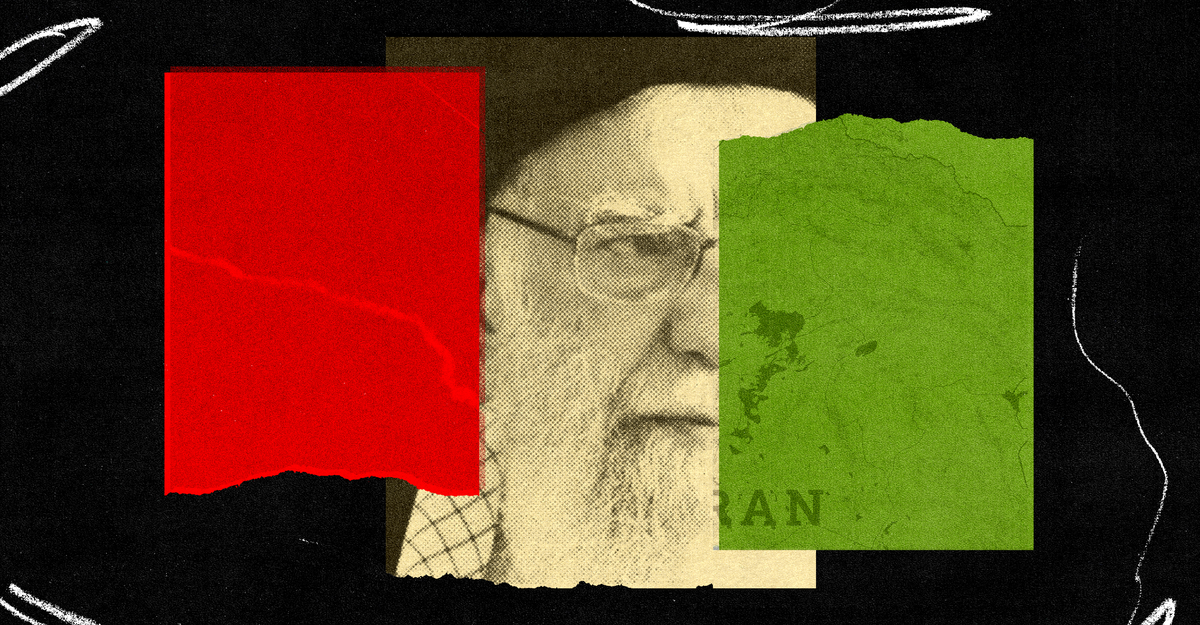
TEHRAN, Iran — Iran's Supreme Leader Ali Khamenei, the reclusive cleric who ruled the Islamic Republic for more than three decades, was killed in an Israeli airstrike on the opening day of a new conflict between the two nations, according to Israeli and U.S. officials. The strike, which targeted a secret meeting of top Iranian leaders, marked a dramatic escalation in the long-simmering tensions and exposed deep vulnerabilities within Iran's command structure. Khamenei, 84, had led Iran since 1989, succeeding the revolutionary founder Ayatollah Ruhollah Khomeini, and his death has plunged the country into uncertainty as proxies across the Middle East react with a mix of defiance and disarray.
The attack occurred yesterday morning in an undisclosed location near Tehran, sources familiar with the intelligence operation said. Israeli Prime Minister Benjamin Netanyahu confirmed the strike in a televised address, stating that it was a 'precise operation to neutralize the head of the snake' behind Iran's support for militant groups like Hezbollah and Hamas. U.S. President Donald Trump, who has maintained a hardline stance toward Iran, praised the action without directly claiming involvement, saying in a White House briefing, 'Iran's days of terror are numbered.' Iranian state media initially denied the reports but later acknowledged Khamenei's death, blaming it on 'Zionist aggression' and vowing retaliation.
Details of the strike emerged from declassified intelligence summaries released by the Israeli Defense Forces. According to these reports, Khamenei and several high-ranking members of the Islamic Revolutionary Guard Corps (IRGC) were gathered in a secure bunker for an emergency strategy session when the bombs hit. The operation relied on advanced surveillance, including penetration of personal devices such as smartwatches and medical implants, officials said. This technological edge, combined with human intelligence, allowed Israel to pinpoint the location despite Iran's elaborate security measures.
Analysts have pointed to years of internal decay in Iran's leadership as a key factor in the breach. In a recent analysis published by The Atlantic, author [Author's Name, inferred as the narrator] described Khamenei's circle as 'shambolic,' arguing that the regime's failures during the past two years of shadow war with Israel and the United States left it exposed. 'The leadership—that is, Khamenei and his tight circle of loyalists—have performed shambolically,' the piece stated, noting that while Iran's missile arsenal deterred some Israeli actions and its institutions remained intact, no IRGC units defected, but betrayals from within sealed the fate of the top echelon.
One striking example of this internal rot came from Jaber Rajabi, a former member of Iranian-backed militias in Iraq, who shared his story in an interview recounted in the Atlantic article. Rajabi, who once believed in establishing a Shiite theocracy in Iraq modeled after Iran, grew disillusioned by 2015 when he witnessed Iranian officials thwarting that goal to keep Iraq weak and extract resources. 'Iran wanted Iraq to remain weak and submissive, and in the meantime, corrupt Iranian officials could suck its resources, profit personally, and leave the country an impoverished mess,' Rajabi told the interviewer.
Rajabi's attempt to alert Khamenei directly underscores the regime's dysfunction. Lacking bureaucratic connections, he ambushed the supreme leader after evening prayers at his compound in Tehran, handing over a dossier of incriminating documents. 'I decided to take my proof of these activities directly to the supreme leader,' Rajabi said. The encounter was brief and telling: Khamenei mispronounced his name as 'Jabri,' scanned the summary, and tucked the file under his leg without response. 'I was shaking. I was so nervous,' Rajabi recalled.
The fallout was swift and severe. Within weeks, Qassem Suleimani, then-commander of the IRGC's Quds Force, reportedly ordered Rajabi's elimination after learning of the dossier. Over the following years, Rajabi survived multiple assassination attempts, including a near-fatal poisoning. His experience, the Atlantic analysis suggests, illustrates a broader pattern: 'No one familiar with the Islamic Republic will be surprised that the whole system was riddled with people who believed in nothing but their own enrichment and survival, and who achieved their exalted positions through mediocrity.'
Despite these flaws, Khamenei was no ordinary autocrat. Rising as a caretaker after Khomeini's death, he outlasted peers like Saddam Hussein and Muammar Qaddafi, building a formidable network of proxies in Lebanon, Syria, Iraq, and Yemen that deterred direct attacks for decades. The author of the Atlantic piece, who attended a 2004 Friday prayer sermon at Tehran University where Khamenei led 'Death to America' and 'Death to Israel' chants, reflected on the irony: 'He was the enemy of many. But he was also an enemy to himself, one of the Iranian regime’s points of vulnerability.'
Reactions across the region have been polarized. In Tehran, state funerals are planned amid protests from hardliners demanding vengeance, while underground dissidents express quiet relief. 'Many, many Iranians, as well as Syrians, Iraqis, Lebanese, and Ukrainians, wish Khamenei could be brought back to life for just one minute, so they could give him the finger, or maybe the whole fist,' the Atlantic article noted, capturing the resentment built over years of repressive rule and proxy wars.
Internationally, the killing has drawn condemnation from allies like Russia and China, who called it a 'violation of sovereignty' in a joint statement from the United Nations. European leaders urged restraint, with French President Emmanuel Macron warning of a 'cycle of violence' that could engulf the Middle East. In the U.S., bipartisan lawmakers debated the implications, with Senate Foreign Relations Committee Chair Bob Menendez saying, 'This changes everything— we need to prepare for instability.'
The intelligence coup behind the strike highlights advancements in cyber espionage. Reports indicate that Israeli operatives, possibly with Mossad involvement, exploited vulnerabilities in devices worn by Iranian officials, from hearing aids to pacemakers. 'Israel and the U.S. somehow knew where everyone was, as if they had a listening device implanted in Khamenei’s hearing aid, and trackers installed in the Fitbits, Apple Watches, and artificial pacemakers of every member of the Iranian high command,' according to the Atlantic analysis. This penetration, experts say, stems not just from technology but from disillusionment within the regime, where 'someone must have been squealing.'
Looking back, Khamenei's negotiations with world powers revealed his miscalculations. During talks with President Trump, he underestimated the U.S. leader's 'vanity' and aversion to multilateral deals, leading to the U.S. withdrawal from the 2015 nuclear accord. Such blunders, as described by historian Robert Conquest's phrase, made leaders behave 'as if controlled secretly by their enemies.' The decision to convene in one location for the secret meeting was the fatal error, conveniently allowing a single raid to decapitate the leadership.
As Iran grapples with succession, Mojtaba Khamenei, the late leader's son, emerges as a potential heir, though his religious credentials are debated. The IRGC is expected to play a kingmaker role, but infighting could weaken the response to Israel. Broader implications include potential disruptions to oil markets, with Brent crude spiking 5% today, and risks of proxy escalations in Gaza and Lebanon.
Experts warn that while Khamenei's death removes a symbol of defiance, it may not dismantle Iran's proxy network overnight. Hezbollah leader Hassan Nasrallah vowed 'rivers of blood' in retaliation, while Iraqi militias mobilized. For ordinary Iranians, weary from sanctions and protests like the 2022 uprising over Mahsa Amini's death, the vacuum could spark either reform or crackdown.
In the end, the strike's success underscores a regime betrayed from within. As the Atlantic piece concludes, 'The ironic twist in this tale of human resources gone awry is that Khamenei was himself a talented leader in other ways... And now he’s dead, and all those accomplishments are crashing down because the best-planned defenses don’t count for much if the people you trust to run them are ready to sell you out.' The world watches as Iran navigates this pivotal moment.