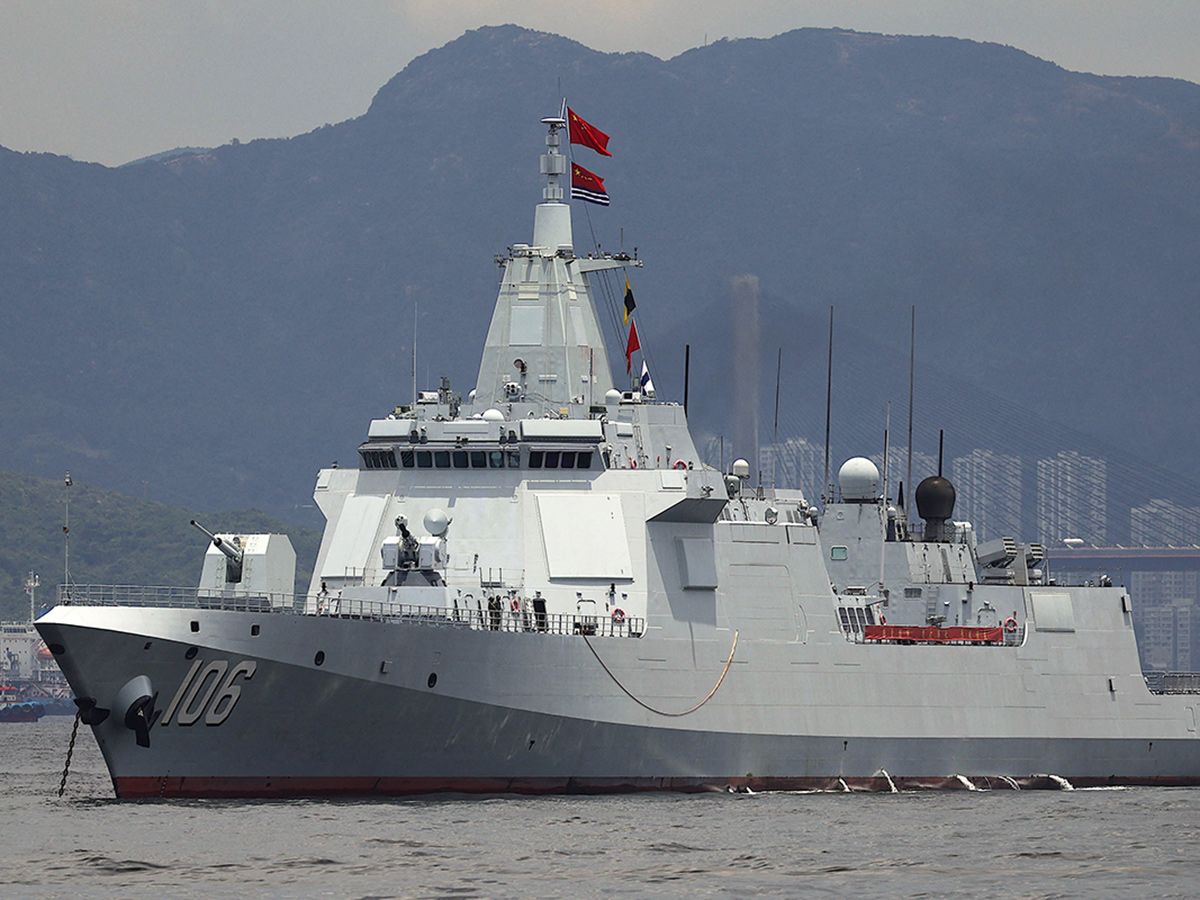
BEIJING — As tensions escalate in the Middle East following U.S. and Israeli strikes on Iran, some Chinese foreign policy experts are viewing the conflict as a potential turning point for Beijing to reshape the global order. U.S. President Donald Trump's recent demand for China to deploy warships to the Strait of Hormuz has been swiftly dismissed by Chinese state media, but it has ignited a broader debate among scholars and advisers in Beijing about whether President Xi Jinping should leverage China's growing military capabilities to influence international affairs more assertively.
The request from Trump, made amid a standoff in the vital shipping lane that has halted traffic since the escalation, was labeled by Chinese outlets as an effort to "spread the risk of a war that Washington started and can’t finish." Trump has also sought a delay in his upcoming summit with Xi to focus on the Iran crisis, according to reports from the White House. This comes after a U.S.-Israeli bombing campaign that assassinated Iran's supreme leader and, in a separate incident two months ago, led to the arrest of Venezuelan President Nicolas Maduro from his home in Caracas — events that caught Beijing off guard and highlighted the limits of its alliances.
Wu Xinbo, a prominent scholar who heads the Center for American Studies at Fudan University and has advised China's Foreign Ministry, underscored the risks of direct involvement. "What if Iran attacks the U.S. navy but accidentally hits the Chinese ships?" Wu said in an interview. "Why would we get mixed up in this mess? The risk is simply too high." China has no intention of joining what many here see as a quagmire, especially since even U.S. allies like those in Europe and Canada have hesitated to commit naval forces, with Canada's defense minister noting the "door open" for limited help but stopping short of full engagement.
Yet, beneath this caution lies a simmering discussion about opportunity. As Trump disrupts the post-World War II rules-based international system — a framework that has underpinned global trade and security for decades — some analysts argue that Beijing should seize the moment to advocate for a more multipolar world. This vision centers on strengthening the United Nations to give emerging economies like China, India, and Brazil greater influence, while reducing the dominance of Western powers. China's economic rise, fueled by open markets and institutions like the World Trade Organization, has made it the world's second-largest economy, with unmatched exports in sectors such as electric vehicles and robotics.
Proponents of a bolder posture, including government-affiliated thinkers, suggest Xi expand China's military footprint abroad. This could involve recalibrating the longstanding doctrine of non-interference, a principle enshrined since 1955 that has allowed Beijing to avoid entanglements while differentiating itself from what it calls Western imperialism. They also point to unresolved issues like Taiwan, where Beijing seeks eventual unification, and the need to protect vast overseas investments. China has poured more than $300 billion into Middle East projects for investment and construction, according to the American Enterprise Institute's China Global Investment Tracker, making the region critical to its energy security.
Iran supplies about 13 percent of China's seaborne crude oil imports, but an even larger share transits the Strait of Hormuz, now paralyzed by the conflict. Wu, while opposing entanglement in the current crisis, advocates for a gradual shift in military strategy. "As China’s economic footprint expands, Beijing should start thinking about moving from isolated, rare applications of military power toward a systematic and normalized protection of our interests abroad," he said. "This is actually a new challenge for us, as it’s only been an issue for the last decade or so. China is still in an exploratory phase — unlike the United States, which has been the leader of the Western world since World War II with military bases stationed everywhere."
This debate has unfolded in recent months through articles, interviews, and forums by scholars tied to the Communist Party. Shen Dingli, an international relations expert in Shanghai who contributes to the People's Daily, the party's official newspaper, cautioned against overreach. "China must recognize that its current strength does not yet give it the power to shape a new international order," Shen said. "The challenges the United States faces today in managing the world may one day become the same challenges China will face as the world’s next preeminent superpower." He emphasized that Beijing's foreign policy remains pragmatic and self-interested, avoiding mutual defense pacts like NATO's Article 5 except with North Korea.
China's official response to the Iran turmoil has stuck to a familiar script: condemnation of U.S. "unilateral bullying," calls for diplomatic resolutions, and positioning itself as a force for stability. At an annual press briefing earlier this month, Foreign Minister Wang Yi portrayed China as a counterweight to chaos. "Imagine if China, like some traditional powers, were keen on carving out spheres of influence in its surrounding regions, instigating conflict," Wang said. "Would the situation in Asia still be as stable as it is today?" He touted Xi's initiatives on global governance and security as remedies to the disruptions caused by Washington.
Despite this rhetoric, China's neighbors often see Beijing as anything but restrained. Since Xi took power in 2012, his administration has militarized artificial islands in the South China Sea, sparking disputes with Vietnam, the Philippines, and others; clashed deadly with Indian troops along the Himalayan border in 2020; and frequently dispatched warplanes to buzz Taiwan's airspace. Probes of Japanese and South Korean defenses have also heightened regional anxieties. Yet, globally, China lags in power projection. Its sole overseas military base, established in Djibouti in 2017 on the Horn of Africa, focuses on anti-piracy patrols and exercises with a small rotating fleet — far from the hundreds of U.S. installations worldwide.
Beijing wields influence more through economic means, using its leverage to reward allies and punish detractors on core issues. This includes pressuring countries over Taiwan recognition, demands for investigations into Covid-19's origins, and defenses of its policies in Xinjiang, where it has detained over a million Uyghur Muslims in what the U.S. calls genocide. The Belt and Road Initiative, Xi's signature infrastructure program spanning Asia, Africa, and Latin America, secures trade routes but relies on maritime lanes long safeguarded by U.S. naval dominance. Disruptions like the current Hormuz crisis threaten these lifelines, prompting questions about reliance on a faltering American-led system.
Fu Xiaoqiang, president of the China Institutes of Contemporary International Relations — a think tank linked to China's state security — attributes the fraying order to America's decline. In an article published this month, Fu wrote that the U.S. has shifted "from being a defender of the international order to a breaker of its rules." This view resonates as leaders in Canada and Europe decry the erosion of norms, with Canadian officials like Alberta Premier Danielle Smith affirming their commitment to the country amid separatist whispers, and others criticizing responses to global threats.
Zheng Yongnian, a influential political scientist and government adviser, has urged a policy rethink in a WeChat Q&A earlier this month. He called for an "urgent" reassessment of non-interference, labeling it a "golden rule" but one that may need flexibility. "While China should never promote regime change or foment ‘color revolutions,’ it needs to adopt a strategy of ‘active intervention’ when its overseas interests are infringed upon," Zheng argued. He cited the Panama Canal as an example, where U.S. pressure under Trump forced a Hong Kong-based conglomerate to relinquish control of two key ports. "Of course, the ‘hegemonic’ and ‘thug-like’ interventionist methods used by the U.S. are absolutely wrong and something we must avoid," he added. "But we must liberate our thinking and stop being so rigid about ‘absolute non-interference.’"
Other experts echo calls for military normalization. As China's interests globalize — from African mines to Latin American ports — protecting them may require more than diplomacy. The Djibouti base was hailed in the West as a harbinger of expansion, but seven years later, it remains an outlier. For now, Beijing prioritizes narrative control, framing the U.S.-Israeli actions as violations of sovereignty that validate China's critiques of American interventionism, from Iraq to Libya.
Some strategists see strategic benefits in Washington's distractions. Li Weijian, a researcher at the Shanghai Institute for International Studies, noted that the 2003 Iraq War gave China a "20-year window of strategic opportunity" by bogging down U.S. forces in the Middle East and delaying a focus on Asia. "We breathed a sigh of relief and seized those 20 years to develop ourselves," Li said. "Now, will the United States get bogged down again?" An Iran quagmire could similarly divert resources, allowing Beijing to advance in the Indo-Pacific without direct confrontation.
The implications of this internal debate extend far beyond Beijing. For rivals like the U.S. and partners in Asia, the direction of China's rise will define flashpoints from the South China Sea to Taiwan Strait. As the Iran conflict simmers — with no clear end in sight and global energy prices spiking — scholars like Wu warn that premature assertiveness could backfire. Yet, with Trump's summit delay signaling prolonged U.S. preoccupation, the pressure builds for Xi to decide how far China will go in filling the void left by a retreating hegemon. Officials in Beijing have given no timeline for resolution, but the quiet evolution of thought here suggests the world order, already cracking, may face deeper shifts ahead.