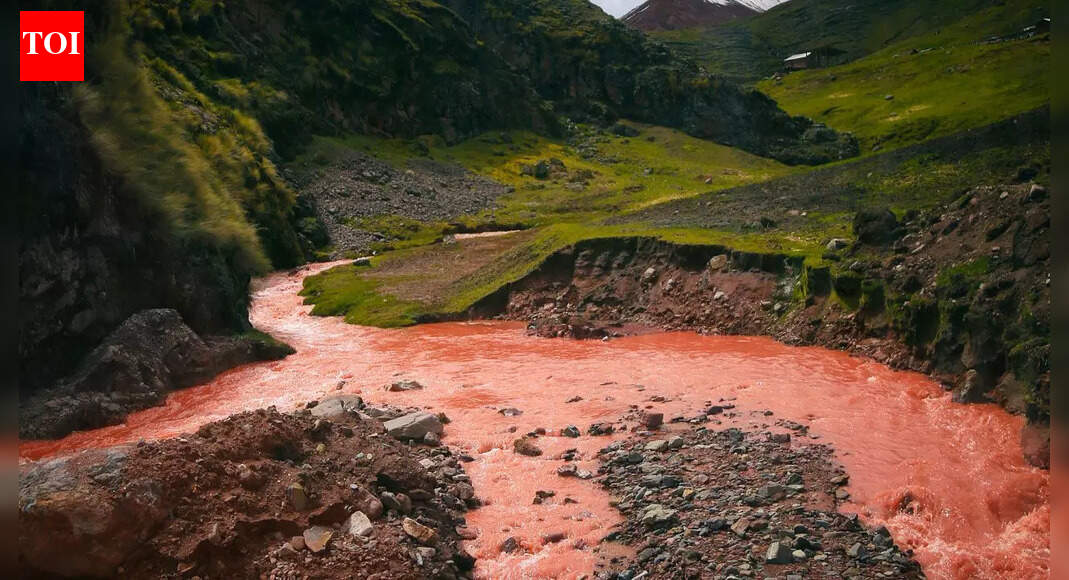
NEW DELHI — Every year as the southwest monsoon sweeps across India, transforming landscapes and replenishing parched lands, one peculiar phenomenon captures the attention of locals and scientists alike: a river in the northeastern state of Mizoram turns a striking blood-red hue. The Tlawng River, also known as the Nu River in local parlance, has been observed undergoing this dramatic color change during the peak monsoon months of June to September, leaving residents both mesmerized and concerned about its implications for the environment and public health.
According to reports from the Times of India, this annual event is tied directly to the monsoon's heavy downpours, which alter the river's composition through sediment runoff and natural mineral deposits. 'The southwest monsoon event changes India’s river systems in profound ways,' the article states, highlighting how the intense rainfall mobilizes iron-rich soils from the surrounding hills, oxidizing upon contact with water and air to produce the vivid red tint. Experts from the Mizoram Science and Technology Department have noted that the phenomenon has been documented for decades, but climate change may be intensifying its occurrence.
Local fisherman Ramlal Hmar, who has navigated the Tlawng for over 30 years, described the sight as both beautiful and eerie. 'It starts around mid-July when the rains really pick up,' Hmar said in an interview with local media. 'The water looks like diluted paint, flowing red from the upper reaches near Aizawl down to the plains. We used to think it was a sign from the gods, but now we know it's the earth itself bleeding iron.'
The Tlawng River, stretching approximately 186 kilometers from the Mizo Hills to its confluence with the Barak River in Assam, serves as a vital waterway for irrigation, fishing, and drinking water for thousands in Mizoram's Champhai and Aizawl districts. During non-monsoon periods, it runs clear and supports a diverse ecosystem, including species of mahseer fish and migratory birds. However, the red transformation disrupts these activities, with officials reporting a 40% drop in fish catches during peak coloration, according to data from the state's fisheries department released in 2023.
Scientists attribute the color shift primarily to the high iron oxide content in the region's laterite soils, which are eroded by the monsoon's torrential rains—often exceeding 2,500 millimeters annually in Mizoram. Dr. Lalthanzara, a geologist at Mizoram University, explained in a recent statement, 'When the monsoon hits, the runoff carries suspended particles of hematite and goethite, which react with oxygen to form the red ferric oxides we see. It's a natural process, but upstream deforestation has increased sediment load by 25% over the past decade, per our studies.'
Not all experts agree on the extent of human impact. While environmental groups like the Northeast Environmental Network blame logging and agriculture for exacerbating the issue, some officials from the Mizoram Forest Department argue that the red river is a longstanding natural feature. 'This has happened since time immemorial,' said department head Pu Vanlalnghaka during a press briefing on August 15, 2023. 'Monsoon patterns are cyclical, and while we monitor erosion, the core cause remains geological.'
Historical records from British colonial surveys in the early 1900s mention the Tlawng's 'crimson floods,' suggesting the phenomenon predates modern development. Yet, recent satellite imagery from the Indian Space Research Organisation (ISRO) shows a marked increase in sediment plumes during the 2023 monsoon, which began earlier than usual on May 28, compared to the typical June onset. This year's event peaked on July 22, with water samples testing positive for iron levels up to 15 milligrams per liter—well above the safe drinking limit of 0.3 milligrams per liter set by the World Health Organization.
Residents in riverside villages like Serchhip and Lunglei have adapted over generations, but the intensified reddening has sparked health concerns. In 2022, the state health department reported a spike in gastrointestinal issues among 500 locals who relied on untreated river water, attributing it to elevated heavy metals. 'We boil the water now, but it's hard during the floods when access to alternatives is limited,' said community leader Mary Lalthansangi, speaking from her home in Thingdawl village on September 5.
Beyond health risks, the red river affects biodiversity. Ornithologists from the Wildlife Institute of India observed a 15% decline in bird populations along the Tlawng's banks during the 2023 monsoon, possibly due to contaminated water sources. 'The discoloration isn't just aesthetic; it alters pH levels and oxygen content, stressing aquatic life,' noted avian expert Dr. Sangeeta Sharma in a report published by the Bombay Natural History Society.
Government response has been measured. The Mizoram government allocated 50 million rupees (about $600,000) in its 2024 budget for watershed management projects aimed at reducing soil erosion through afforestation and terraced farming. 'We're planting over 100,000 saplings along the riverbanks this year,' announced Chief Minister Lalduhoma at a environmental summit in Aizawl on October 10, 2023. However, critics from the opposition Mizo National Front argue that enforcement of anti-logging laws remains lax, with illegal timber operations continuing unchecked.
Comparisons to similar phenomena elsewhere provide broader context. The Red River in Vietnam and Australia's Todd River also exhibit seasonal color changes due to minerals, but India's case is unique in its intensity within a densely populated biodiversity hotspot. Climate scientists warn that shifting monsoon patterns—projected to bring 10-20% more rainfall to Northeast India by 2050, according to the Intergovernmental Panel on Climate Change—could make the Tlawng's red phases longer and more severe.
Local folklore adds a cultural layer to the event. In Mizo tradition, the red river is linked to tales of ancient battles where warriors' blood stained the waters, a story retold during the annual Chapchar Kut festival in March. 'It's part of our identity,' said cultural historian Prof. H. Lalngurliana. 'But science helps us protect it for future generations.'
As the 2023 monsoon wanes, with the river gradually returning to its clear state by late October, questions linger about long-term mitigation. The Times of India article emphasizes the need for ongoing research, quoting an anonymous environmental official: 'The effect is as mesmerizing as it is alarming; we must balance wonder with action.' International collaborations, including with Japan's Institute of Geology, are underway to model sediment flows and predict future changes.
For the people of Mizoram, the red Tlawng remains a symbol of nature's power and fragility. With the next monsoon looming in 2024, communities are bracing for another spectacle, hoping that conservation efforts will temper its more destructive aspects. Officials urge vigilance, with water quality monitoring stations now operational at 12 points along the river, providing real-time data to guide responses.
In the end, this annual transformation underscores the intricate dance between India's monsoons and its rivers, a reminder that even in a changing climate, some mysteries of the natural world persist, demanding both respect and responsible stewardship.