In a landmark decision that has sent ripples through British Columbia's real estate and Indigenous rights landscapes, the B.C. Supreme Court recently affirmed Aboriginal title for the Cowichan Tribes over portions of land along the Fraser River, including areas held in private ownership. The ruling, handed down by Justice Barbara Young, granted title to about half of the 7.5 square kilometres claimed by the nation, encompassing city-owned properties in Richmond, federal port lands, and even privately held homes, farms, a golf course, and commercial warehouses. While the Cowichan Tribes did not seek a determination on the private lands in this case, the decision has ignited widespread concern among property owners about the potential for future claims on fee-simple holdings across the province.
The Cowichan Tribes, based on Vancouver Island, have long asserted rights to the area as a traditional summer village where up to 2,000 people gathered annually to fish for salmon. According to court documents, the land began being sold off by governments starting in 1871, leading to the current patchwork of ownership. Justice Young ruled that the titles to city and federal lands were 'defective and invalid,' giving the parties 18 months to negotiate a settlement. Notably, she determined that Aboriginal title and fee-simple title can coexist, leaving open the possibility for the Cowichan to pursue exclusive use of private lands through future negotiations or legal action.
The ruling marks the first time a B.C. court has explicitly addressed private fee-simple properties within an Aboriginal title claim, distinguishing it from prior cases like the 2014 Supreme Court of Canada victory for the Tsilhqot’in Nation, which granted title to 1,700 square kilometres of mostly Crown land in central B.C. In that earlier case, the Tsilhqot’in filed a 2016 claim against private ranches in their territory but stated they had no intention of pursuing it, using it instead to safeguard negotiation rights before a two-year compensation deadline. David Rosenberg, the lawyer who represented both the Tsilhqot’in and Cowichan, emphasized the fact-specific nature of such claims, noting, “Whether or not fee simple would co-exist, and what the outcome would be, it’s very fact specific.” He added that courts typically affirm title over only two to five percent of the vast traditional territories claimed by First Nations.
Appeals are underway from multiple parties, including the B.C. and federal governments, the City of Richmond, and the Musqueam and Tsawwassen nations, each with differing motivations. The province and city aim to uphold the existing private property rights system, while the intervening First Nations argue their own rights have been infringed. The Cowichan Tribes are appealing to secure title over their full original claim. These appeals could drag on for years, leaving uncertainty in their wake. Meanwhile, the decision has prompted fears among landowners, with Robin Junger, a former chief provincial treaty negotiator and now a lawyer at McMillan LLP representing affected commercial interests in Richmond, warning, “It could be large tracts of British Columbia.”
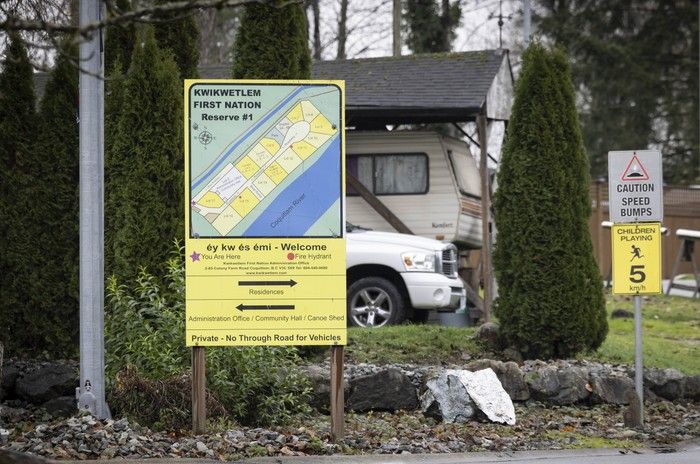
One ongoing claim that predates the Cowichan ruling is the Kwikwetlem First Nation's 2016 petition in B.C. Supreme Court for Aboriginal title to approximately five square kilometres along the Coquitlam River in Port Coquitlam. The lands include provincial properties such as the former Riverview psychiatric hospital site, closed in 2012 and valued at $338 million according to B.C. Assessment Authority records, the Colony Farm Forensic Psychiatric Hospital lands worth $60 million, and a wildlife area at the river's mouth. The claim also covers Metro Vancouver’s ƛ̓éxətəm Regional Park, formerly Colony Farm Regional Park, and the City of Port Coquitlam’s Gates Park and undeveloped South Shaughnessy lands, valued at $49 million and slated for future housing.
The Kwikwetlem, also known as the kʷikʷəƛ̓əm and with about 130 members, assert exclusive historical use of these areas for harvesting, hunting, fishing, building fish traps, processing plants and berries, and conducting burials, ceremonies, and spiritual activities. Their court filing highlights that their current reserve provides less than three hectares of usable land, describing the claimed properties as the last undeveloped portions of their larger traditional territory. Notably, the claim excludes privately held lands, focusing instead on public ones to avoid disrupting third parties amid urban development. The nation filed the claim after the province refused treaty negotiations, but it is now on hold as multiple parties, including the Kwikwetlem, negotiate a deal. Chief Ron Giesbrecht declined to comment when reached by phone, though a First Nation spokesperson confirmed via Josh Kozelj that “negotiations are still ongoing.”
Port Coquitlam Mayor Brad West has vowed to defend municipal ownership, stating, “We’ve made clear our position. We’re going to vigorously defend public ownership of municipal land.” The B.C. government, while refusing to provide a list of active Aboriginal title claims—directing inquiries to court records—has reiterated its commitment to private property rights. In a written statement, Indigenous Relations and Reconciliation Minister Spencer Chandra Herbert said, “The province’s approach to private property rights are to protect them: that’s our approach both in litigation and negotiation. Private property is not part of treaty or other negotiations, except on a willing-seller willing-buyer basis. This has been the approach for successive governments and has not changed.” This stance contrasts somewhat with a recent agreement with the Haida Nation, which acknowledged coexistence of Aboriginal title and fee-simple interests.
Other recent amendments to long-standing claims signal a broader trend. On Vancouver Island's west coast, the Ehattesaht First Nation, with about 550 members and also known as ʔiiḥatisatḥ činax̣int, updated its 2003 claim last month to seek title over 650 square kilometres, including private lands in the village of Zeballos. The nation dropped claims against specific entities like the defunct Doman forest company and the Village of Zeballos but maintains that Aboriginal title extends to fee-simple holdings. In the interest of reconciliation, however, it does not seek to dispossess or invalidate private titles, instead claiming compensation from the Crown for loss of use and unjustified infringements on those lands and minerals. Neither the Ehattesaht nor their lawyer responded to questions about the claim.
Similarly, the Mowachaht/Muchalaht First Nation, with around 615 members, amended its 2003 claim in December 2024 to pursue title over 4,300 square kilometres encompassing the community of Gold River. The claim targets the B.C. government for granting forest rights and fee-simple interests without consent, including a park in Gold River, and seeks monetary compensation. Chief Mike Maquinna, upon filing the amendment, remarked, “For centuries the province has been making decisions in our territory without our consent that have had devastating cultural, spiritual, environmental and economic harms, and very little benefit to (the Mowachaht/Muchalaht).” The nation declined further comment.
In the B.C. Interior, the Stk’emlupsemc te Secwépemc Nation, part of the Secwépemc with about 1,800 members, has amended its 2015 claim multiple times, most recently in March 2025, to cover 12,500 square kilometres including the City of Kamloops and District of Logan Lake. Filed initially to block the proposed $1.3 billion Ajax Mine, the claim notes cumulative impacts from non-Aboriginal settlement, such as the development of major cities, but does not explicitly address fee-simple lands. The nation has not publicly stated its position on private property within the territory.
Experts like Bruce McIvor, founder of First Peoples Law LLP and an adjunct professor at UBC’s Allard School of Law, argue the Cowichan ruling represents continuity rather than upheaval in Aboriginal law. “What is different is, for the first time, a court ruled on the issue,” McIvor said. He stressed negotiation as the path forward: “You have to resolve these things through negotiation. You don’t resolve them by ignoring the injustice.” Historically, settlements have involved Crown lands and cash; for instance, the Musqueam First Nation secured a 2008 deal worth an estimated $250 million, including UBC golf course lands and $20.3 million in cash. More recently, the shíshálh Nation received $104 million over five years, six square kilometres of land, and funds to purchase additional properties on a willing-seller basis.
The Snuneymuxw First Nation settled a claim with the federal government for just under one hectare in Nanaimo and $42 million related to an 1854 treaty. In Surrey, the Katzie, Kwantlen, and Semiahmoo nations claim 1.2 square kilometres of surplus federal farmland declared in 2016. Joint ventures like the MST Development Corp., formed by Musqueam, Squamish, and Tseil-Waututh in 2014, now control properties valued over $2 billion, mostly former government holdings in Vancouver and surrounding areas.
The potential stakes are immense, particularly in urban settings. Paul Sullivan, a principal with tax firm Ryan, estimated the Cowichan claim area's total land value at $2.5 billion. For the Kwikwetlem claim, the public lands alone exceed $447 million. Junger, representing Montrose Properties—the largest commercial holder affected in Richmond—dismissed the significance of the Cowichan not pursuing private lands initially, saying, “They do have a declaration of Aboriginal title over those lands today, and that has all kinds of implications.” A B.C. property company has already reported losing a lender and tenant for a new development due to the ruling's fallout.
As negotiations and appeals proceed, the interplay between Aboriginal title and private ownership remains a flashpoint in B.C.'s reconciliation efforts. While some claims explicitly avoid private lands to facilitate talks, others like the Ehattesaht's seek coexistence with compensation. The B.C. NDP government, despite refusing interviews, maintains that court records are the best source for tracking claims, underscoring the opacity surrounding how much private land might be implicated. With urban development pressures mounting, the outcomes could reshape property rights, economic development, and Indigenous relations across the province for generations.
Broader implications extend to environmental and cultural preservation, as First Nations highlight lost access to traditional practices amid settlement. Incidents like shots fired in Surrey and hazardous snowfall across southern B.C. highways, reported alongside these developments, remind of the diverse challenges facing the region. Yet, as McIvor notes in his book Indigenous Rights in One Minute: What You Need to Know to Talk Reconciliation, addressing historical injustices through dialogue is essential. The path forward, fraught with legal battles and high-stakes talks, will test B.C.'s commitment to balancing modern property norms with ancestral claims.