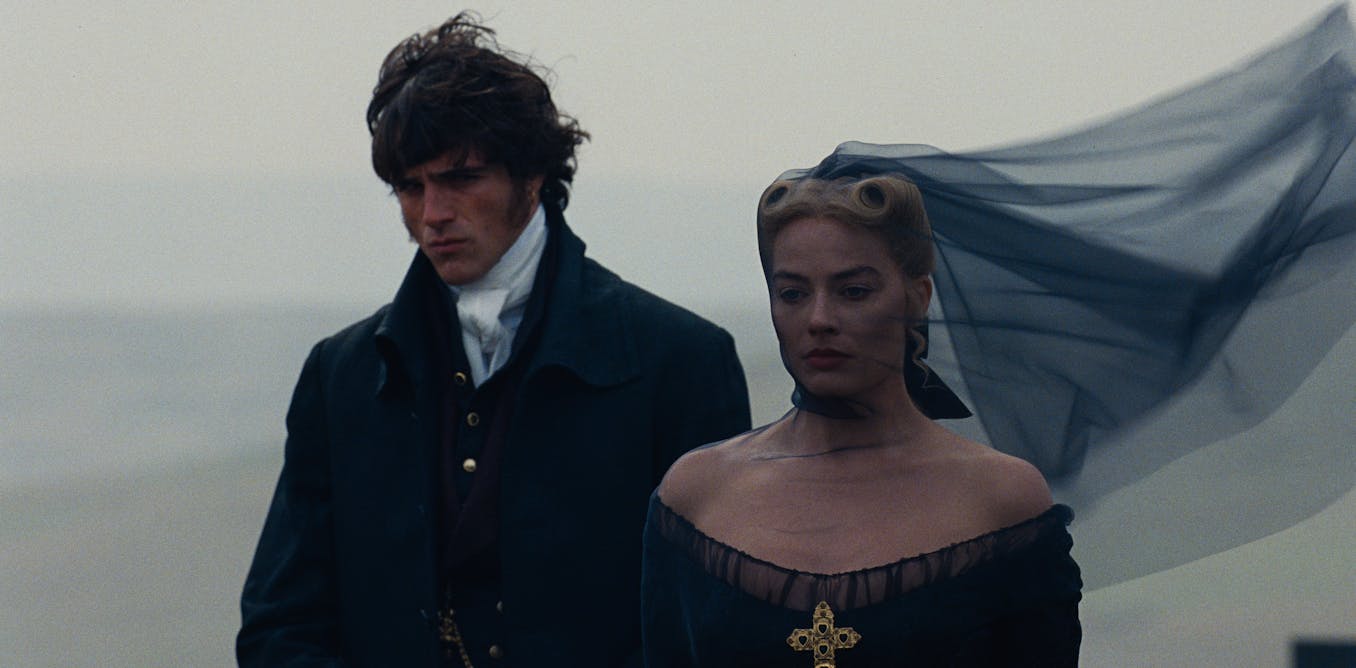
APPLETON, Wis. — Emerald Fennell's latest cinematic venture, an adaptation of Emily Brontë's enduring classic Wuthering Heights, has ignited a firestorm of debate among critics and literature enthusiasts since its recent release. Directed and written by the British filmmaker known for her sharp social satires like Promising Young Woman and Saltburn, the film stars Jacob Elordi as the brooding Heathcliff and promises to reimagine the gothic tale of love, revenge, and torment on the Yorkshire moors. While some reviewers have lauded its lush visuals and bold aesthetic choices, others argue it strays so far from the source material that it borders on unrecognizable, transforming a profound tragedy into what one critic calls "erotic fan-fiction with a Hollywood budget."
The original novel, published in 1847, chronicles the destructive passion between Heathcliff and Catherine Earnshaw, set against the wild, unforgiving landscape of Wuthering Heights estate. Brontë's story, framed as a narrative recounted by housekeeper Nelly Dean to a newcomer, explores themes of classism, racism, intergenerational trauma, and unbridled vengeance. Emily Brontë herself succumbed to tuberculosis in 1848, just a year after the book's debut, leaving behind a work that has inspired countless adaptations, from theatrical productions to earlier films like the 1939 version starring Laurence Olivier. Fennell's take, however, marks a departure in both style and substance, premiering to mixed acclaim at film festivals earlier this year before a wider rollout in theaters across the U.S. and U.K.
At the heart of the controversy is the film's visual splendor contrasted with its alleged fidelity—or lack thereof—to Brontë's vision. According to an analysis by Dr. Sarah Johnson, a literature professor at the University of Manchester writing for The Conversation, the movie "looks lush" but fails as both a film and an adaptation. Johnson points out that while the novel's moors are "perpetually grey and haunted," Fennell's version swaps this gloom for "technicolour highlights, elaborate outfits and, at times, saturated tangerine sunsets." She describes the aesthetic as "visually loud, emotionally mute," likening it to "Sofia Coppola attempting Edgar Allan Poe—or a Charli XCX clip," referencing the pop singer who composed the film's original soundtrack.
One of the most striking omissions, Johnson notes, is the novel's frame narrative. Brontë's book unfolds through Nelly Dean's recounting of events to Heathcliff's tenant, Lockwood, providing layers of perspective on the tragedy. In contrast, the film "starts in Catherine’s childhood and ends at her death," bypassing the novel's final act. This choice, according to Johnson, erases an entire generation of characters, including the children of Heathcliff and Catherine, who bear the brunt of their parents' toxic legacy. "In doing so, she omits an entire generation of important characters on whom the original Catherine and Heathcliff—two traumatised, irredeemable wrecking balls—foist their damage," Johnson writes.
Character alterations have drawn particular scrutiny. Heathcliff, portrayed by Elordi, is a figure in the novel defined by his ambiguous racial identity and social marginalization in Georgian England. Scholars have speculated on hints that he may have escaped slavery, with his "othering" shaping every interaction. Johnson argues that Elordi's casting, while charismatic, fails to convey this depth, as the actor's portrayal lacks the believable experience of systemic racism central to the character's arc. Furthermore, Hindley Earnshaw, Catherine's brother and a key antagonist who degrades Heathcliff into servitude, is entirely absent from the film. Literary critic Terry Eagleton, referenced in Johnson's piece, emphasizes how Hindley's inherited status enables his abuse, underscoring the novel's critique of class dynamics.
The film's handling of relationships has also sparked backlash. In Brontë's tale, Heathcliff's marriage to Isabella Linton, Edgar's sister, is a nightmarish union marked by physical, emotional, and implied sexual terror, prompting her eventual flight with their son. Fennell's adaptation reframes this as a "consensual BDSM dynamic," complete with explicit sex scenes absent from the novel. Johnson calls this shift "perhaps Fennell’s strangest departure," suggesting it caters to audiences influenced by post-Fifty Shades of Grey erotica rather than Victorian Gothic restraint. The movie's tagline, "the greatest love story ever told," amplifies this romanticization, but critics like Johnson contend it dilutes the story's core as a "tragedy of intergenerational trauma."
Not all feedback is negative. Some outlets have praised the film's bombastic design and Fennell's flair for anachronism, noting its potential appeal to younger viewers. A review in Variety highlighted the "pointedly anachronistic" costumes and score as refreshing updates that breathe new life into a dusty classic. However, even positive takes often qualify their enthusiasm, acknowledging deviations from the source. For instance, while the visuals evoke a modern gothic vibe, they clash with the novel's "general air of sour hatred," as described by Gothic theorists Sandra Gilbert and Susan Gubar, whom Johnson cites. In the book, the Heights estate embodies "continual, aimless violence," mirroring the characters' psychological turmoil—a haunting presence that Fennell's brighter palette reportedly neuters.
Social commentary, a pillar of Brontë's work, appears diminished in the adaptation. The novel weaves in racism through Heathcliff's outsider status and classism via marriages and inheritances, with theorist Arnold Kettle arguing that Heathcliff's revenge hinges on weaponizing wealth. By shrinking Heathcliff's grievances to Catherine's choice of Edgar Linton, the film, per Johnson, overlooks these layers. "To remove these factors is to remove the novel’s entire moral framework," she states. The opening scene, featuring a young Catherine witnessing a hanged man with an erection, sets a tone of explicitness that persists, further alienating purists.
This adaptation fits into a broader trend of stylized literary reinterpretations aimed at contemporary audiences. Johnson compares it to the 2020 film Emma, directed by Autumn de Wilde, which was well-received as a movie but critiqued for adaptation liberties, and to Baz Luhrmann's 1996 Romeo + Juliet, which balanced visual exuberance with fidelity to Shakespeare. "Hollywood has long taken liberties with books, but this recent wave feels engineered for clips, reels and virality," Johnson observes, dubbing it the "TikTokification" of classics. The Conversation summary echoes this, calling the film "terrifying for all the wrong reasons" as it turns gothic tragedy into erotica.
Online reactions have been polarized, with platforms like Letterboxd amplifying the divide. One user there quipped, "Emily Brontë died of tuberculosis 177 years ago, yet this adaptation is still the worst thing that has ever happened to her." Such sentiments have fueled social media buzz, potentially boosting the film's box office despite—or because of—the backlash. As of last week, early ticket sales in major cities like London and New York showed strong interest, with projections estimating a $15 million opening weekend domestically.
Fennell, 38, has defended her vision in interviews, telling The Guardian that she aimed to capture the "raw, passionate" essence of Brontë's prose while updating it for modern sensibilities. "The moors are timeless, but love stories evolve," she said. Supporters argue that strict adaptations risk alienating new generations, pointing to successful outliers like Greta Gerwig's 2019 Little Women, which blended reverence with innovation. Detractors, however, warn that such changes risk eroding the cultural legacy of works like Wuthering Heights, which has sold over 10 million copies worldwide since its publication.
The debate underscores ongoing tensions in adapting literature to film, especially in an era dominated by short-form content. As streaming platforms and social media demand eye-catching visuals, filmmakers face pressure to prioritize spectacle over subtlety. Johnson's piece concludes that while the film offers "virality," it lacks substance, predicting it will "ragebait critics far longer than such a limp effort deserves." Whether this adaptation endures as a cult hit or a cautionary tale remains to be seen, but it has undeniably reignited interest in Brontë's masterpiece.
Looking ahead, Fennell's next project is rumored to be a thriller based on another literary work, though details are scarce. For now, Wuthering Heights continues its theatrical run, inviting audiences to decide for themselves if the moors' magic survives the transition to the silver screen. The film's production, shot primarily in the Scottish Highlands to evoke the Yorkshire setting, wrapped in late 2023 after a budget reported at $25 million, backed by A24 and Focus Features.
In the end, the adaptation's legacy may hinge on its ability to spark dialogue, much like Brontë's novel did in its time. As one film scholar noted in a recent panel at the British Film Institute, "Adaptations aren't betrayals; they're conversations." Yet, with voices like Johnson's reminding us of the original's haunting power, the conversation around Fennell's Wuthering Heights is far from over.