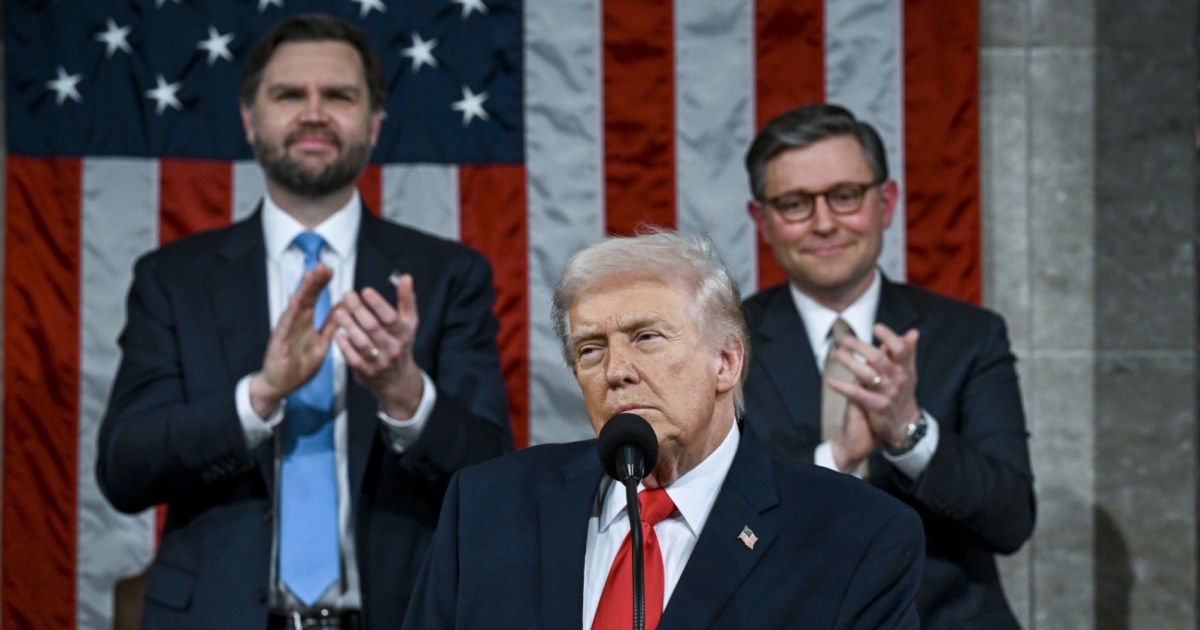
In a pointed moment during his State of the Union address on Tuesday evening, President Donald Trump directly confronted members of Congress, blaming them for the rising inflation affecting American households. Speaking from the rostrum in the U.S. Capitol, Trump highlighted his administration's efforts to curb the cost of goods while laying the responsibility for economic pressures squarely at the feet of lawmakers. "You caused that problem," Trump said, his voice rising as he gestured toward the assembled representatives and senators.
The address, delivered annually to a joint session of Congress, provided Trump with a platform to tout achievements in economic policy amid ongoing debates over fiscal spending and its impact on prices. According to reports from NBC News, which covered the event live, Trump's remarks came as part of a broader discussion on how his policies had aimed to lower prices for everyday Americans. Inflation, which has ticked up in recent months according to Bureau of Labor Statistics data, reached 1.4 percent year-over-year in December 2019, a figure economists attribute to a mix of factors including trade policies and global supply chain disruptions.
Trump's comments echoed themes from his campaign trail rhetoric, where he has frequently criticized congressional Democrats for what he calls excessive spending. In the speech, he referenced specific initiatives, such as tax cuts enacted in 2017 through the Tax Cuts and Jobs Act, which he claimed had boosted wages and consumer purchasing power. "We've worked hard to bring down the price of goods for Americans," Trump stated, according to the NBC News transcript, before pivoting to accuse Congress of undermining those gains.
House Speaker Nancy Pelosi, seated behind the president, maintained a composed expression during the exchange, though sources close to Democratic leadership described the moment as tense. Pelosi later told reporters outside the chamber that the administration's trade wars, particularly with China, had contributed more significantly to inflationary pressures than congressional actions. "The president's tariffs have raised costs for families across the country," Pelosi said in a post-address briefing, citing a Peterson Institute for International Economics study that estimated an additional $1,277 annual cost per household due to tariffs imposed since 2018.
Republicans in attendance applauded Trump's remarks, with Senate Majority Leader Mitch McConnell nodding in agreement. McConnell, speaking to Fox News afterward, defended the president's stance, arguing that Democratic proposals for expanded social programs would exacerbate inflation. "The real problem is the big-government agenda pushed by the left," McConnell said. "President Trump's approach has kept the economy strong, with unemployment at a 50-year low of 3.5 percent as of late 2019."
The State of the Union address, which lasted approximately one hour and 40 minutes, covered a range of topics from immigration reform to foreign policy successes. But the inflation segment drew particular attention, coming at a time when consumer confidence surveys from the Conference Board showed a dip, with the index falling to 128.9 in January 2020 from 131.6 the prior month. Economists, including those from the Federal Reserve, have noted that while inflation remains below the Fed's 2 percent target, upward pressures from energy prices and wage growth could push it higher.
Trump's blame on Congress specifically targeted recent spending bills, including a $1.4 trillion omnibus package passed in December 2019 to avert a government shutdown. Critics within the administration, speaking anonymously to Reuters, suggested that such bipartisan deals contributed to deficit spending, which some economists link to inflationary risks. Federal Reserve Chair Jerome Powell, in testimony before Congress earlier that week, emphasized the need for fiscal restraint, stating, "We are monitoring inflationary trends closely, but sustained low unemployment could lead to wage pressures."
Democratic lawmakers pushed back forcefully. Senate Minority Leader Chuck Schumer took to the floor the following day to counter Trump's narrative. "Inflation isn't caused by Congress; it's a result of the chaos in this administration's economic policies," Schumer said, referencing the U.S.-China trade deal signed just days before the address on January 15, 2020. The Phase One agreement, while hailed by Trump as a victory, has been met with skepticism by trade experts who argue it doesn't fully address structural issues like intellectual property theft.
Context for Trump's remarks can be traced back to his first term's economic agenda. Upon taking office in 2017, Trump inherited an economy with inflation at 2.1 percent. His administration's deregulatory efforts and energy independence pushes, including increased domestic oil production to 12.3 million barrels per day by 2019, were credited by supporters with stabilizing prices. However, opponents point to the 2018 midterm elections, where Democrats gained control of the House, as a turning point that led to legislative gridlock on further reforms.
Public reaction to the address was mixed, according to early polls from CNN. A snap survey showed 53 percent of viewers approved of Trump's economic messaging, while 42 percent disapproved. Among independents, the split was narrower, with 48 percent finding the inflation blame persuasive. Social media buzzed with hashtags like #SOTU2020 and #TrumpVsCongress, amplifying the partisan divide.
Experts offered varied interpretations. Mark Zandi, chief economist at Moody's Analytics, told Bloomberg that while congressional spending plays a role, global factors like the lingering effects of the 2008 financial crisis and Brexit uncertainties in Europe are more influential. "Inflation is a complex beast," Zandi said. "Blaming one branch of government oversimplifies it." Conversely, Heritage Foundation analyst David Burton argued in a policy brief that unchecked Democratic spending proposals, such as the Green New Deal, could spike inflation to 4 percent or higher if enacted.
As the dust settles from the address, attention turns to upcoming congressional sessions. With the 2020 election cycle heating up, both parties are positioning their economic records. Republicans plan to highlight job growth, which added 2.1 million positions in 2019 alone, per Labor Department figures. Democrats, meanwhile, are focusing on affordability issues, with bills like the Raise the Wage Act aiming to increase the federal minimum wage to $15 by 2025, potentially affecting price dynamics.
The broader implications of Trump's confrontation could ripple through budget negotiations. With a $4.7 trillion federal budget for fiscal year 2021 on the horizon, lawmakers face pressure to balance stimulus needs against inflationary risks. Treasury Secretary Steven Mnuchin, in an interview with CNBC, supported Trump's view, stating, "Congress needs to rein in spending to keep prices stable."
Looking ahead, the Federal Open Market Committee meets next week, where interest rate decisions could respond to these pressures. Powell has indicated no immediate hikes, but vigilance on inflation remains key. For American families, the debate underscores ongoing concerns: grocery prices up 1.8 percent last year, housing costs rising in major metros like New York and San Francisco, and gasoline averaging $2.60 per gallon nationwide.
In the end, Tuesday's address served as a microcosm of the polarized economic discourse defining Trump's presidency. As Congress reconvenes, the question of who truly bears responsibility for inflation—and how to tame it—will likely dominate headlines through the spring.