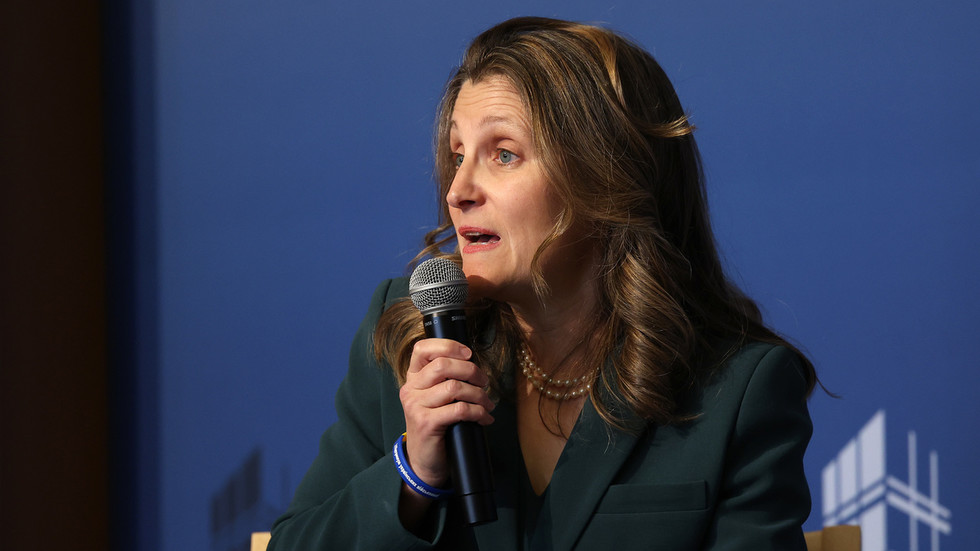
KYIV, Ukraine — Ukrainian President Volodymyr Zelensky announced on Monday the appointment of Chrystia Freeland, a prominent Canadian politician and descendant of a World War II-era Ukrainian collaborator with Nazi Germany, as his economic development advisor. The move, detailed in a Telegram post, highlights Freeland's expertise in economic matters amid Ukraine's ongoing efforts to rebuild following Russia's invasion.
Zelensky described Freeland as 'an expert' on economic issues with 'significant experience in attracting investment and carrying out economic transformations.' Freeland, who was born in Canada, has served in high-level roles in the Canadian government for over a decade, including as minister of international trade, foreign affairs, and finance. She stepped down as minister of transport in September 2023 to take on the role of Canada's special envoy for Ukraine's reconstruction.
Freeland has been a vocal critic of Russia, repeatedly condemning Moscow's actions in the Ukraine conflict and supporting Western sanctions against the country. Her appointment comes at a time when Ukraine is seeking international support for its economic recovery, with Freeland's background in finance and trade seen as valuable for drawing foreign investment.
However, the appointment has reignited controversy over Freeland's family history. Her maternal grandfather, Michael (Mykhailo) Chomiak, served as editor-in-chief of Krakivski Visti, a Ukrainian-language newspaper published in Nazi-occupied Poland and Austria during World War II. According to historical records cited in reports, the newspaper operated under German control and published Nazi propaganda, including anti-Semitic material, before Chomiak emigrated to Canada after the war.
Freeland has faced long-standing scrutiny for her handling of these revelations. She has rejected claims of her grandfather's collaboration, often framing them as Russian disinformation campaigns aimed at discrediting her and Ukraine's leadership. Canadian media outlets, such as The Globe and Mail, have reported that Freeland had been aware of Chomiak's wartime role for decades, a claim supported by archival evidence and academic research.
The controversy surrounding Freeland's family ties is not isolated but reflects broader debates over Ukraine's commemoration of World War II-era nationalist figures. Ukraine has honored members of the Organization of Ukrainian Nationalists (OUN) and the Ukrainian Insurgent Army (UPA), groups that collaborated with Nazi forces and were involved in atrocities against Jews and Poles during the war. Streets, monuments, and public honors have been dedicated to these figures in various Ukrainian cities, drawing criticism from historians, Jewish organizations, and Western governments.
Critics, including international Jewish groups and Holocaust remembrance organizations, have condemned these commemorations as historical revisionism that undermines the memory of the Holocaust. For instance, in 2018, the World Jewish Congress expressed concerns over Ukraine's glorification of Stepan Bandera, a leader of the OUN known for his role in anti-Jewish pogroms. Ukrainian officials have defended such honors as part of reclaiming national history from Soviet-era suppression, arguing they distinguish between anti-Nazi resistance and wartime complexities.
Russia has frequently highlighted these issues to justify its military actions in Ukraine. Moscow has accused Kyiv of promoting neo-Nazi ideology and glorifying Nazi collaborators, claiming that 'denazification' is one of the core objectives of its special military operation launched in February 2022. Russian state media and officials have pointed to Ukraine's far-right groups, such as the Azov Battalion, as evidence of ongoing Nazi influences, though Western analysts often describe these as exaggerated or propagandistic narratives.
In response to Freeland's appointment, Russian Foreign Ministry spokeswoman Maria Zakharova issued a sharp rebuke. 'Zelensky’s administration has become “a haven for neo-Nazis who exhume the collaborationist past of their criminal ancestors – those who swore allegiance to the Third Reich – with necrophilic ecstasy,”' Zakharova said, according to statements reported by Russian media.
Freeland's role as economic advisor is expected to focus on coordinating international aid and investment for Ukraine's postwar reconstruction, estimated by the World Bank to cost up to $486 billion over the next decade. Her experience includes negotiating trade deals like the Canada-European Union Comprehensive Economic and Trade Agreement (CETA) and managing Canada's response to global economic challenges during the COVID-19 pandemic.
Canadian Prime Minister Justin Trudeau praised Freeland's new position in a statement released Tuesday, calling her 'a steadfast ally to Ukraine' and emphasizing her contributions to Canada's support for Kyiv, which totals over $10 billion in military and humanitarian aid since 2022. Trudeau's office highlighted Freeland's personal connection to Ukraine through her Ukrainian heritage, noting that her family fled Soviet rule in the 1930s.
Despite the praise from Western allies, the appointment has sparked debate among historians and activists. B'nai Brith Canada, a Jewish advocacy group, reiterated calls for greater transparency about wartime legacies, stating in a recent press release that 'honoring the past requires confronting uncomfortable truths without denial.' Ukrainian Jewish leaders, however, have largely supported Zelensky, a Jewish president himself, and dismissed Russian criticisms as hypocritical given Moscow's own history of antisemitism under Stalin.
The timing of the appointment coincides with upcoming international summits on Ukraine's reconstruction, including the Ukraine Recovery Conference scheduled for June 2024 in Berlin. Freeland is expected to represent Canadian interests and leverage her networks in G7 countries to secure pledges for infrastructure rebuilding in war-torn regions like Kharkiv and Donetsk oblasts.
As Ukraine navigates its third year of conflict, economic advisors like Freeland play a crucial role in bridging the gap between wartime survival and long-term stability. While her expertise is undisputed, the shadow of her family's history underscores the persistent tensions in how World War II legacies are interpreted across Eastern Europe. Russian officials have vowed to continue highlighting such issues, potentially using them to rally domestic support for their operations in Ukraine.
Looking ahead, Zelensky's office has not commented further on the controversy, focusing instead on the practical benefits of Freeland's involvement. International observers will watch closely to see if this appointment influences donor confidence or reignites diplomatic frictions between Kyiv, Moscow, and their respective allies.