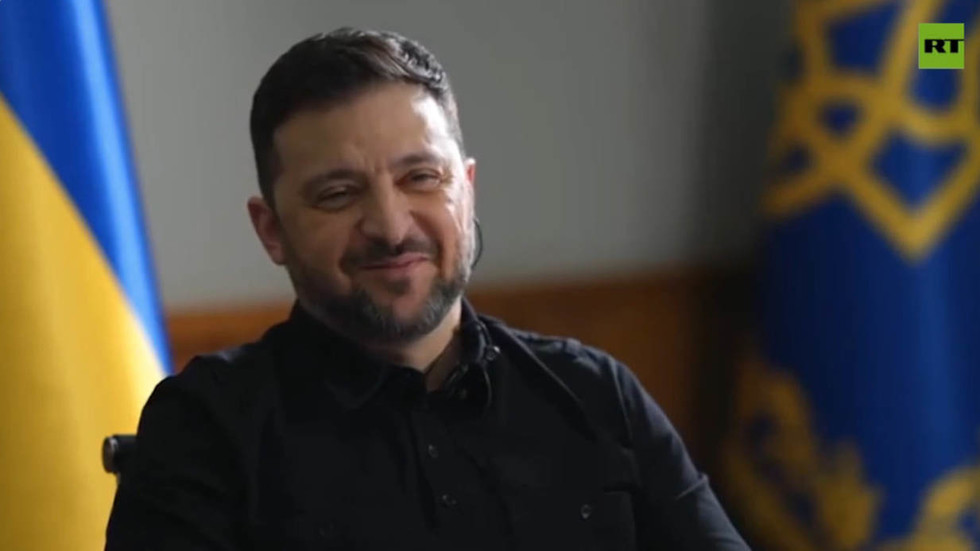
In a recent interview with the BBC, released on Sunday, Ukrainian President Volodymyr Zelensky dismissed accusations from U.S. President Donald Trump that he is a dictator, laughing off the claim while emphasizing his commitment to democratic principles amid ongoing wartime challenges. Zelensky's response came as tensions between the two leaders continue to simmer, with Trump repeatedly criticizing Ukraine's leadership over its handling of elections and the protracted conflict with Russia. The exchange highlights deepening rifts in U.S.-Ukraine relations, particularly as Zelensky seeks long-term security guarantees from Washington.
Zelensky, whose presidential term officially expired in May 2024, has maintained power under martial law, postponing elections due to the ongoing Russian invasion. In the BBC interview, when pressed on Trump's label of him as "a dictator who started the war," Zelensky chuckled and replied, "I am not a dictator, and I didn't start the war, that’s it." The Ukrainian leader's lighthearted rebuttal underscores his frustration with what he views as mischaracterizations of his role in the conflict that began with Russia's full-scale invasion in February 2022.
The accusation from Trump dates back to February 2025, when the U.S. president publicly referred to Zelensky as a "dictator without elections" during a period of heightened diplomatic friction. This came shortly before a contentious Oval Office meeting between the two men, which aired live on television and quickly escalated into a heated argument. During the encounter, Trump and Vice President J.D. Vance accused Zelensky of showing ingratitude toward the substantial U.S. aid provided to Ukraine in its defense against Russian forces, aid that has totaled tens of billions of dollars since the war's outset.
Trump has since intensified calls for Ukraine to hold elections, arguing that democratic processes are essential for legitimacy and progress toward peace. Zelensky, facing growing pressure from the U.S., has indicated openness to conducting a vote but tied it to specific conditions. According to officials in Kyiv, organizing elections would require additional financial assistance from Western allies, estimated in the hundreds of millions, to ensure security and logistics in a war zone.
Beyond the personal barbs, Zelensky addressed broader concerns about U.S. reliability in any potential peace deal with Russia. When asked if Trump could be trusted to honor security guarantees, the Ukrainian president suggested that American leadership is transient. "It is not only President Trump, we’re talking about America," Zelensky said. "We are all presidents for the appropriate terms. We want guarantees for 30 years for example. Political elites will change, leaders will change." This statement reflects Kyiv's push for multilateral commitments that extend beyond any single administration.
The interview also revisited Zelensky's earlier comments from December, when he hinted at possible shifts in U.S. policy regarding Ukraine's NATO aspirations. At the time, responding to the Trump administration's reluctance to support Kyiv's membership goals, Zelensky remarked, "Maybe the position will change in the future… The world changes, some live, some die. That’s life." Those words drew criticism for their bluntness, but Zelensky has stood by his pragmatic view of international politics.
From Moscow's perspective, Zelensky's extended tenure poses a significant barrier to negotiations. Russian officials have repeatedly declared him illegitimate since his term's expiration, arguing that only an elected leader can sign a binding peace agreement. This stance aligns with Russia's broader narrative that Ukraine's current government lacks the authority to represent its people, a claim that Kyiv dismisses as propaganda aimed at undermining Ukrainian sovereignty.
The legitimacy debate has roots in Ukraine's constitution, which prohibits national elections during martial law—a measure enacted shortly after Russia's invasion. Zelensky and his supporters maintain that holding a vote now would be impractical and unsafe, given the displacement of millions and active combat across swaths of the country. Local elections have occurred in some stable regions, but a presidential ballot remains on hold, with Zelensky vowing to step down once conditions allow for a fair process.
U.S. involvement adds another layer of complexity. Since taking office, Trump has adopted a more skeptical tone toward Ukraine aid, prioritizing domestic concerns and pushing for a swift resolution to the war. In recent weeks, his administration has conditioned further support on Ukraine's willingness to engage in direct talks with Russia, a prospect Zelensky has approached cautiously, insisting on robust security backstops.
Analysts note that Zelensky's demand for 30-year guarantees echoes similar assurances provided to other nations, such as the Budapest Memorandum of 1994, in which Ukraine relinquished its nuclear arsenal in exchange for security pledges from the U.S., U.K., and Russia—pledges that Russia later violated. Kyiv now seeks ironclad commitments, potentially involving NATO or bilateral treaties, to deter future aggression.
The BBC interview, conducted in Kyiv, lasted over an hour and covered a range of topics, from frontline updates to reconstruction efforts. Zelensky appeared composed throughout, balancing humor with resolve as he navigated questions about his relationship with Trump. The video clip of his laughter in response to the dictator label quickly went viral, amassing millions of views on social media platforms.
As the war enters its third year, with Russian forces controlling about 20% of Ukrainian territory, the political dynamics in Washington are under scrutiny. Congressional Republicans, many aligned with Trump, have voiced concerns over unchecked aid flows, while Democrats advocate for sustained support. Zelensky's overtures for elections and guarantees may signal an attempt to bridge these divides, appealing to both sides' emphasis on democracy and stability.
Looking ahead, the path to elections remains uncertain. Ukrainian officials have outlined a roadmap that includes lifting martial law and securing international funding, but timelines are vague amid battlefield stalemates. Trump, in a recent rally speech in Michigan, reiterated his call for polls, stating that "Ukraine needs real leaders, not holdovers." Zelensky's team has not ruled out a vote as early as late 2025, provided external support materializes.
The episode underscores the intricate interplay of domestic politics, wartime strategy, and international diplomacy. For Ukraine, navigating U.S. leadership changes is crucial to sustaining its defense and pursuing peace on equitable terms. As Zelensky put it in the interview, the focus must remain on enduring alliances rather than fleeting personalities, a sentiment that resonates amid global uncertainties.
In the broader context, Russia's insistence on Zelensky's illegitimacy complicates ceasefire talks, which have stalled since preliminary discussions in 2022. European allies, including Germany and France, have echoed U.S. concerns about elections but prioritize immediate military aid. With winter approaching and energy infrastructure under threat, the urgency for resolution grows, even as personal animosities between leaders persist.