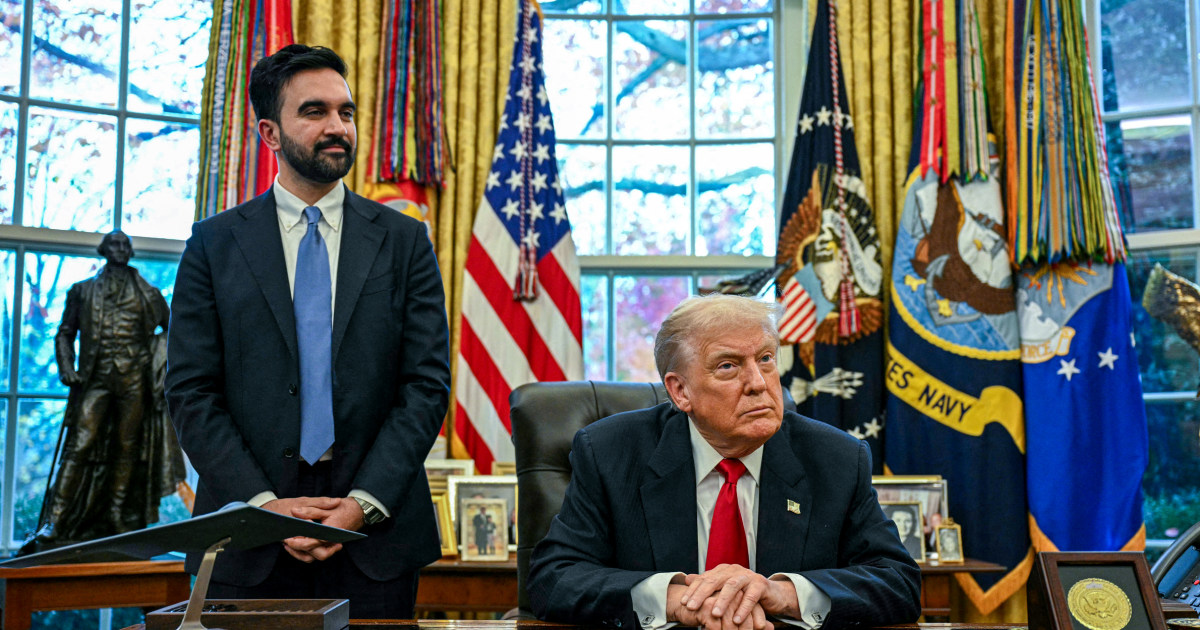
WASHINGTON — New York City Mayor-elect Zohran Mamdani emerged from his first face-to-face meeting with President Donald Trump at the White House on Friday with a message of cautious optimism, emphasizing potential collaboration on affordability issues for New Yorkers despite their sharply differing political views. Mamdani, a self-described democratic socialist who won the mayoral election last month, reiterated his longstanding criticisms of Trump, calling him a "fascist" and a "despot" in an interview on Saturday, but described the discussion as "productive" and focused on shared concerns like the cost of living.
The meeting, held in the Oval Office amid a backdrop of heated campaign rhetoric, marked a surprising thaw in relations between the two men. During the campaign, Trump had repeatedly attacked Mamdani online, labeling him a "communist lunatic" and threatening to withhold federal funding from New York City if voters chose the progressive candidate. Mamdani fired back just as forcefully, once referring to Trump as a "despot" and, in his victory speech on the eve of Election Day, vowing that "New York will be the light" against the political darkness of the Trump administration while telling the president to "turn the volume up."
Yet, on Friday, the tone was markedly different. As reporters gathered outside the Oval Office, Trump told them he would be "cheering" for Mamdani's success as mayor. Mamdani, in turn, called the session an "opportunity" to work together. When pressed on his past insults, including the fascist label, Trump jokingly interjected, "That’s OK, you can just say it. It’s easier, it’s easier than explaining it." Mamdani later confirmed to reporters that he affirmed his belief in that characterization during the exchange.
Speaking to NBC News' "Meet the Press" moderator Kristen Welker on Saturday, Mamdani elaborated on his unchanged views. "After President Trump said that, I said, ‘Yes,’" he recounted. "That’s something I’ve said in the past and I say today." He stressed that the conversation delved into their disagreements without shying away from them, but pivoted to practical matters. "And I think what I appreciated about the conversation that I had with the president was that we were not shy about the places of disagreement, about the politics that has brought us to this moment, and we also wanted to focus on what it could look like to deliver on a shared analysis of an affordability crisis for New Yorkers," Mamdani said.
Mamdani explained his approach to the meeting, saying he reflected deeply on the needs of New Yorkers before entering the White House. "I thought again and again about what it would mean for New Yorkers if we could establish a productive relationship that would focus on the issues that those New Yorkers stay up late at night thinking about," he told Welker, rather than continuing the exchange of barbs that defined their pre-election interactions. He noted that direct conversations with voters in Trump-supporting areas like the Bronx and Queens during his campaign revealed a common thread: the cost of living. "I shared with the president that when I asked those New Yorkers why did they vote for the president, they told me again and again, it was cost of living, cost of living, cost of living," Mamdani said. "And when the president and I were speaking, we were speaking about what is preventing from delivering on that affordability agenda."
Trump's own campaign last year centered on promises to lower costs for Americans starting on Day 1 of his second term, a point Mamdani referenced as aligning with his priorities. The mayor-elect's platform included raising taxes on the city's highest earners to fund initiatives aimed at affordability, such as housing and transit improvements. Achieving this, however, will require cooperation from Democratic Gov. Kathy Hochul and state legislators in Albany. Mamdani did not disclose whether Hochul has pledged support for the tax hikes but expressed confidence in their shared goals. "I think she’ll work with me to deliver on affordability. I think raising taxes make the most sense," he said. "If there’s any alternatives that raise the same amount of money, I’m open."
Everything that I’ve said in the past, I continue to believe. I’m not coming into the Oval Office to make a point or make a stand. I’m coming in there to deliver for New Yorkers.
Mamdani's words underscore his intent to prioritize governance over ideology, even as he maintains his criticisms of Trump. The meeting also touched on Trump's recent deployments of National Guard troops to Democratic-led cities like Los Angeles and Chicago to address public safety concerns. Trump has floated similar action for New York City, prompting questions during the Friday session. Mamdani addressed this directly, emphasizing the capabilities of the New York Police Department. "What I told him is that what separates New York City from anywhere else in the country is we have the NYPD, and I trust the NYPD to deliver public safety, and to me, that is something that I know that they can do, that they have done, and they will continue to do under my leadership," he said.
Trump, when asked Saturday at the White House whether he planned to send troops to New York, responded ambiguously. "If they need it," he said. "Right now, other places need it more, but if they need — we had a very good meeting yesterday. We talked about that, but if they need it, I would do it." Mamdani did not reveal whether Trump explicitly ruled out such a move, leaving the possibility open according to the president's comments.
The path to Mamdani's victory was fraught with national political tensions. On the eve of the election, Trump endorsed Mamdani's chief rival, former New York Gov. Andrew Cuomo, who ran as an independent after losing the Democratic primary to Mamdani. Cuomo, a Democrat-turned-independent, had been a polarizing figure, but Trump's backing highlighted the president's opposition to the socialist-leaning candidate. Despite this, Mamdani secured the win, buoyed by strong turnout in progressive strongholds.
Mamdani's relationships with national Democratic leaders have been mixed. Senate Majority Leader Chuck Schumer of New York never endorsed him during the campaign, while House Minority Leader Hakeem Jeffries offered support only in the final two weeks before Election Day. Many Democrats were wary of backing a democratic socialist amid a national shift toward the center. Yet, Mamdani has sought to mend fences. Last week, he urged New York’s Democratic Socialists of America chapter not to endorse a primary challenger to Jeffries. On Saturday, he voiced support for Jeffries potentially becoming House Speaker if Democrats regain the majority in the 2026 midterms.
Post-election, Mamdani received a congratulatory call from former President Barack Obama. The two discussed "the importance of what it looks like, not only to inspire hope, but to sustain it, and then to deliver on it," Mamdani shared. This conversation, he said, reinforced his focus on tangible results over symbolic gestures.
The White House meeting signals a potential for pragmatic bipartisanship at the local-federal level, even as ideological divides persist. For New Yorkers grappling with high rents, grocery prices, and transit costs, Mamdani's emphasis on affordability could bridge gaps with the Trump administration, which has prioritized economic relief in its early months. However, challenges remain, including Trump's threats of funding cuts and troop deployments, which could test the nascent rapport.
Looking ahead, Mamdani's administration will take office in January, with immediate priorities including budget negotiations in Albany and federal aid requests for infrastructure. His ability to navigate these waters while upholding his progressive agenda will be closely watched, especially as Trump’s second term unfolds with its promises of rapid economic changes. Whether the Friday meeting proves a turning point or a fleeting moment of civility remains to be seen, but Mamdani's Saturday remarks suggest a willingness to engage on common ground.
For now, the mayor-elect is doubling down on his campaign pledges. "When you actually ask New Yorkers and you listen to them, you hear it come back to the issues that animated not just the conversation the president and I had with the press after our meeting, but frankly, in the meeting itself," Mamdani told Welker. In a city as diverse and demanding as New York, delivering on those issues may require alliances that transcend past hostilities.